
By Kalinga Seneviratne*
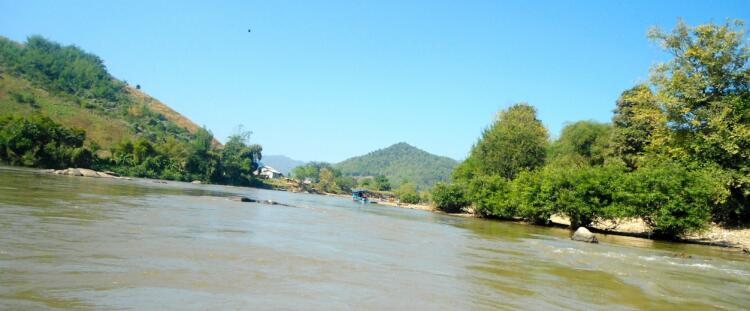
BANGKOK, Thailand | 12 August 2026 (IDN) — Witnessed by the visiting Myanmar President Min Aung Hlaing and Thailand’s Prime Minister Anutin Charnvirakul, the two ASEAN members signed a Terms of Reference (TOR) on 7th August for the establishment of a joint working group on water quality management for transboundary rivers, such as the Sai and Kok rivers, which have been contaminated from unregulated rare earth mining activities in Myanmar’s Shan state, in areas that is controlled by several armed minority groups, such as United Wa State Army (UWSA).
The TOR was signed by Dr. Raweewan Bhuridej, Permanent Secretary of Thailand’s Ministry of Natural Resources and Environment and her counterpart, Hla Maung Thein, Permanent Secretary of Myanmar’s Ministry of Natural Resources and Environmental Conservation.
Bhuridej told Thai PBS that while the agreement marks an important step forward in cooperation between the two countries in addressing the unresolved pollution problem that has been dragging on for 2 years, yet, she admitted, that there are obstacles to implementing the agreement because the Myanmar government is not in full control of the Shan State.
The TOR which will be valid for 3 years, includes joint water quality monitoring, data sharing and technical cooperation to address the transborder problem that is devastating the lives of communities living along the river banks in northern Thailand as well as in Myanmar. Thus, Bhuridej said that a joint working group of the two government and relevant agencies will address the health problems of those affected by pollutants.
However, geopolitics of the area will hinder these efforts, with critics arguing that China need to come in because the mining companies that are operating in the Shan state prospecting for rare minerals that fuel green technology are ethnic Chinese companies, and some critics tend to link them to the Chinese government.
At a seminar held at the Foreign Correspondents Club (FCC) in Bangkok two days before President Hlaing’s arrival in Thai capital to a red carpet welcome, speakers were critical of China for the environmental crisis because the UWSA is believed to be supported by Beijing.
Sor Rattanamanee Polkia, a Lawyer at the Community Resource Center in Bangkok noted referring to the minerals been extracted at a high environmental cost, “we call it green energy, and this is energy transition (phase), but it’s becoming a green crime”.
“I don’t know how to deal with this situation,” she lamented. “Thai government try to talk with the armed groups, but it’s difficult to do this. That’s the challenge”.
“This is a fully fledged disaster. It is an ecological disaster on a transboundary scale, and it is a human rights catastrophe,” noted Pichamon Yeophantong, member of the UN Working Group on Business and Human Rights, another panelist at the FCC media event.
“They question whether their rice, the vegetables, the fruits grown in their fields are safe to eat, whether the fish they catch can be consumed, and whether the water they draw from the rivers can be used at all,” she said referring to her recent visit to the area and conversations with people living on the river banks. “Testing of water and soil quality, as well as of agricultural products by local government agencies and other third parties, has already revealed contamination by cadmium, mercury and arsenic, among other pollutants. Fish stocks are on the verge of collapse, agricultural produce is tainted, and livelihoods are vanishing as we speak”.
Senator Norasate Prachayakorn, chairman of the Thai Senate Committee on Political Development, Public Participation and Human Rights, who was another participation in the panel discussion said that for the past 2 years he has seen no action in parliament to address this issue. He argues the TOR does not fully address the cause of the problem.
The Senator referred to the 2017 Mineral Act which Thailand could use to control the movement of the minerals from “illegal” mines in Myanmar that need to pass through Thailand to reach international markets. “The Mineral Act allows the Minister of Industry to regulate, control imports and storage of rare earth minerals (in Thailand)”.
Extraterritorial Obligation Watch Coalition, a network of civil society organisations monitoring transboundary investments and human rights violations in the region issued a statement during Hlaing’s visit, calling on the Thai government not to sign the TOR because it “contains no clear measures to regulate mining activities, identify polluters, enforce environmental laws, rehabilitate contaminated areas or provide remedies for affected communities”
Other critics, including the opposition Peoples’ Party, have criticized the lack of transparency in the TOR and Thailand caving into Myanmar’s demand that information gathered will be kept confidential, and lack of involvement of regional bodies such as ASEAN, the Mekong River Commission or Mekong-Lancang Cooperation.
In response to a question by IDN at the FCC meeting, Yeophantong argued that China needs to step in to resolve this environmental disaster. “China needs to assume leadership in actually taking responsibility for this issue as well, because Chinese companies are involved”, she noted. “China’s continued position in relation to this issue, is that, Chinese companies are always required to abide by local laws. (But)in this case, the local law in Myanmar is not working”.
Senator Prachayakorn also agrees that China needs to play a part. “China is, in fact, quite well known for being able to enforce the polluter pays principle in its own domestic, pollution problems. And yet, when it comes to overseas, this commitment to safeguarding the environment, to safeguarding human life is missing,” he notes. “China has a number of voluntary guidelines when it comes to Chinese investment overseas. So the framework already exists for China to do something”.
A retired senior ASEAN diplomat (who did not disclose his name) speaking from the floor at the FCC meeting argued that it makes no sense for the Thai government to take up this issue only with the Myanmar government because their army does not control the areas where the polluting mining activities are taking place. “Every Chinese company, state enterprise or private, are all more or less under the total control of the Communist Party of China,” he noted. “So, no point in speaking to the Chinese firms, who run the mines. The Thai government must have the guts and determination to speak directly to the Chinese government only”.
“Both the Thai government and the Chinese government, regardless of the domestic situation in Myanmar, have obligations to protecting human rights as primary duty bearers,” argues Yeophantong. “So long as there are Chinese companies operating in Myanmar, regardless of whether these are in conflict zones, controlled by non-states, under international human rights law, they (governments) have responsibilities to ensuring that people’s human rights are not being adversely impacted”.
*Dr Kalinga Seneviratne is a Sri Lankan-Australian journalist and international communication scholar currently. based in Bangkok. He is the author of many books on international communications, including ‘GeoPolitics and the Media in Asia and the Pacific: Pulling in Different Directions’
[IDN-InDepthNews]