By Tariq Rauf
A Special Report on the collapse of the Eleventh NPT Review Conference, New York, 27 April– 22 May 2026.[i]
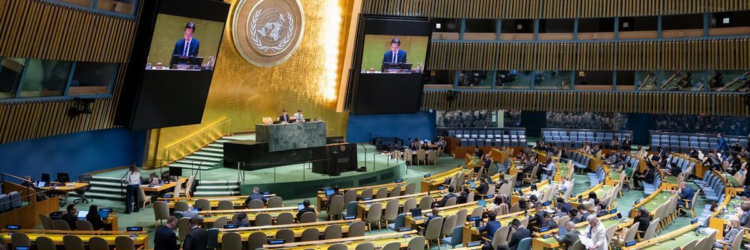
NEW YORK | 25 May 2026 (IDN) — On the evening of Friday, 22 May 2026, Ambassador Do Hung Viet, the President of the Eleventh Review Conference of the Treaty on the Non-Proliferation of Nuclear Weapons (NPT) solemnly took his seat on the elevated podium in the cavernous UN General Assembly hall in New York and announced what many had feared for weeks: consensus could not be reached.

For the third consecutive Review Conference — following the failures of 2015 and 2022 — the States parties to the most important nuclear arms control treaty in history had failed to agree on a single substantive sentence about nuclear disarmament. The NPT is entering its third consecutive decade without an agreed outcome document. The bomb, once again, had won.
That this outcome was not a surprise does not make it any less alarming. The divergences between nuclear-armed and non-nuclear-armed States were plainly visible from the Conference’s opening day on 27 April. What unfolded over four weeks — and what the documents produced during those weeks reveal with cold precision — is a story of a treaty under siege from both within and outside, hollowed out by the very States whose compliance is most essential to its survival. Responsibility for that hollowing-out is widely distributed: it belongs to Moscow and Washington in equal measure, to NATO allies which shelter behind extended deterrence while preaching disarmament, impunity of certain States’ violations of the UN Charter and international humanitarian law, and to a multilateral system that has so far been unable to hold any of them to account.
A DRAFT DESIGNED TO DISAPPOINT
Even before the final collapse, the trajectory of the draft outcome documents told a damning story. The Conference President’s penultimate draft, circulated in the small hours of Thursday 21 May, had already stripped the text of virtually every meaningful disarmament commitment. A paragraph-by-paragraph comparison circulated by me to diplomats in Vienna of the two final versions of the draft — designated CRP.2/Rev.3 and CRP.4 — makes the steady erosion visible in granular, vertiginous detail.
Urgency was deleted. The affirmation that the indefinite extension of the NPT does not mean the indefinite possession of nuclear weapons was gone. Past commitments from 1995, 2000 and 2010 were no longer reaffirmed — merely “recalled,” like something vaguely remembered from a distant past. The word “urge” directed at nuclear-armed States was softened to “call on.” The requirement for “equal” transparency by nuclear-weapon States was quietly excised. The reference to the “catastrophic humanitarian consequences of the use of nuclear weapons” was narrowed to the consequences of “nuclear war” — as if the distinction matters to those who have already experienced a detonation.
By the time the final version, CRP.4, was circulated on Friday morning, the review process language had been further degraded. Transparency discussions with nuclear-armed States — the one area where genuine progress had seemed possible — were moved from open plenary settings to private ones, gutting the transparency mechanism of actual transparency. The paragraph on nuclear sharing and extended nuclear deterrence was deleted entirely. So was every reference to North Korea’s nuclear and ballistic missile programmes. The IAEA Director General’s Five Concrete Principles for the Zaporizhzhia Nuclear Power Plant, under Russian military occupation since 2022, vanished without replacement. Language on artificial intelligence in nuclear command and control systems — which Russia alone had opposed in earlier drafts — was dropped entirely. What remained was a document that, as civil society observers from Reaching Critical Will noted with barely restrained fury, “conveys the sense that it was written by the nuclear-armed States.” They presciently were not wrong.
FAULT LINES ON BOTH SIDES: RUSSIA, THE WEST, AND THE DISARMAMENT BARGAIN
The NPT rests on a core grand bargain struck in 1968 and reaffirmed through all subsequent ten Review Conferences: non-nuclear-weapon States forgo the bomb in exchange for the genuine, good-faith pursuit and implementation of nuclear disarmament by the five recognised nuclear-weapon States — the N5: China, France, Russia, the United Kingdom and the United States. That bargain has been fraying for years. At this Conference, it came close to unravelling entirely, and the blame is not one-sided.
Russia’s blocked inclusion of AI and nuclear command-and-control language in earlier drafts, insisting on language so hedged as to be meaningless. It objected to the phrase “total elimination” of nuclear arsenals, insisting instead on “ultimate and complete elimination” — a formulation that gestures toward disarmament at some unspecified endpoint approaching infinity. Russia demanded removal of language recognising the norm against nuclear testing, despite the fact that well over 180 States have signed the Comprehensive Nuclear-Test-Ban Treaty (CTBT) and the norm against testing is one of the most broadly supported in the entire arms control canon. It pushed to have the humanitarian consequences language narrowed from “any use of nuclear weapons” to “nuclear war.” And in its closing statement, Russia described the unadopted text as “a serious compromise reflecting a delicate and well-calibrated balance” — rich words from a delegation that had systematically diluted agreed language accumulated over three decades. Russia’s ongoing war against Ukraine — including the military seizure and occupation of the Zaporizhzhia Nuclear Power Plant, Europe’s largest — cast a shadow over discussion of nuclear safety in regions of conflict at this conference.
Yet it would be a serious error to read Russia’s position as the primary cause of failure, or to allow that diagnosis to exculpate the West. The United States arrived in New York not as a neutral custodian of the NPT but as an active participant in the erosion of its disarmament pillar. It showed its belligerency right at the beginning by opposing Iran as one of the 34 vice presidents of the conference. Its closing statement — “This is called the nuclear non-proliferation treaty, not the nuclear disarmament treaty” — was not a slip of the tongue. It was a deliberate, callous political declaration, one that inverts the treaty’s own architecture. Article VI of the NPT imposes a clear legal obligation on all States parties, including the nuclear-weapon States, to pursue negotiations in good faith on nuclear disarmament — negotiations that the International Court of Justice confirmed in its 1996 advisory opinion must lead to nuclear disarmament.
The 2000 Review Conference produced an “unequivocal undertaking” by the N5 to eliminate their arsenals. These are not aspirational statements; they are solemn, negotiated legal commitments. The argument that the NPT also is not a nuclear disarmament treaty is, in practice, empirically false. It encapsulates precisely the interpretation that the overwhelming majority of non-nuclear-weapon States — from the Non-Aligned Movement (NAC) to the New Agenda Coalition (NAC) to individual States like Austria, Brazil, Canada, Indonesia, Ireland, Malaysia, Mexico, New Zealand and South Africa, among others — have spent decades resisting. Canada — a loyal NATO ally and no radical voice — gently but firmly rejected the US framing, calling on nuclear-weapon States simply to “honour their word.”
China spoke of the difficulties of the international security environment while remaining conspicuously silent about its own rapidly expanding arsenal — a build-up that the European Union specifically lamented the conference had failed to address. France and the United Kingdom insisted the main challenge to the Treaty is proliferation risk, as if their own modernisation programmes and submarine fleet upgrades exist in a separate moral universe. The collective performance of the N5 at this conference was a masterclass in deflection: each nuclear-armed state blamed the security environment, blamed proliferators, blamed each other — while collectively ensuring that no new disarmament commitments would survive into the final text.
AN ARMS RACE IN PLAIN SIGHT: MODERNISATION, NEW START’S COLLAPSE, THE CTBT UNDER FIRE, AND ATTACKS ON THE TPNW
Whatever ambiguity might remain about the long-term intentions of the nuclear-armed States was dispelled by the strategic landscape that served as the backdrop to this Review Conference. The N5 are not disarming. They are rearming — comprehensively, expensively, and with governments and parliaments voting the funds to do so. The 2026 conference took place in conditions that are objectively worse, in terms of the nuclear danger, than those prevailing at the 2010 Review Conference that produced the last agreed outcome document.
All five nuclear-weapon States are engaged in qualitative and, in several cases, quantitative modernisation of their nuclear arsenals. The United States is executing a multi-decade, multi-trillion dollar recapitalisation of its entire nuclear triad — land-based missiles, submarine-launched ballistic missiles and strategic bombers — along with new nuclear warheads, upgraded gravity bombs and low-yield weapons specifically designed to lower the threshold of nuclear use. The United Kingdom is expanding the ceiling on its nuclear warhead stockpile, reversing a decade of slow reduction and scrapping previously stated disarmament milestones. France is modernising both its submarine-based and airborne deterrent forces, including the development of a new generation of nuclear-armed cruise missiles. Russia, despite — or perhaps because of — its war in Ukraine, continues to develop and deploy novel nuclear delivery systems, including hypersonic glide vehicles, nuclear-powered cruise missiles and submarine-launched systems, alongside explicit nuclear threats directed at European NATO members. Regarding China: multiple Western assessments, including from the US Department of Defence and the Bulletin of the Atomic Scientists, confirm that China is expanding its nuclear arsenal at an unprecedented pace, constructing new missile silo fields and developing a nuclear triad for the first time. China reaffirmed its long-standing policy of no-first-use of nuclear weapons, a nuclear strategy of self-defence, and traditional policy that a “special and primary” responsibility for nuclear disarmament rests with the countries possessing the largest nuclear arsenals. None of this was adequately addressed in the conference’s drafts of an outcome document. The N5 individually and collectively ensured it would not be.
The collapse of bilateral nuclear arms control between the United States and Russia has further eroded the strategic environment within which this conference met. The New START Treaty — the last remaining legally binding bilateral instrument constraining the strategic nuclear arsenals of the world’s two largest nuclear powers — expired in February 2026 after Russia’s suspension of its participation in January 2023 and Washington’s failure to negotiate a successor agreement.
The expiry of New START means, for the first time since 1972, that there are no agreed ceilings, no verification mechanisms, no on-site inspections and no data exchanges governing the roughly 10,000 nuclear warheads held between them. Russia and the United States together possess approximately 90 per cent of all nuclear weapons in existence. The absence of any treaty constraints on those arsenals is not a technical footnote to the NPT debate; it is its central strategic context. Several delegations raised this directly, but the conference had no mechanism to compel the two powers to resume negotiations, and neither showed any inclination to do so.
The CTBT — perhaps the most symbolically important multilateral arms control instrument after the NPT itself — came under deliberate and sustained attack during this review cycle. The CTBT has not entered into force because nine States whose signature/ratification is required under Annex 2 of the Treaty have not yet done so, including India, North Korea, Pakistan, Israel, China, Egypt, Iran, Russia and the United States. But its practical effect has been enormous: no nuclear test explosion has been conducted by any nuclear-armed state since 1998, and the norm against testing has hardened into one of the most durable in the arms control system. That norm is now under active threat. Russia announced in late 2023 that it had revoked its ratification of the CTBT — but continued as a party to the CTBT. More alarming still is the posture of the current United States administration, which has publicly questioned the value of the CTBT and the Comprehensive Nuclear-Test-Ban Treaty Organisation (CTBTO), the Vienna-based body whose global monitoring network provides the verification backbone of the nuclear testing ban. Earlier this year, the US accused China of carrying out prohibited very low yield nuclear tests, that China resolutely denied. Credible reports have circulated, and were referenced by delegations at this conference, that the US is considering withdrawing its funding from the CTBTO and may even be assessing resumption of nuclear explosive testing at the Nevada National Security Site. The conference’s draft language recognising the norm against nuclear testing was deleted from the final version, in no small part due to resistance from States that preferred to keep that question open. The deletion is not a procedural footnote; it is an active permission structure for the resumption of testing.
The Treaty on the Prohibition of Nuclear Weapons (TPNW) — adopted in 2017 with 122 votes in the UN General Assembly and now ratified by 99 States parties — remained the most politically charged subtext of the entire conference. France was its most aggressive critic, deploying language at and around the conference that went significantly beyond the standard nuclear-weapon-state objection that the TPNW is “incompatible” with the NPT’s framework. French officials and diplomats routinely have characterised the TPNW as a destabilising instrument that undermines deterrence and endangers European security, have pressured non-nuclear-weapon States in their sphere of influence to maintain distance from it, and at this conference resisted even the most neutral factual reference to its existence. France’s position is consistent with its broader strategic culture, in which nuclear deterrence is a near-sacred pillar of national sovereignty, but it sits in acute tension with the legal and moral force that the TPNW’s growing membership increasingly represents.
The other N5 States — the China, Russia, the United Kingdom and the United States — share France’s opposition to the TPNW in substance, though some have expressed it with somewhat less rhetorical aggression. None has attended any meeting of States parties to the TPNW even as observers. The factual reference to the TPNW that survived into the unadopted outcome document — barely — was a diplomatic achievement that reflected the determination of the treaty’s 99 States parties not to be erased from the multilateral nuclear discourse.
NATO NUCLEAR SHARING AND EXTENDED DETERRENCE: A LOSERS’ FIGHT
Among the most contentious and least publicly acknowledged fault lines at the 2026 Review Conference was the question of NATO nuclear sharing and extended nuclear deterrence arrangements. The debate exposed a deep structural contradiction within the NPT itself — one that Western States have managed, with some success, to keep out of formal conference conclusions for decades.
Under NATO’s nuclear sharing arrangements, the United States deploys nuclear weapons — an estimated 100 or so B61 gravity bombs — on the territory of several non-nuclear-weapon States party to the NPT: Belgium, Germany, Italy, the Netherlands and Turkey. Pilots from those States are trained to deliver those weapons by their national air forces. Germany, Italy, Belgium and the Netherlands operate or are upgrading dual-capable aircraft to carry them. This is not a secret: NATO has discussed burden-sharing openly. But it sits in deeply uncomfortable tension with Articles I and II of the NPT, which prohibit nuclear-weapon States from transferring nuclear weapons or control over them to any non-nuclear-weapon state, and prohibit non-nuclear-weapon States from receiving them.
NATO States unconvincingly have long maintained that these arrangements predate the NPT and that, during a conflict, control would remain with the United States until the moment of use — a legal interpretation that many non-nuclear-weapon States find unpersuasive, and that others regard as a transparent fiction. At the 2026 Review Conference, that simmering dispute erupted into the open with unusual force. Iran reiterated its position — shared by many States in the Non-Aligned Movement — that nuclear sharing and extended nuclear deterrence constitute a clear breach of Articles I and II of the NPT. The Arab Group lamented that the final draft document did not reflect language on these arrangements, negative security assurances, or the obligations they implicate.
NATO States and their allies offered a very different account. Their argument, advanced with varying degrees of explicitness, runs roughly as follows: NATO’s nuclear posture is a product of a security environment shaped by Russia’s war against Ukraine, its nuclear threats against European States, and the general deterioration of the strategic landscape. Extended deterrence — the commitment by the United States to defend NATO allies with nuclear weapons if necessary — is, in this view, a stabilising arrangement that reduces the incentive for non-nuclear allies to develop their own arsenals. Germany, Belgium and the Netherlands do not have their own nuclear weapons precisely because they are covered by a US guarantee; removing that umbrella, the argument runs, could trigger independent proliferation decisions. The UK pointed to Russia’s aggression as the central challenge to European security, and France emphasised that deterrence remains the cornerstone of strategic stability. Both positions were offered, implicitly, as justifications for why the NPT’s disarmament pillar cannot be advanced in the current environment.
The Non-Aligned Movement’s (NAM) counter-argument is legally grounded, legally and politically powerful. Non-nuclear-weapon States that accepted the NPT’s bargain did not do so conditionally — they did not agree to forgo nuclear weapons only on the condition that the great powers would one day feel sufficiently secure to disarm. The treaty’s obligations are unconditional. Moreover, the deterrence logic — that nuclear weapons make the world safer — is precisely the logic that non-nuclear-weapon States reject as a matter of principle and that the humanitarian evidence contradicts. Mexico put it most sharply: calls for dialogue among nuclear-armed States do not constitute disarmament measures and “may even serve to idealise a supposed stability predicated on nuclear weapons, a notion that ultimately erodes the NPT itself.”
The CRP.2/Rev.3 draft had at least acknowledged these arrangements, noting “the ongoing discussion regarding existing and evolving nuclear sharing and extended deterrence arrangements” and emphasising that “sustained dialogue on issues relevant to the implementation of Articles I and II can contribute to strengthening the Treaty.” That formulation — cautious, balanced, non-committal — was nonetheless too much for the final version. The nuclear sharing paragraph was deleted entirely in CRP.4, leaving no trace in the unadopted outcome document of one of the most legally and politically significant debates the conference had. The deletion pleased no one: States opposed to these arrangements saw it as deliberate erasure; States that support them lost even the mild acknowledgement that a discussion was taking place. What it revealed, above all, is that the NPT’s member States cannot yet agree even on the terms in which to describe a structural challenge that has existed for more than five decades.
Looking ahead to the next review cycle, in a sly move on Thursday morning, 21 May, at the 15th meeting of the 11th NPT Review Conference, the Netherlands on behalf of a number of EU Member States, as well as Argentina, Australia and Canada, advanced a proposal that charitably could be termed as “plain misguided”. This proposal called for only two sessions of the Preparatory Committee for the 12th NPT Review Conference in 2030 — the first in Vienna in 2028, and the second in Geneva “on a date as close as possible to the review conference … at least six months prior.” In reality, this was an underhand ploy to surreptitiously amend the 1995 Decision 1 on the strengthened review process, reaffirmed by States parties in 2000, without actually transparently proposing to change the sequence of Preparatory Committee sessions from three to two. The statement by the Netherlands made no reference to Decision 1 and its provisions on the Preparatory Committee, rather it cleverly laid out a new scheme justified for efficiency and continuity.
Reducing the Preparatory Committee to two sessions as proposed by the Netherlands would not only be ultra vires in connection with Decision 1 (1995), but also reduce the time for accountability for implementation of the Treaty and agreed commitments — especially by the nuclear-weapon States regarding Article VI on nuclear disarmament — and consequently reduce the time available to review reports submitted by nuclear-weapon States. The real underlying reason was likely even more calculated: to take pressure off NATO and allied States relying on extended nuclear deterrence and nuclear sharing, and further to undermine support for the TPNW. Fortunately, the proposal did not meet with support and was rejected, leaving its proponents unapologetic.
THE 1995 MIDDLE EAST RESOLUTION: IMPLEMENTATION AT THE 2026 REVIEW CONFERENCE
The Resolution on the Middle East, adopted by the 1995 Review and Extension Conference and co-sponsored by the three NPT depositary States (Russia, the United Kingdom and the United States), was an essential and integral element of the package that persuaded Arab States parties to agree to the indefinite extension of the NPT. It called for all States in the region to adhere to the NPT, for Israel — the only Middle Eastern State outside the Treaty — to place its nuclear facilities under full-scope IAEA safeguards, and for practical steps toward a zone free of nuclear weapons and all other weapons of mass destruction (MENWFZ/WMDFZ). Thirty-one years later, none of these requirements has been met. The 2026 Review Conference, the fourth conference since the 1995 NPTREC to fail to adopt a consensus outcome document, provided no new agreed multilateral mandate to advance implementation.
The 2026 Conference convened against the most volatile regional backdrop since 1995. Following Israeli and United States military strikes on Iranian nuclear facilities at Natanz, Fordow and Isfahan in June 2025, further strikes were conducted in February, March and April 2026. Drone strikes have taken place in the vicinity of the Bushehr Nuclear Power Plant in Iran, and others launched from Iraq according to the UAE were carried out in the vicinity of the Barakah Nuclear Power Plant. These attacks — against facilities under IAEA comprehensive safeguards — caused the Agency to lose continuity of knowledge on nuclear material in Iran and raised acute nuclear safety concerns. Iran’s opening statement at the Conference characterised the targeting of safeguarded facilities as a fundamental violation of the NPT. Iran submitted a Working Paper calling for unequivocal condemnation of attacks on nuclear facilities and legal accountability for perpetrators. The Arab Group and a majority of non-Western States parties supported this framing; the United States and its allies refused any such language in the draft outcome document.
The four successive revisions of the draft outcome document (CRP.2 through CRP.2/Rev.3 and the final CRP.4) tell a familiar story of progressive erosion. Earlier drafts reaffirmed the validity of the 1995 Resolution, called on all regional States not party to the NPT to accede without further delay, and endorsed the ongoing UN-mandated zone conference process (established by UNGA decision 73/546 in 2018, with six sessions held through 2025). Arab States and Iran sought explicit language obligating Israel to accept IAEA comprehensive safeguards and acknowledging the attacks on Iranian safeguarded facilities as violations of the NPT’s underlying safeguards regime. The United States resisted both demands. By CRP.4 — not tabled for adoption — the reference to Israel’s NPT obligations had been reduced to near-invisibility, the co-sponsorship responsibilities of the depositary States had been stripped to vague aspiration, and no acknowledgement of the strikes on Iranian facilities appeared. The Arab Group’s closing statement lamented that the final draft reflected none of the group’s core demands on the 1995 Resolution, negative security assurances, or the safeguards violations occasioned by the attacks on Iran.
The structural impasse remains unchanged. Israel — not present at the Conference as a non-party — continues to operate an undeclared nuclear arsenal estimated at 80–90 warheads, has never accepted IAEA comprehensive safeguards, and has declined to participate in the UN-mandated zone conference. The United States, as co-sponsor of the 1995 Resolution, has for thirty-one years simultaneously invoked that resolution and shielded its primary obstacle from accountability — a contradiction that was once again in plain sight at the 2026 Conference. Algeria’s and Iran’s national reports, together with Iran’s Working Paper on the zone, document the sustained regional commitment to implementation and the exhaustion of Arab States and Iran with a process perpetually frustrated by a single non-NPT State and its nuclear-armed patron. The 1995 Resolution remains incontestably legally valid until its objectives are achieved, and accountability for its implementation is fully vested legally and politically in the NPT review process and not in the UN Conference on a MENWFZ/WMDFZ. Whether the 2030 Review Conference will generate the political will to advance those objectives — absent a fundamental shift in the positions of the depositary States and without a new agreed multilateral mandate from the 2026-2030 NPT strengthened review process — is, at best, an open question?
IRAN: A PROXIMATE CAUSE, NOT THE REAL PROBLEM
The formal reason consensus could not be reached was a dispute over paragraph 15 of the final draft — a passage singling out Iran with the line that “Iran can never seek, develop or acquire any nuclear weapons.” Iran objected to being named in isolation in a document that otherwise treated all States parties equally. The United States refused to remove the language.
The impasse was real, but to focus on it as the cause of failure is to mistake a proximate trigger for the underlying condition. The US and Israel had conducted illegal military strikes against Iranian nuclear facilities over the preceding year and this year — strikes that incontestably violated the UN Charter and international law, and that notably only non-Western delegations condemned. This continued a broader and deeply troubling pattern: Western countries resolutely declined to condemn, at the UN Security Council, the General Assembly, the IAEA Board of Governors and General Conference, and now at the NPT Review Conference, the Israeli and US military strikes on IAEA-safeguarded and verified Iranian nuclear facilities. Iran insisted the attacks on its safeguarded facilities be reflected in the document. The US, along with its allies and partners, refused. Both sides, in different ways, held the conference hostage to their own demands. The President’s decision not to table the final version of the draft outcome document for formal adoption — reportedly at the suggestion of China — attracted praise as a way of avoiding a situation where any single State could be named as the blocker, but it changed nothing about the underlying reality: the nuclear-armed States and their allies had prevented any meaningful disarmament language from surviving into a final document.
Iran’s own conduct at this conference was not without controversy. Several delegations — including France, the UK, Germany and Norway — expressed concern about Iran’s non-compliance with its IAEA safeguards obligations, and many called on Iran to provide full transparency and access to inspectors, without any reference to the illegal military strikes on Iran’s nuclear facilities that rendered them “uninspectable” and caused the IAEA to lose continuity of knowledge on nuclear material in Iran. In the same vein, Ireland simplistically regretted the conference could not reflect the IAEA’s findings on Iran’s non-compliance. These are legitimate concerns that the international community has a real interest in seeing resolved through diplomacy and verified compliance. But as several delegations also noted, the context of two nuclear-armed States, including one non-NPT nuclear-armed State, having bombed Iranian territory and Iranian nuclear facilities in the preceding year and this year makes the demand for Iranian compliance — without any acknowledgement of those unlawful attacks — an exercise in selective principle that the majority of NPT parties found impossible to accept.
THE FISSILE MATERIALS PROBLEM: A REGIME IN FREEFALL
Beyond the political theatre of the closing sessions, the substantive technical discussions held on the conference’s margins painted an equally bleak picture. The basic infrastructure governing fissile materials — the physical building blocks of nuclear weapons — is deteriorating. The United States announced in 2024 that it will resume production of highly enriched uranium (HEU) by 2030. China, in 2026, has restarted separating plutonium. Negotiations on a Fissile Material Cut-off Treaty (FMCT) have been stalled for decades in the dysfunctional Conference on Disarmament. The IAEA, despite expert advice to the contrary, continues to treat only HEU — not high-assay low-enriched uranium (HALEU) — as requiring the highest levels of safeguards, even though recent research has demonstrated that HALEU can serve as a precursor material sufficient to build a nuclear weapon. Meanwhile, the AUKUS submarine deal will transfer weapon-grade HEU-fuelled submarines to Australia, a non-nuclear-weapon State — a transaction with no clear precedent or adequate safeguards framework under the NPT, yet one that escaped any serious mention in the conference plenary.
THE HUMANITARIAN ARGUMENT: STILL THE MOST POWERFUL TOOL
Against this landscape of institutional decay and great-power intransigence, civil society and many non-nuclear-weapon States continued to insist on the one argument that nuclear-armed States most viscerally resist: the humanitarian argument. That nuclear weapons cause catastrophic, indiscriminate, transboundary, intergenerational harm is not a political claim. It is a documented fact, demonstrated by the bombings of Hiroshima and Nagasaki, by the medical aftermath of nuclear testing across the Marshall Islands, Kazakhstan, Nevada and elsewhere, and by decades of scientific modelling of nuclear winter.
Russia’s accusation that non-nuclear-armed States were “instrumentalising” humanitarian concerns to pressure the nuclear-armed States to disarm is worth dwelling on. What it amounts to, in plain language, is an objection to the use of evidence about the real-world effects of nuclear weapons as a basis for legal and political arguments in favour of disarmament. The implication — that the NPT framework should be insulated from the consequences of the weapons it regulates — is itself a form of normative capture. It is the logic of those who prefer that arms control discussions remain abstract and technical, safely remote from the bodies of the dead. But the West’s hands are not entirely clean here either. The progressive weakening of humanitarian language in successive drafts — from “great concern” to “deep concern,” from “use of nuclear weapons” to “nuclear war” — reflected pressure not only from Moscow but from Western capitals unwilling to accept language that might be read as undermining deterrence doctrine. As Austria noted, the outcome of this debate shows that “the discussion is tilted heavily towards the security concerns of nuclear-weapons States, and does not sufficiently reflect the concrete and legitimate security concerns of the vast majority of non-nuclear-weapon States.”
The Treaty on the Prohibition of Nuclear Weapons (TPNW), which now has 99 States parties, was built precisely to resist this insulation. It was not widely discussed in the NPT hall — nuclear-armed States see to that — but its shadow was present. Thailand noted pointedly that the TPNW’s 99 parties represent the majority of NPT States parties at the Review Conference. New Zealand confirmed it looks forward to the TPNW Review Conference later this year. Palestine called on all States to join the Treaty. The TPNW is not going away; if anything, consecutive NPT failures are accelerating its moral and political authority.
WHAT COMES NEXT: A TREATY WITHOUT OUTCOMES?
The dejected but unbowed Conference President, in his closing remarks, noted that in 2030 the NPT will mark twenty years without a consensus outcome document. He urged States to “bolster, refresh and reinvigorate” the treaty before that milestone arrives. The foundational problem is not procedural. It is not a matter of meeting formats, reporting templates or the sequencing of preparatory committees. It is a problem of political will — specifically, of its absence among the States that possess the weapons the treaty was designed to eliminate. The nuclear-armed States came to this conference modernizing their nuclear arsenals, expanding the roles of nuclear weapons in their doctrines, and in some cases issuing explicit nuclear threats. They left without having accepted a single new commitment, or having reaffirmed a previous commitment to nuclear disarmament.
For the non-nuclear-weapon States, the message is being received. Malaysia’s observation that the nuclear-armed States “seem to increasingly be trying to normalise their indefinite possession of nuclear weapons” was among the sharpest diagnoses of the conference. South Africa’s reminder that the 1995 indefinite extension of the NPT did not grant the N5 the right to possess nuclear weapons in perpetuity was legally accurate and politically urgent. Brazil’s warning that “as long as the security of some States is predicated on nuclear weapons, insecurity will persist for the vast majority of States” is not a radical proposition. It is the premise on which the NPT was constructed.
The only bright spot in the conference was the competent and efficient leadership of Ambassador Viet, the Conference President. He established new standards of time management and efficiency in the conduct of the proceedings. By circulating a zero draft of an outcome document at the beginning of week two, 5th May with subsequent revised versions on 13th and 17th May, and final revisions on 21st May, and charging the three main committees to negotiate respective sections, he provided the time and space for States parties to negotiate and suggest revisions. By appointing Main Committee chairs to also chair subsidiary bodies (SBs) and assigning each SB specific issues to discuss, the President created order in their work. Furthermore, the President did not resort to selective secretive consultations in a so-called “Friends” group, but consulted inclusively with States and regional and political groupings. Fittingly, Ambassador Viet emerged unscathed with no scars at the end of the conference, earning praise for competency, transparency and inclusiveness.
CONCLUSION: BEFORE THE ASHES
The title of Reaching Critical Will’s closing editorial — “Let Us Not Await the Ashes” — captures the essential choice confronting the international community. It is between a world in which the slow, painstaking architecture of disarmament law is maintained, strengthened and eventually implemented, and a world in which it is quietly dismantled, paragraph by paragraph, review conference by review conference, until nothing remains but the weapons themselves.
The 2026 NPT Review Conference did not end with an explosion. It ended with expressing regret and a disappointed Conference President’s appeal to States to do better next time. That solemn quietness should not be mistaken for safety. The incremental erosion of nuclear disarmament norms is not a lesser danger than their sudden rupture; it is merely a slower one. Each Review Conference that ends without an outcome makes the next one harder. Each weakened paragraph signals to nuclear-armed States that the cost of non-compliance is acceptable. Each deletion of urgency from a draft outcome document is a small permission slip for the continuation of the world as it is.
What distinguished this conference from its predecessors is the breadth of the disillusionment it produced. Mexico’s observation that there was “no genuine search for common solutions based on a negotiating package that integrated the priorities of all States in a balanced manner” applied not just to Russia’s maximalist position but to a Western posture that, under the cover of NATO solidarity and the Russian threat, quietly ensured that disarmament obligations would remain aspirational. Canada was right that the “primary weight of responsibility for restoring the Treaty’s credibility rests with the nuclear-armed States” — but that weight falls on all five, not selectively.
The non-nuclear-weapon States left New York with their legal obligations intact and their political patience visibly exhausted. The nuclear-armed States left with their arsenals unencumbered by any new commitment whatsoever. The NPT survives, technically. Whether it survives as a meaningful instrument of disarmament, or merely as a framework for managing the permanence of nuclear weapons, is the question that the next five years must answer. History — and the dead of Hiroshima and Nagasaki, and the downwinders and survivors of Nevada, Kazakhstan, Kiribati and the Marshall Islands, and every community that lives in the shadow of a nuclear weapons facility or a missile silo — is watching.
Where do we go from here? I end by recalling my comments titled “Ending the Perpetual Menace of Nuclear Weapons” at an event in Ottawa organized by Canadians for a Nuclear Weapons Convention and the Centre for International Policy Studies, that “an international order anchored on legal norms and treaties offers the best hopes for survival. In this regard the NPT and the TPNW, together with international humanitarian law, could establish an erga omnes “right to nuclear peace” and prevent nuclear weapons becoming a “perpetual menace”. The bomb won this round. It must not and cannot win the next one!
[1] Tariq Rauf – is former Head of Verification and Security Policy, Alternate Head of NPT Delegation, Office of the Director General, IAEA; member of Canadian NPT delegation (1987-2000), co-drafter of the strengthened review process (1995/2000); delegate with other States parties (2012-2025).