
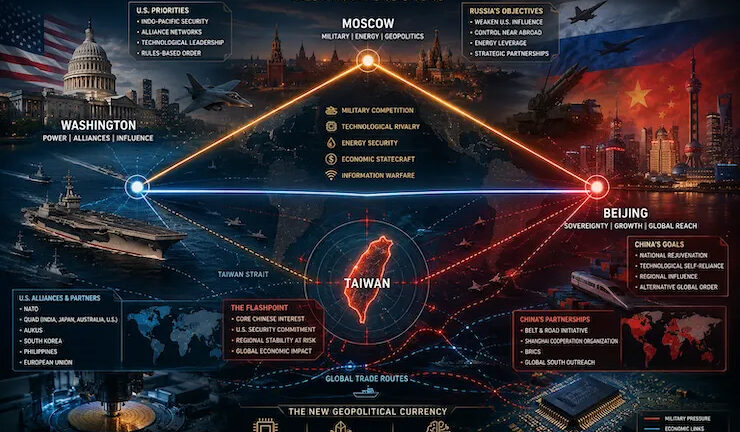
The New Age of Power and Peril
By Ramesh Jaura
This article first appeared on https://rjaura.substack.com
BERLIN | 21 May 2026 (IDN) — The world’s geopolitical centre of gravity is shifting once again, and the personal diplomacy of US President Donald Trump is increasingly part of the equation. His complex and often controversial relationships with Russian President Vladimir Putin and Chinese President Xi Jinping have added an unpredictable dimension to an already fragile global order.
While Trump has repeatedly praised Putin’s strength and signalled an interest in improving ties with Moscow, he has also oscillated between confrontation and accommodation towards Beijing, combining harsh trade measures with expressions of personal respect for Xi.
These leader-to-leader dynamics are unfolding against a backdrop of intensifying geopolitical rivalry among the United States, Russia, and China — three nuclear powers whose actions are increasingly shaping the international system.
Across Europe, Asia, the Middle East, Africa and the Arctic, the consequences are already visible: rising military spending, expanding alliances, trade wars, sanctions, technological decoupling, energy rivalries, cyber warfare and renewed fears of nuclear escalation.
For diplomats and historians alike, one question is becoming increasingly difficult to avoid: what are the potential risks and stability implications of this emerging ‘new strategic triangle’ akin to the Cold War? The comparison is tempting.
In the 1970s, the United States exploited the deepening hostility between the Soviet Union and China to alter the global balance of power. President Richard Nixon’s historic opening to China in 1972 weakened Moscow’s strategic position and transformed the geopolitical landscape.
Today, however, the ‘inverted’ triangle differs from Cold War configurations by emphasising the complex, interconnected relationships among Washington, Moscow, and Beijing, rather than clear bipolar rivalry.
Instead of Washington exploiting divisions between Moscow and Beijing, US pressure on both powers has pushed Russia and China toward closer alignment. Though they are not formal allies, their strategic partnership has deepened markedly, driven by shared opposition to what they see as American hegemony.
Yet history rarely repeats itself in identical form.
The triangle taking shape in the twenty-first Century differs fundamentally from its Cold War predecessor. Today’s world is more economically, technologically, and politically interconnected. China is deeply embedded in the global economy. Russia remains a military and nuclear superpower despite its economic weakness. The United States still enjoys overwhelming military primacy, even as it confronts challenges from two major powers simultaneously.
The result is not a return to the Cold War, but the birth of a more fragmented and multipolar era. This understanding encourages policymakers and students to adapt their strategies to a fundamentally different geopolitical landscape.
The Collapse of the Unipolar Moment
When the Soviet Union collapsed in 1991, many in Washington believed history had entered a new phase. The United States emerged as the world’s sole superpower. Liberal democracy, free-market capitalism and Western-led institutions appeared triumphant. NATO expanded eastwards, the European Union enlarged, and globalisation accelerated under American leadership.
Russia, weakened economically and politically during the 1990s, initially sought integration with the West. China, meanwhile, focused on economic reform and global trade integration. But the post-Cold War order gradually began to fracture. Moscow saw NATO’s expansion into Eastern Europe as a direct threat to its security interests. The wars in Kosovo, Iraq and Libya deepened Russian distrust of Western intentions.
China, meanwhile, transformed itself into an economic giant. What many American policymakers once regarded as a potentially “responsible stakeholder” instead evolved into Washington’s principal strategic competitor.
The pillars of unipolarity eroded steadily:
- US military interventions in Iraq and Afghanistan damaged perceptions of American invincibility — as has the US involvement in Iran.
- Economic globalisation produced political backlash across Western societies.
- China’s rise altered the global balance of economic power.
- Russia reasserted itself militarily under Vladimir Putin.
- New groupings such as BRICS and the Shanghai Cooperation Organisation reflected the growing influence of non-Western powers.
Then came the Ukraine war. Russia’s invasion of Ukraine in 2022 altered global geopolitics more dramatically than any event since the end of the Cold War. The conflict deepened the rupture between Russia and the West while accelerating Moscow’s strategic dependence on China.
From Estrangement to Open Hostility
Relations between the United States and Russia have deteriorated steadily for more than two decades. The breakdown did not happen overnight. Russian leaders repeatedly argued that NATO expansion violated understandings reached after German reunification. Western governments rejected that claim, insisting that sovereign states had the right to choose their own alliances.
The disagreements multiplied:
- The 2008 Russia–Georgia war.
- NATO missile defence systems.
- Russia’s annexation of Crimea in 2014.
- Accusations of election interference and cyber attacks.
- Sanctions and diplomatic expulsions.
- The collapse of arms-control agreements.
The Ukraine war pushed the relationship into outright confrontation. Washington coordinated military aid to Kyiv, imposed sweeping sanctions on Russia and reinforced NATO unity. Finland and Sweden moved towards NATO membership, precisely the outcome Moscow had long sought to avert.
The Kremlin responded by portraying the conflict as a proxy war between Russia and the West. The consequences have reverberated globally.
Europe’s security architecture has been fundamentally recast. Military spending has surged across NATO, while energy markets were thrown into turmoil as Europe cut its dependence on Russian gas.
Meanwhile, the collapse of strategic trust between Washington and Moscow has revived fears of a new nuclear arms race.
Several Cold War-era arms-control frameworks have weakened or disappeared altogether. Communication channels between the two powers are fragile. At the same time, emerging technologies such as cyber warfare, artificial intelligence and hypersonic missiles are complicating traditional deterrence calculations.
The danger is no longer merely a reprise of Cold War nuclear rivalry. It is the prospect of simultaneous crises erupting across multiple theatres — Ukraine, the Baltic region, the Arctic or cyberspace — in an environment with fewer stabilising mechanisms than existed during the Cold War.
Russia’s Pivot Toward China
As Western sanctions isolated Russia economically, Moscow accelerated its strategic pivot toward Asia. China became Russia’s most important economic lifeline. Trade between the two countries expanded sharply. China increased its purchases of Russian oil and gas, often at discounted prices. Financial cooperation deepened as both sought alternatives to Western-dominated financial systems.
Military cooperation also intensified. Joint naval exercises, strategic bomber patrols, Arctic cooperation and diplomatic coordination at the United Nations all signalled a closer alignment.
In February 2022, shortly before the Ukraine invasion, Presidents Vladimir Putin and Xi Jinping declared a “no limits” partnership. The phrase alarmed Western capitals. Although Beijing has avoided direct military support for Russia’s war effort, it has provided Moscow with crucial economic and diplomatic backing. For both countries, the partnership serves clear strategic purposes.
Russia needs markets, investment, technology and diplomatic support to withstand Western pressure. China benefits from secure energy supplies and from having a major strategic partner that challenges American global dominance.
Yet the relationship is not entirely equal. China’s economy is vastly larger than Russia’s. Beijing increasingly occupies the dominant economic position in the partnership, fuelling concern among some Russian analysts that Moscow risks becoming overly dependent on China.
There are also historical suspicions. Russia and China competed for influence in Central Asia for decades. Border tensions once brought them to the brink of conflict during the Cold War. Still, shared hostility toward US policies has overridden many of these differences.
Washington and Beijing: From Partnership to Rivalry
If US–Russia relations are defined chiefly by military confrontation, US–China ties are shaped by something more complex: intense strategic rivalry within a deeply interconnected global economy. For decades, Washington believed economic integration would eventually encourage political liberalisation in China.
Instead, China fused state-led capitalism with authoritarian political control, becoming the world’s second-largest economy. Its technological and military rise transformed American perceptions. By the late 2010s, a bipartisan consensus had emerged in Washington that China posed the principal long-term strategic challenge to the United States. The rivalry now spans nearly every domain.
Economic Competition
Trade wars, tariffs, export controls and industrial subsidies have become defining features of the relationship. Washington has restricted Chinese access to advanced semiconductors and sensitive technologies, arguing that national security is at stake. China, meanwhile, is pursuing technological self-reliance through major state investments.
The contest increasingly centres on who will dominate the industries of the future: artificial intelligence, quantum computing, green technology, biotechnology and advanced manufacturing.
Military Tensions in the Indo-Pacific
The Indo-Pacific has become the primary theatre of strategic competition. China’s expanding naval capabilities, the militarisation of islands in the South China Sea and pressure on Taiwan have intensified regional tensions.
The United States has strengthened alliances with Japan, South Korea, Australia and the Philippines while promoting new security frameworks such as the trilateral security partnership between Australia, the United Kingdom and the United States (AUKUS).
Beijing views many of these developments as attempts at containment. Washington insists they are necessary to preserve regional stability and freedom of navigation.
Nothing illustrates the danger of US–China rivalry more clearly than Taiwan. For Beijing, Taiwan is inseparable from Chinese national identity and territorial integrity. For Washington, the island occupies a central place in Indo-Pacific strategy and global semiconductor production.
Any military conflict over Taiwan would carry catastrophic consequences. It could disrupt global supply chains, trigger worldwide economic shock and potentially escalate into direct confrontation between nuclear powers.
Taiwan has also figured prominently in Donald Trump’s conversations and political signalling toward Chinese President Xi Jinping. During both his presidency and subsequent political engagements, Trump alternated between hardline rhetoric on China and suggestions that sensitive issues such as Taiwan could become part of broader negotiations with Beijing. Such ambiguity has fuelled concern among allies and analysts alike, particularly because Taiwan sits at the intersection of strategic deterrence, economic interdependence, and nationalist politics.
For Xi, Taiwan remains a non-negotiable core interest tied to China’s historical identity and national rejuvenation. For Washington, however, preserving Taiwan’s security has become increasingly linked to maintaining credibility and strategic balance across the Indo-Pacific.
Unlike the Cold War, however, the two rivals remain deeply economically interconnected. China remains one of America’s largest trading partners, while American companies remain heavily invested in Chinese manufacturing and markets.
This interdependence makes the rivalry both more restrained and more volatile. Neither side can easily disengage without major economic consequences.
Is a New Triangle Emerging?
The growing tensions between Washington and both Moscow and Beijing have revived interest in triangular diplomacy. There are certainly echoes of the Cold War. The policies of one power increasingly shape the calculations of the other two. Nuclear deterrence remains central. Strategic balancing has returned to the core of diplomacy. Yet today’s triangle differs profoundly from the one that shaped the twentieth Century.
The Cold War triangle worked because China and the Soviet Union were divided. During the 1960s, China and the Soviet Union became bitter ideological and geopolitical rivals. Washington exploited that division brilliantly. Nixon’s opening to China weakened Moscow strategically while allowing Beijing to emerge from international isolation. Today, however, the opposite dynamic is unfolding.
American pressure on both Russia and China has encouraged closer cooperation between them. The United States now faces the strategic challenge of managing rivalry with two major powers at once — precisely the scenario many American strategists long warned against.
Economic Interdependence Changes Everything
The Cold War involved relatively separate economic systems. Today’s world is profoundly interconnected. China is central to global manufacturing and trade. Western economies depend heavily on Chinese supply chains. Even amid growing “de-risking” efforts, full economic decoupling appears unlikely in the near term.
Russia’s isolation from Western markets has accelerated efforts by Moscow and Beijing to reduce dependence on the US dollar and Western financial systems. This has contributed to broader debates about de-dollarisation and the future of global economic governance.
Unlike the original Cold War, technological competition now sits at the heart of great-power rivalry. Artificial intelligence, cyber warfare, space systems, quantum technologies, rare Earth minerals and semiconductor production have become instruments of geopolitical power.
Control over data, digital infrastructure and technological standards increasingly shapes international influence. This technological dimension gives the modern triangle a global reach extending far beyond military alliances.
The World Is More Multipolar
Perhaps the biggest difference from the Cold War is the growing importance of middle powers and the Global South. Countries such as India, Brazil, Saudi Arabia, South Africa, Indonesia and Türkiye are pursuing increasingly independent foreign policies.
Many refuse to align fully with either Washington or the Moscow–Beijing partnership. Instead, they favour strategic autonomy and multi-alignment. The Ukraine war highlighted this shift.
Numerous countries in Asia, Africa and Latin America declined to join Western sanctions against Russia, even while avoiding support for the invasion itself. At the same time, many governments seek economic cooperation with China while maintaining security relations with the United States. This reflects a more fragmented and flexible international order.
Europe’s Difficult Position
Europe sits uneasily within the emerging triangle. The Ukraine war strengthened transatlantic unity and revived NATO’s relevance. But European governments also face difficult economic realities regarding China. Germany, France and other European powers remain deeply tied to Chinese markets and manufacturing networks.
As a result, European leaders increasingly speak of “de-risking” rather than complete economic decoupling. Europe’s challenge is to balance three competing imperatives:
- Dependence on American security guarantees.
- Economic engagement with China.
- Confrontation with Russia’s military threat.
This balancing act is likely to define European foreign policy for years to come.
Nuclear Stability in a Three-Power Era
The rise of China as a major nuclear power introduces additional complexity. For decades, nuclear arms control focused primarily on Washington and Moscow. Now China is rapidly modernising and expanding its nuclear arsenal.
The result is an emerging three-way nuclear environment. The United States must deter both Russia and China simultaneously. Russia is also concerned about NATO and China’s long-term rise. China is seeking a more credible second-strike capability while avoiding vulnerability to American missile defences.
Traditional bilateral arms-control frameworks may no longer be sufficient. ithout new mechanisms, the risks of miscalculation could increase significantly.
The Global Economy Under Pressure
The evolving triangle is also reshaping globalisation itself. Economic fragmentation is accelerating. Washington is attempting to reduce dependence on China in critical sectors such as semiconductors, batteries and rare earths.
China is pursuing self-sufficiency in strategic technologies. ssia has redirected energy exports toward Asia following European sanctions.
These trends are having profound consequences:
- Slower global growth.
- Competing technological ecosystems.
- Rising protectionism.
- Fragmented supply chains.
- Inflationary pressures.
- Intensified resource competition.
Unlike the Cold War, however, the costs of division are far higher because the world economy is deeply interconnected.
The Return of Geopolitics
Perhaps the most important consequence of the emerging triangle is the return of classical geopolitics. For much of the post-Cold War period, economic globalisation appeared to overshadow traditional power politics. That illusion has faded.
Military alliances, territorial disputes, energy security, strategic resources and spheres of influence have once again moved to the centre of international relations. The Arctic, the South China Sea, Eastern Europe, the Indo-Pacific, cyberspace and outer space are increasingly viewed through geopolitical lenses.
At the same time, climate change, pandemics, migration and economic instability continue to demand international cooperation. This creates a paradox. The great powers are competing more intensely even as global problems demand deeper cooperation.
What Comes Next?
Several futures are possible. The most optimistic scenario involves competitive coexistence.
The United States, Russia and China would continue their strategic rivalry while avoiding direct military confrontation. Limited cooperation on climate change, nuclear stability and global health would remain possible.
A darker scenario would involve the formation of rigid geopolitical blocs resembling a new Cold War. A still more dangerous possibility is direct military conflict over Taiwan, Ukraine or another flashpoint.
But another possibility is also emerging: a more decentralised multipolar order in which no single triangle fully dominates global politics. Middle powers and regional actors may continue gaining influence while alliances remain flexible and issue specific.
A Triangle — But Not the Same Triangle
The strategic interactions among Washington, Moscow and Beijing are undeniably reshaping the world order. There are unmistakable similarities to the triangular diplomacy of the Cold War. But the differences are even more important.
The original Cold War triangle emerged from ideological divisions between China and the Soviet Union. The contemporary triangle is driven instead by economic interdependence, technological competition, geopolitical fragmentation and the gradual erosion of American unipolar dominance.
The United States remains the world’s leading military power. China is emerging as the principal economic and technological challenger. Russia, though economically weaker, still wields formidable military and nuclear influence. Together, their interactions are producing a more unstable but also more pluralistic international system.
History is not repeating itself mechanically. Yet triangular diplomacy has returned to global politics in a new, more complicated form. The geometry of power is shifting once again — and its consequences will shape international relations for decades to come.
About the author: Ramesh Jaura is affiliated with ACUNS, the Academic Council of the United Nations, and an accomplished journalist with sixty years of professional experience as a freelancer, head of Inter Press Service, and founder-editor of IDN-InDepthNews. His expertise is grounded in extensive field reporting and comprehensive coverage of international conferences and events. Subscribe for free or pay and stay updated. Buy SKYWARD HAVEN – A Speculative Novel. [IDN-InDepthNews]
Original link: https://rjaura.substack.com/p/the-world-tilts-into-a-new-great
Related links:
https://www.eurasiareview.com/19052026-the-world-tilts-into-a-new-great-power-struggle-analysis/