
By Cheryl Bera
Honiara, Solomon Islands, 20 June 2026 (IDN/Wansolwara) — The relocation of the A’ama tribe due to the impact of climate change reflects the perils of loosing one’s treasured homes.
In April 2014, after over two weeks of slow moving tropical depression, that later became Cyclone Ita, Solomon Islands experienced flash flooding across the country and particularly in the capital city Honiara, leaving at least 23 people killed and around 50,000 people affected.
Known to locals as Koa Hill, the A’ama tribe resided along the Mataniko River bank and into the sloped hill just a few kilometres from China Town, one of Honiara’s central business districts. Their settlement lacks basic services such as road access or proper drainage system which makes them ill equipped for severe weather conditions.
Fleeing From Floods
The community was forced to flee their homes along the river bank during the devastating flash floods in 2014, leaving behind permanent homes and belongings as they escaped to safety to higher grounds. It claimed four lives and destroyed the home of 100 families along river bank that was prone to floods and landslides. They were later relocated to April Valley in 2015.
Their plight is replicative of many communities across the South Pacific island nation that are prone to Climate Change, making adaptation inevitable in the communities.
In an effort to rehabilitate the victims, the government then led by Gordon Darcy allocated April Valley in East Honiara as the relocation site. The land was surveyed and subdivided into individual plots to be transferred to the affected families.
Facing Challenges A Decade Later
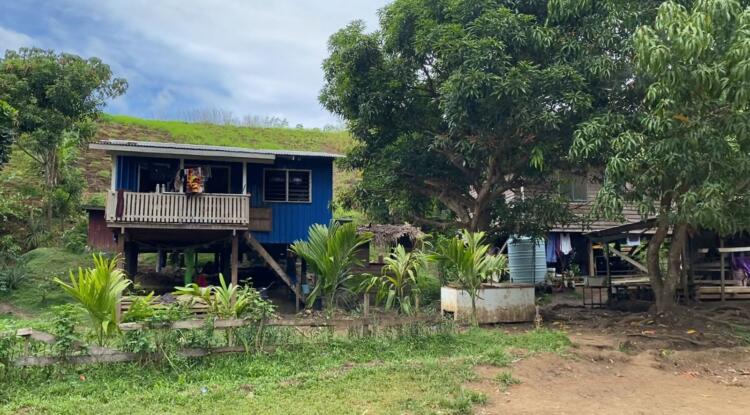
After 11 years, the 300 people of the A’ama tribe are now settling well into their new homes at April Valley, according to the government, but, this process is not executed as planned says local community members.
Anglican priest, Father Seth Oirii who is one of the victims and the very first settlers in April Valley shared his experience on the challenges they faced when moving in, after living in two different evacuation centres.
“Our first challenge here at April Valley is dealing with the surrounding communities who used the land to do their gardening,” he told Wansolwara.
Despite the arguments with the surrounding communities, Fr Oirii and others started building tents as their temporary homes. Water, Road access, education, health and sanitation are the major problems. “We are from different ethnic backgrounds so we are settling according to where we come from “, he said.
Clean Water Hard To Get
Joy Mauriota who is among the very first women settlers reflected on how water was so hard to find compared to living under a tent. “I looked around and saw a creek nearby, it gave us a bad smell so I started digging the ground to find water”, she said.
The well is used for cooking, washing and swimming while they continue to dig other wells that can be suitable for drinking as there was no other options left for them.
As a mother looking after her children and being a house wife, Blandina Alice explained how she struggled with the access to health services. A hundred dollars is not enough to get to the health clinic at that time and babies and pregnant mothers are the most affected ones.
“Road access is so difficult without a proper road infrastructure and it takes about two hours to get to the main road, building materials and other heavy items had to be carried a long distance”, she said.
Lack Of Urban Development Planning Hinders Resettlement
A case study on April Valley Relocation Initiative, emphasised that almost a third of the 10.72 hectares of the identified land is sloping. The area has a lower flooding risk than the Mataniko riverside, but lacks any pre-existing infrastructure such as electricity, water and roads, resulting in serious limitations to long term adaptation.
As mentioned in the study, community members confirmed that the land is fertile; however, the lack of urban development will make it vulnerable to disasters such as flooding, soil erosion and waterlogging in rainy seasons.
Chief Michael Fa’abona said “the lower grounds may be suitable for farming, but given the lack of a drainage system during the rainy season it collects a pool of water which is not favourable for cropping.”
There is also no financial assistance from the Ministry of Commerce and the Ministry of Agriculture to support them in their relocation process. While 277 plots of land are allocated to the settlers in April Valley, the Ministry of Lands, Housing and Survey is yet to transfer the lands title. This remains a major concern to the residents.
Media Training Program
11 years after the devastating flood, the regional news network ‘Pacific Media Voices’ (PMV) put a face to loss and damage in the Solomon Islands and visited April Valley recently. PMV was initiated at the 7th Pacific Media Summit in Niue in 2024, to provide news with a Pacific peoples’ perspective to the region and beyond.
The program was part of a media training program by the Media Association of Solomon Islands (MASI) facilitated by the Secretariat of the Regional Environment Programme (SPREP) to train the media to understand the climate induced ‘Loss and Damage Reporting’
Fr Oirii pointed out to visiting journalists that the flash floods not only claimed four lives, destroyed 100 permanent homes, it also swept away belongings worth millions of dollars.
“For two to three years, our children did not attend school because they were traumatised,” he told local newspaper Solomon Star. “After three years, parents slowly started sending their children to Juniper Tree School, which was closer to them.”
He says that families have gradually rebuilt their lives, with many semi-permanent houses now standing in the settlement, and the villagers now have access to Solomon Water Services, unlike in the past when they depended on boreholes.
Securing Land Titles
However, Fr Oiril says one of their major concerns is securing land titles from the Ministry of Lands, Housing and Survey for the plots they currently occupy. 277 plots at April Valley were allocated by the Ministry of Lands to victims displaced by the 2014 flash floods.
Solomon island’s Permanent Secretary of the Ministry of Environment, Climate Change, Disaster Management and Meteorology, David Hirisia argues, “this is a national development challenge, a growing economic burden and a human crisis: not just an environmental concern. These stories can transform the statistics into human narratives so that the world understands the dimensions of climate change.”
A Board member of MASI, Ednal Palmer told Wansolwara that there is a need to “amplify and advocate the needs of the re-settlers with clarity and determination moving forward”.
* Cheryl Bera is a journalism student at the University of the South Pacific (USP) in Fiji. This story is transmitted as part of an arrangement with USP’s student newspaper Wansolwara.