By Jan Servaes
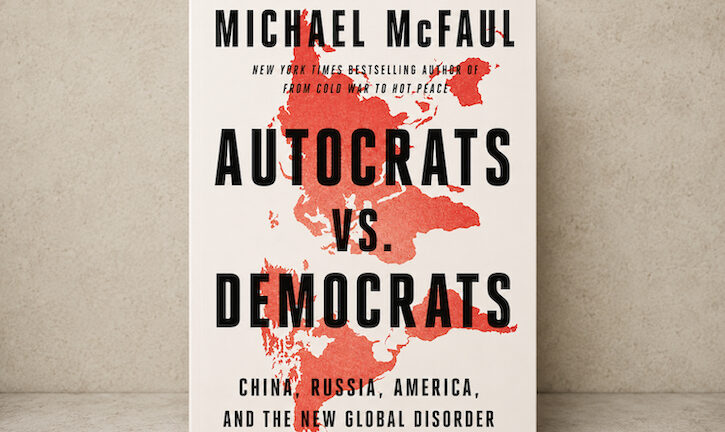
MIAMI | 6 May 2026 (IDN) — Anyone visiting a reputable U.S. bookstore today in search of an analysis of the position the United States occupies on the global stage under President Trump will immediately spot the hefty 534-page tome: Autocrats vs. Democrats: China, Russia, America, and the New Global Disorder by Michael McFaul.
McFaul belongs to the Democratic Party’s diplomatic policy elite. He occupied—and, to some extent, still occupies—a privileged vantage point from which to observe and influence the shifts in U.S. foreign policy.
McFaul served for five years in the Obama administration: first as Special Assistant to the President and Senior Director for Russian and Eurasian Affairs at the National Security Council in the White House (2009–2012), and subsequently as U.S. Ambassador to the Russian Federation (2012–2014).
Over time, he witnessed the relationship between the U.S. and Russia deteriorate. For instance, he was involved in negotiating Russia’s fateful abstention during the United Nations Security Council vote on the NATO intervention in Libya.
He became an informal advisor to Hillary Clinton’s presidential campaign and subsequently a commentator for MSNBC and MSNOW, where he draws connections between domestic resistance to President Donald Trump and the promotion of democracy abroad.
Concurrently, he has served as a Professor of International Politics since 1995, and from 2015 to 2025, he directed the Freeman Spogli Institute for International Studies (FSI) at Stanford University. He has dedicated a significant portion of his academic career to researching political change, great-power competition, and U.S. policy toward Russia. He speaks from experience, drawing upon a wealth of facts, statistics, and personal encounters that exceeds that of many others in his field.
He is also the author and co-author of several books, including Autocrats vs. Democrats: China, Russia, America, and the New Global Disorder (2025); From Cold War to Hot Peace: An American Ambassador in Putin’s Russia (2018); Russia’s Unfinished Revolution: Political Change from Gorbachev to Putin (2015); and Advancing Democracy Abroad: Why We Should, How We Can (2009).
A ‘liberal internationalist’
McFaul considers himself a “liberal internationalist—albeit not a traditional one, at a time when illiberal nationalism is considered in vague. Perhaps Trump’s reelection signals a permanent trajectory toward isolationism, unilateralism, and indifference to American values in American foreign policy. I do not know. I certainly hope not, because I am concerned that these ideas do not serve the long-term interests of the American people” (p. 13).
With this, the tone is set. As the book’s subtitle already indicated, Europe plays hardly any role in McFaul’s worldview, which views the world—and, more specifically, the targeted global rivals, China and Russia—primarily through an American lens.
Originally, McFaul had intended to feature Europe as the fourth major power on the liberal, democratic side; however—aside from constraints on space—there was “analytical decision also driven by the historical observation that the West used to act in relative unison in response to the Soviet threat. Whether that remains true in this century, especially in the Trump era, is unclear … If Europe does begin to act as an autonomous great power influencing outcomes in the international system, independent from the United States, that historical pivot will require another book” (pp. 14–15).
China and Russia
McFaul structures the book into three parts: a brief history of U.S. relations with Russia and China, a comprehensive comparison of the current global balance of power, and a series of policy recommendations intended to adapt the lessons of the Cold War to the situation today. The book is not merely descriptive, but also analytical. McFaul compares autocracies and democracies based on economic performance, military capability, innovation, and alliance networks.
In each section, he examines Russia and China side by side. Although—as McFaul rightly notes—Russia and China are both authoritarian, they also differ distinctly from one another. After all, the tools required to counter Russian aggression are not the same as those needed to compete with China’s long-term ambitions.
Russia is a state in decline, possessing a relatively small economy, severe demographic challenges, and a leadership that relies on repression, nationalism, and military power to maintain its influence. Its global impact is often manifested through coercion and disruption: military aggression, disinformation, cyberattacks, the weaponization of energy, and political interference.
China, by contrast, is an emerging economic and political superpower operating within the existing global order. Rather than attempting to blow up that system, Beijing generally operates within it, leveraging trade, investment, supply chains, and international institutions to expand its influence and protect its interests.
While Russia often destabilizes, competes, and maneuvers, China seeks to tilt the system in its favor without destroying the existing international framework within which it operates.
Trump
McFaul argues that Trump—acting as a “useful idiot”—is dismantling the four pillars of American power. By rejecting the lessons of the previous century, he is undermining the American advantage relative to China and Russia.
However, McFaul emphasizes that this decline began even before Trump’s arrival.
By overestimating the power of the Soviet Union and the global appeal of communism, the U.S. frequently supported corrupt dictators who professed anti-communism and abused their power in wars ostensibly intended to spread democracy.
Russia—economically small compared to China—has become belligerent, obsessed with restoring its status as a great power.
China’s rise and growth have debunked the myth that prosperous nations automatically become democratic. Yet McFaul also warns us not to overestimate China, just as we did with the Soviet Union. He notes that the Chinese economy is faltering and that nine of the ten wealthiest nations in the world are democracies. The U.S. possesses dozens of allies, whereas China and Russia must make do with North Korea and Iran.
Relatively little attention is devoted to the rise and impact of the BRICS nations. “While China continues to grow as a great power, it is not inevitable that it will push the United States out of its leading role in the global economy. I think it is unlikely” (p. 318), because “the U.S. dollar remains the preferred currency for most nations” (p. 319).
Nevertheless, McFaul finds it disheartening that President Trump fails to champion democracy or condemn human rights violations in China and Russia. Instead, Trump praises their leaders, belittles American allies, and has withdrawn from treaties and other efforts at international cooperation.
McFaul writes: “Our adversaries clearly understand the benefits of our domestic divisions and have at times interfered in American politics to exacerbate these divisions.”
He sounds rather pessimistic: “Trump is not making America great again. He is making America weak, precisely at a moment in history when we cannot afford to make such mistakes. China is rising, and Putin is unlikely to stop in Ukraine” (p. 436).
Ukraine
One of the book’s strengths is that it addresses the challenges that China and Russia create together. The Russian war against Ukraine is not taking place in isolation. China has helped mitigate the impact of sanctions by expanding trade, offering diplomatic support in international forums, and echoing narratives that place the blame on the West. If we are concerned about long-term global security, we must understand the goals and actions of both Russia and China, McFaul emphasizes.
Russia’s corruption and flawed battlefield logistics in Ukraine are not isolated failures, but rather reflect deeper weaknesses inherent in autocratic governance—systems where information is distorted and accountability is limited.
At the same time, democracies have their own vulnerabilities, particularly when political polarization slows down decision-making or weakens resolve.
The Future?
The third part of the book offers recommendations for U.S. policymakers regarding the future. McFaul notes, for instance, that it is neither feasible nor wise to confront China everywhere and at all times. China is simply too large and too deeply integrated into the global system.
Democracies must distinguish between areas that require vigorous resistance, areas of manageable competition, and areas where cooperation remains possible.
The United States should strengthen alliances rather than acting alone; invest domestically in democratic institutions and economic competitiveness; clearly and consistently deter aggression; and avoid both isolationism and overconfidence, McFaul argues.
The central—perhaps even defining—theme of the book, however, remains an unwavering faith in the importance and righteousness of post-Cold War liberal foreign policy, coupled with an unwillingness to examine the unintended consequences that emerged along the way.
McFaul laments the waning public support for the liberal international order—or the rising “America First” isolationism—yet does so without dwelling much on the reasons why American attitudes have shifted so dramatically. Nor does he ask whether some of these liberal crusades may have contributed to the nationalism and illiberalism that now plague politics across the Western world.
A Nostalgic Reading Experience for Foreign Policy Elites
For this reason, McFaul’s book feels to Emma Ashford—a senior fellow in the Stimson Center’s Reimagining U.S. Grand Strategy program and author of First Among Equals: U.S. Foreign Policy in a Multipolar World—as though it were written in 2015, not 2025.
Our core interests, McFaul argues, are:
- Protecting American territory;
- Deterring attacks on allies worldwide;
- Halting Russian annexation and conquest in Europe;
- Preventing a war with China over Taiwan; and
- Preserving freedom of navigation in the South China Sea.
We must do all of this without overextending our capabilities, he says, and while “maintaining the best military in the world.”
However, these policy proposals—enumerated in Chapter 14 (starting on p. 396)—align closely with the Biden administration’s approach: a sustained American exceptionalism (including a unified elite that accepts that the U.S. “must lead the free world”), substantial investment in military capabilities, stronger alliances with other democracies, an increased U.S. troop presence abroad, and new international institutions.
Regarding concrete plans to realize all of this, McFaul remains rather vague. Moreover, he concedes that “unlike during the Cold War, the greatest threats to America today do not come from Russia or China, but from within.” Trump, he argues, has “weakened or destroyed” “almost all” of America’s Cold War-era assets.
In many respects, it is fortunate for McFaul that Trump exists to serve as his foil, Emma Ashford cynically observes: Trump may not be blamed for everything, but certainly for a great deal—from democratic dysfunction to isolationism, nationalism, and protectionism.
“Is lumping Trump and his voters together with foreign autocrats really the best way to restore confidence in our democratic system?”, she asks.
Moreover, according to some, the Democratic Party is not merely unpopular; it is rudderless and uncertain whether its path forward lies through the center or through a sharp turn to the left.
Reference
Michael McFaul (2025), Autocrats vs. Democrats: China, Russia, America, and the New Global Disorder, Mariner Books, New York, 544 pages, ISBN 978-0-358-67787-1. [IDN-InDepthNews]
Book cover: Mariner Books; background adaptation by ChatGPT/OpenAI.