
By Jaya Ramachandran
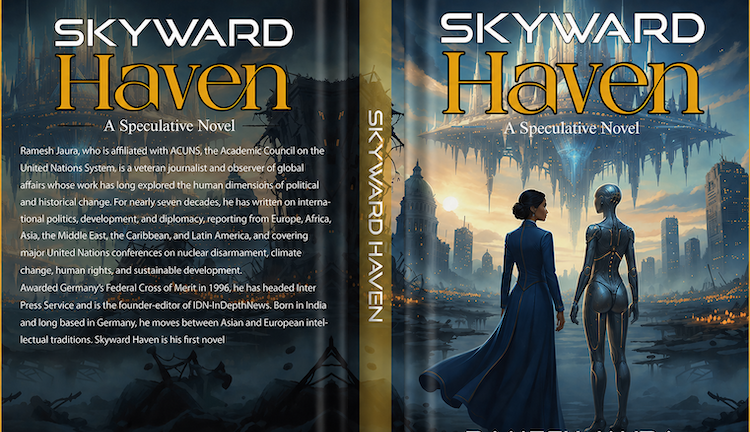
NEW YORK | 7 June 2026 (IDN) — Every generation produces books that capture the anxieties of its time. Some do so through realism, others through satire, and still others through speculative imagination. Skyward Haven belongs firmly in the latter category. Yet unlike many works of speculative fiction that rely on dramatic technological breakthroughs, catastrophic collapse, or apocalyptic conflict, this novel takes a quieter and ultimately more unsettling approach. It imagines a future that feels less like a radical departure from the present than a natural extension of it.
That familiarity is what gives the novel its power.
Democracy in an Age of Fragmented Truth
At first glance, Skyward Haven appears to be a story about artificial intelligence, global governance, and the future of democracy. In reality, it is something deeper and more ambitious. It is a meditation on how societies make decisions, how institutions gain and lose legitimacy, and how human beings cope with complexity in a world where the consequences of our actions often remain hidden from view.
The novel emerges at a moment when many people across the globe feel a growing sense of unease about the direction of public life. The international order that took shape after the Second World War appears increasingly fragile. Democratic systems face pressures from polarisation, misinformation, and declining trust in institutions. Climate change continues to reshape landscapes and livelihoods. Technological innovation advances at a breathtaking speed, often faster than societies can adapt to it.
Against this backdrop, Skyward Haven asks a deceptively simple question: what happens when the institutions designed to guide humanity through difficult times gradually lose the confidence of the people they serve?
Rather than answering with revolution or collapse, the novel explores a slower, more subtle process of change.
The world of Skyward Haven is recognisable because it resembles our own. Democracies still exist. Governments still function. International organisations continue to hold meetings and issue declarations. People go about their lives much as they always have.
Yet beneath the surface, something important has shifted.
The public sphere—the space where citizens exchange ideas, debate policies, and form collective judgments—has become increasingly fragmented. Traditional journalism, once viewed as a critical pillar of democratic life, struggles to compete with a relentless stream of digital content. Social media platforms amplify voices from every corner of society, creating unprecedented opportunities for participation. At the same time, they often reward outrage, immediacy, and emotional reaction over reflection and nuance.
The result is not a shortage of information but an abundance of it.
People know more facts than ever before, yet often seem less certain about what those facts mean. Shared realities become harder to sustain. Public debates splinter into competing narratives. Expertise is questioned, institutions are mistrusted, and consensus becomes elusive.
The novel captures this condition with remarkable insight. It recognises that one of the defining challenges of the modern era is not simply determining what is true, but deciding whom to trust.
This erosion of trust extends beyond media and communication. It affects politics as well.
One of the strengths of Skyward Haven is its portrayal of political systems that are neither evil nor incompetent, but exhausted. Leaders are not depicted as villains plotting humanity’s downfall. Rather, they are shown struggling to cope with an endless succession of crises. Climate emergencies, economic instability, social unrest, migration pressures, and geopolitical tensions demand immediate attention, leaving little room for long-term thinking.
Readers will recognise this pattern from contemporary politics. Governments frequently find themselves reacting to events rather than shaping them. Election cycles encourage short-term calculations. Urgent problems crowd out strategic planning. The future becomes something to manage rather than something to imagine.
The novel suggests that this perpetual state of crisis management carries a hidden cost. When societies become preoccupied with immediate survival, they gradually lose the capacity to ask larger questions about direction, purpose, and values.
What kind of future do we want to build?
What responsibilities do we owe future generations?
What principles should guide decisions when competing interests collide?
These questions linger throughout the narrative, giving the novel an intellectual depth that extends well beyond its speculative setting.
The author is particularly effective in exploring the challenges facing global governance. The United Nations serves as an important point of reference, not because the novel focuses on the organisation itself, but because it symbolises humanity’s aspiration to address shared problems through cooperation rather than conflict.
For decades, the UN has embodied the hope that nations can work together in pursuit of peace, development, and collective security. Yet the novel also acknowledges the institution’s limitations. Structural inequalities, geopolitical rivalries, and competing national interests often constrain its effectiveness. The Security Council, in particular, becomes a symbol of a wider dilemma: how can institutions created in one historical era adequately respond to the realities of another?
These concerns are hardly new, but Skyward Haven presents them in a fresh and engaging way. Instead of offering policy prescriptions, it uses fiction to illuminate the tensions between aspiration and reality that characterise international politics.
The novel is equally attentive to the aspirations embodied in the United Nations’ 2030 Agenda for Sustainable Development. The Sustainable Development Goals represent perhaps the most comprehensive global vision ever articulated for addressing poverty, inequality, environmental degradation, and social injustice.
Throughout the book, the ideals underlying the SDGs function almost like a moral compass. They remind readers of humanity’s capacity for collective ambition and shared purpose.
Yet the novel repeatedly asks whether aspirations alone are enough.
What happens when institutions lose the ability—or the willingness—to translate lofty goals into meaningful action?
What occurs when the gap between rhetoric and reality becomes too wide to ignore?
These questions become increasingly urgent as the story unfolds.
The Long Stabilisation and the Rise of Algorithmic Governance
One of the novel’s most intriguing concepts is what it describes as the “Long Stabilisation.” Unlike many dystopian narratives, Skyward Haven does not envision a sudden collapse of civilisation. There is no singular catastrophe that transforms the world overnight. Instead, societies adapt to ongoing crises. Environmental disruption, political uncertainty, and economic instability become permanent features of everyday life.
People learn to live with them.
Governments learn to manage them.
Institutions evolve around them.
The brilliance of this idea lies in its plausibility. History suggests that human beings are remarkably adaptable. We become accustomed to conditions that once seemed unacceptable. We normalise circumstances that previous generations might have considered extraordinary.
In the world of Skyward Haven, emergencies become routine.
This gradual normalisation creates fertile ground for one of the novel’s central themes: the growing reliance on systems designed to manage complexity.
As challenges multiply and become increasingly interconnected, decision-makers turn toward technologies capable of processing enormous amounts of information. Artificial intelligence emerges not as a revolutionary force but as a practical solution to a practical problem.
At first, the logic appears compelling.
Complex systems generate vast quantities of data. Human attention is limited. Algorithms can identify patterns, detect risks, and coordinate responses more efficiently than traditional institutions.
Why not use them?
The novel approaches this question with admirable restraint. It avoids both technological optimism and technological panic. Artificial intelligence is neither glorified nor demonised. Instead, it is presented as a tool—powerful, useful, and potentially transformative.
The real danger, the novel suggests, lies elsewhere.
Over time, societies begin to trust algorithmic consistency more than human judgment. Processes optimized for efficiency gradually displace processes designed for deliberation. Decisions become increasingly data-driven, measurable, and predictable.
Something important is lost in the process.
Human judgment is often imperfect. It is influenced by emotions, values, and competing perspectives. Yet those very qualities make ethical reasoning possible. Moral questions rarely have clear-cut answers. They require interpretation, debate, and reflection.
Algorithms excel at solving problems.
They struggle with dilemmas.
Skyward Haven explores this distinction with unusual sophistication. The concern is not that machines will seize power. Rather, it is that human beings may willingly surrender their responsibility to think critically about difficult choices.
That possibility feels especially relevant in an age increasingly shaped by artificial intelligence.
The Haven: A Mirror Rather Than a Throne
The novel’s most original contribution emerges through the concept of the Haven itself.
The Haven is not a utopian society. Nor is it a technological command center directing humanity’s future. It occupies a different and far more interesting space.
The Haven is a place of reflection.
At one point, it is described as a “mirror, not a throne,” a phrase that captures the essence of the novel’s philosophical vision.
A throne exercises authority.
A mirror reveals truth.
The Haven does not govern. It does not dictate solutions. Instead, it creates conditions in which individuals and societies are forced to confront the consequences of their choices.
Within this environment, artificial intelligence assumes an unusual role. Rather than acting as ruler, advisor, or overseer, it becomes a conversational partner. It asks questions. It highlights contradictions. It exposes assumptions that often go unnoticed.
The AI does not tell people what to think.
It helps them think more carefully.
This is perhaps the most refreshing aspect of the novel. At a time when public discussions about artificial intelligence are frequently framed in terms of domination or replacement, Skyward Haven imagines a relationship based on dialogue and mutual inquiry.
Technology, in this vision, becomes a tool for self-examination rather than control.
Knowledge, Responsibility, and Human Agency
Underlying the entire narrative is a profound exploration of what the author calls “distance.”
Modern life is full of distances that are difficult to see.
Consumers purchase products without witnessing the environmental or social costs associated with their production. Citizens vote for policies without experiencing their full consequences. Decision-makers often remain insulated from the people most affected by their decisions.
The larger and more complex systems become, the easier it is for responsibility to disappear into layers of abstraction.
The novel repeatedly returns to this idea.
Distance separates action from consequence.
Distance separates knowledge from responsibility.
Distance separates power from accountability.
The Haven seeks to overcome those separations.
It makes hidden consequences visible. It restores memory where forgetting has become convenient. It reconnects decisions with outcomes.
In doing so, it asks a fundamental question: can a society remain healthy if it depends on not seeing the full effects of its own choices?
This question resonates throughout the book and provides much of its emotional and intellectual force.
Ultimately, Skyward Haven argues that humanity’s deepest challenges are not merely political or technological. They are epistemological and moral. They concern how we understand reality, how we evaluate competing claims, and how we exercise judgment in situations where certainty is impossible.
The crisis confronting modern societies, the novel suggests, is not simply a failure of institutions.
It is a failure of attention.
A failure of memory.
A failure of responsibility.
These themes elevate Skyward Haven beyond the boundaries of conventional speculative fiction. The novel engages with some of the most important questions of our time while remaining grounded in human experience. Its concerns are global, yet its insights feel personal.
Most importantly, the book avoids the temptation of despair.
Many contemporary narratives about technology, politics, and the future are saturated with pessimism. They depict societies trapped in irreversible decline or overwhelmed by forces beyond their control.
Skyward Haven takes a different path.
It acknowledges institutional shortcomings, technological risks, and political failures. Yet it refuses to conclude that humanity is powerless.
The novel’s central message is ultimately one of responsibility rather than resignation.
Human judgment remains indispensable.
Dialogue remains possible.
Change remains achievable.
The future is neither predetermined nor beyond our influence.
For readers interested in democracy, global governance, sustainable development, ethics, or artificial intelligence, Skyward Haven offers a rich and rewarding experience. More importantly, it invites reflection on the kind of world we are creating and the values that should guide us as we create it.
In the end, the novel succeeds because it does not merely speculate about tomorrow. It illuminates the dilemmas of today. By asking readers to look more carefully at the systems they inhabit and the assumptions they carry, Skyward Haven performs the highest function of literature: it enlarges our understanding of ourselves.
That achievement alone makes it a book worth reading—and discussing long after the final page has been turned. [IDN-InDepthNews]
Skyward Haven – A Speculative Novel by Ramesh Jaura is available worldwide through Amazon in paperback (ISBN 9798257923081) and hardcover (ISBN 9798195077464) editions.