A Bold Proposal Worth Considering
By Ramesh Jaura
This article was first published on https://rjaura.substack.com
BERLIN | 5 June 2026 (IDN) — Imagine Donald Trump receiving a Nobel Prize—not for championing peace, democracy, or global unity, but for inadvertently reminding the world just how vital those ideals truly are.
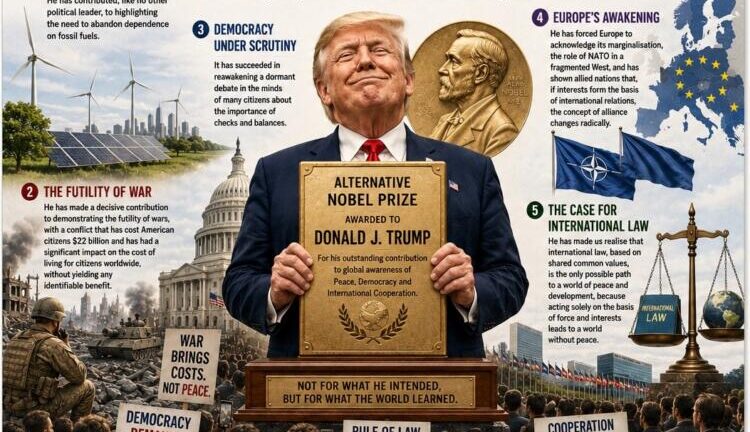
This is the daring idea from veteran Italian journalist and media innovator Roberto Savio, founder of Inter Press Service (IPS) and publisher of Other News. In a widely shared personal appeal, Savio proposes an “Alternative Nobel Prize” for U.S. President Donald Trump—not as an honour, but as a sharp piece of political irony meant to spotlight the unintended consequences of Trump’s actions and words.
The proposal walks a fine line between satire and seriousness. Beneath its humour pulses a deep worry about democracy’s health, the unravelling of international cooperation, and what Savio calls a rising tide of political subservience to a leader he sees as narcissistic, impulsive, and antagonistic to democratic values.
“The current situation of widespread subservience towards Trump strikes me as serious, dangerous and irrational,” Savio writes. He expresses alarm that political leaders and public figures increasingly resort to flattery and accommodation rather than principled engagement.
But rather than resorting to the usual critiques, Savio flips the script entirely.
His concept is straightforward: give Trump an international prize for unintentionally boosting global awareness of peace, democracy, renewable energy, international law, and cooperation—by showing the world what happens when these values are ignored.
The Logic of Political Irony
At first, the proposal seems like pure political satire. Yet Savio’s case is rooted in a classic lesson from history: leaders often end up achieving the very opposite of their aims.
Time and again, controversial rulers and movements have sparked powerful counter-reactions, often leaving a greater mark than their original agendas. By provoking resistance, they end up fortifying the very institutions and values they tried to undermine.
According to Savio, Trump’s political legacy may ultimately fall into that category.
Instead of easing worries about climate change, democratic safeguards, or international law, Trump’s policies have pushed governments, civil society groups, and citizens worldwide to reconsider just how crucial these pillars are.
Renewable Energy Through Disruption
One of Savio’s principal arguments concerns energy policy.
Trump has consistently backed fossil fuels and cast doubt on climate initiatives. Yet Savio contends that this very stance has spurred many nations to speed up their pursuit of energy independence through renewables.
The reasoning is straightforward. Dependence on fossil fuel markets often creates strategic vulnerabilities, exposing countries to geopolitical tensions, supply disruptions, and price volatility.
As energy security becomes increasingly intertwined with national security, governments are ramping up investments in solar, wind, and other renewables. For many policymakers, the message is unmistakable: true energy independence means breaking free from reliance on fossil fuels.
Seen in this light, Trump’s backing of traditional energy may have unintentionally strengthened the global case for renewables.
Reawakening Democratic Vigilance
Savio’s second major argument concerns democracy itself.
Around the world, concerns about democratic backsliding have become increasingly prominent. Debates over judicial independence, executive authority, electoral integrity, and institutional accountability have moved from academic circles into mainstream political discourse.
Savio argues that Trump’s words and deeds have reignited public awareness about why constitutional checks and balances matter.
Agree or disagree, it is clear that debates over the strength of democratic institutions have surged during the Trump years. Courts, legislatures, elections, and independent media now face a level of public scrutiny rarely seen before.
For Savio, this surge in vigilance is an unexpected gift to democratic culture.
By pushing the limits of institutions, Trump has prompted people to question not only how democracies work, but also how they can unravel.
Europe’s Strategic Awakening
A third element of Savio’s argument focuses on transatlantic relations.
For decades, many European governments operated under assumptions shaped by the post-World War II alliance system. Security guarantees, economic cooperation, and political alignment with Washington formed the cornerstone of European strategic thinking.
Trump’s confrontations with NATO, criticism of allies, and deal-driven diplomacy have rattled those long-held beliefs.
According to Savio, this has forced Europe to confront uncomfortable realities regarding its own geopolitical position and strategic dependence.
European leaders now openly debate strategic autonomy, defence budgets, industrial policy, and the fate of the Western alliance. Issues once considered settled are back on the table.
In Savio’s eyes, Trump’s disruption has jolted Europe awake.
The takeaway is not anti-American. Instead, alliances built only on shared interests can shift quickly as priorities change, so nations must strengthen their ability to act independently.
The Return of International Law
Perhaps Savio’s most ambitious claim concerns international law.
In an era characterised by great-power competition, military conflicts, and geopolitical rivalry, the relevance of international norms often appears fragile.
Yet Savio insists that as power politics takes centre stage, the value of international law stands out more clearly than ever.
When states act primarily in pursuit of immediate interests and relative power, the result is often instability rather than lasting security. International law, however imperfect, provides a framework for managing competing interests without resorting to coercion or force.
The more leaders focus solely on power, Savio suggests, the more people see the urgent need for legal and institutional limits.
So what looks like a threat to the international order may, in a twist of fate, actually deepen respect for the rules that hold it together.
More Than Satire
Savio’s proposal goes beyond symbolic criticism.
He imagines a formal award unveiled before the next U.S. midterms, backed by a global coalition, a public citation, and a wave of media attention.
The goal is not just to mock Trump, but to spark a debate about the values many believe are now under siege.
The award’s citation would highlight achievements not in the usual sense, but in the unexpected realm of unintended consequences.
In essence, the prize would honour the world’s responses to Trump’s presidency, not the policies themselves.
The idea acts as a political mirror, reflecting not Trump’s intentions, but what his critics believe his actions have laid bare.
Practical Challenges
Bringing this idea to life would be no simple feat.
Savio identifies several obstacles.
The first is credibility. Who would award such a prize?
A panel of respected public figures could lend prestige, but many might shy away from a project that risks political backlash.
Alternatively, a global coalition of civil society groups could take the lead. Savio envisions 100 organisations from five continents joining forces to present the award.
The second challenge concerns representation.
To avoid the label of anti-Americanism, the initiative would need strong participation from within the United States. American scholars, activists, former officials, and civil society leaders would have to take centre stage.
Otherwise, critics could portray the project as merely another expression of foreign opposition to American politics.
The third challenge involves independence.
Savio suggests a volunteer-run secretariat and shoestring budget. Steering clear of big donors would help keep the award politically neutral and shield it from claims of partisanship.
A Debate About Leadership
At its heart, the proposal sparks bigger questions about leadership and holding power to account.
Can controversial leaders contribute positively to society through the reactions they provoke?
Do political movements sometimes strengthen democratic institutions by forcing citizens to defend them?
Can public satire serve as a legitimate form of democratic engagement?
Supporters might say that humour has always been a tool for challenging authority. Satire can reveal contradictions, deflate political myths, and inspire deeper reflection.
Critics, on the other hand, warn that such efforts could trivialise serious matters or deepen political divisions.
Some argue that turning political disputes into symbolic awards distracts from real policy debates. Others view the proposal as a fresh form of civic activism.
No matter where you stand, Savio’s initiative succeeds in one key way: it gets people talking.
An Uncomfortable Mirror
The most striking part of the proposal is how it shifts the spotlight from Trump to the societies reacting to him.
In the end, the proposed award is less about one politician and more about the collective response to his ascent.
For Savio, the real story is not Trump’s power, but the weaknesses he has laid bare: dependence on fossil fuels, complacency about democracy, overreliance on alliances, and a lack of commitment to international law.
Whether you agree with Savios or not, the proposal invites us to ponder a political paradox: leaders are often remembered not just for their goals, but for the unintended forces they unleash.
If Savio’s Alternative Nobel Prize ever comes to pass, it probably will not sit beside the official Nobel medals in Oslo or Stockholm.
But as a thought experiment, it dares readers to imagine that some political figures leave their deepest mark not through triumphs, but by inspiring others to fiercely defend values once taken for granted. [IDN-InDepthNews]
Original link: https://rjaura.substack.com/p/an-alternative-nobel-prize-for-trump
Related links:
https://www.eurasiareview.com/02062026-an-alternative-nobel-prize-for-trump-oped/
https://www.other-news.info/an-alternative-nobel-prize-for-trump/