By Daniel Tesfa and Filmon Gebremikael
ANTWERPEN | Belgium | 6 July 2026 (IDN) — The United Nations Human Rights Council (UNHRC) has voted to renew the mandate of the UN Special Rapporteur on the situation of human rights in Eritrea for another year, following strong advocacy from the European Union and Eritrean civil society organisations that argued independent international monitoring remains indispensable amid continuing reports of systematic human rights violations.
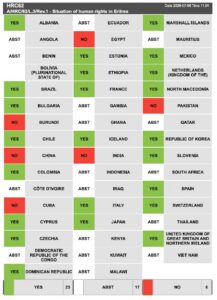
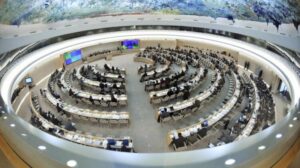
Photo credit: UN Photo/Jean-Marc Ferré UN Photo/Jean-Marc Ferré
The countries voting against the resolution were Burundi, China, Cuba, Egypt, India and Pakistan, while several African, Asian and Middle Eastern states abstained. The resolution received support from European Union member states, Latin American and several African countries, ensuring the continuation of one of the UN’s longest-running country-specific human rights mandates.
The vote represents a significant diplomatic victory for Eritrean human rights defenders who, in recent weeks, launched coordinated international campaigns urging governments not to weaken independent oversight of Eritrea’s human rights record.
Eritrean Human Rights Advocates Call for Continued UN Oversight
Ahead of the Council’s decision, several Eritrean organisations issued open letters warning that ending the mandate would remove one of the few independent mechanisms capable of documenting developments inside one of the world’s most closed political systems.
“The mandate has, over many years, provided an independent, impartial and internationally recognised mechanism for monitoring and reporting on the human rights situation in Eritrea,” states a joint letter signed by Eritrean Human Rights in the Netherlands, Eritrese Vrouwen voor Integratie in the Netherlands, MWS Vereniging in the Netherlands, and Vereniging Eritrease Jongeren Gemeenschap.
The organisations argue that the mandate has enabled the international community to maintain “an objective understanding of developments inside the country and of their consequences for Eritrean citizens, refugees and the wider region.”
A separate appeal from DA’ERONA Worldwide Eritrean Community similarly called upon Member States to renew the mandate, arguing that continued international scrutiny remains essential to uphold human dignity, strengthen accountability mechanisms, preserve impartial documentation of human rights conditions, and demonstrate sustained global solidarity with the Eritrean people.
Both appeals stressed that the mandate should not be viewed as a political instrument directed against Eritrea but rather as a mechanism for protecting universal human rights principles and ensuring independent international monitoring where domestic accountability remains absent.
European Union Defended Renewal
The European Union, which introduced the resolution on behalf of the core group, acknowledged that Eritrea had taken several limited positive steps over the past year, but concluded that these developments were insufficient to justify ending the mandate.
Presenting the resolution before the vote, the EU welcomed increased dialogue with Eritrea, including human rights training conducted by the Office of the UN High Commissioner for Human Rights (OHCHR) in Asmara and the release of some arbitrarily detained individuals.
However, the EU noted that these developments had not altered the overall human rights situation.
According to the EU’s introductory statement, the Special Rapporteur continues to document systematic human rights violations, including enforced disappearances, decades-long arbitrary detention, persecution of political opponents, journalists and religious communities, as well as recent arrests of religious leaders and the closure of Muslim religious institutions.
The EU also rejected suggestions that technical cooperation alone could replace independent monitoring.
Quoting the Office of the High Commissioner for Human Rights, the EU stated that technical assistance and independent monitoring are complementary rather than mutually exclusive mechanisms, reinforcing one another in promoting human rights improvements.
The EU further argued that country mandates have historically ended only after governments demonstrate genuine engagement with international mechanisms and implement measurable reforms.
“To date, this has not been the case with Eritrea,” the EU stated, concluding that the Special Rapporteur’s work remains essential for monitoring violations and advancing accountability where no effective domestic avenues for justice exist.
Why the Mandate Continues to Matter
The mandate of the UN Special Rapporteur on the situation of human rights in Eritrea was established by the Human Rights Council in 2012 following years of international concern regarding arbitrary detention, indefinite national service, restrictions on freedom of expression, religious persecution and the absence of independent judicial institutions.
Since then, successive Special Rapporteurs have documented a broad range of alleged human rights violations including indefinite national service, arbitrary detention, enforced disappearances, restrictions on freedom of expression, religious persecution, and the absence of independent judicial institutions while repeatedly calling on Eritrean authorities to improve cooperation with UN human rights mechanisms.
Although Eritrea has consistently rejected the reports as politically motivated, human rights organisations argue that the Special Rapporteur remains one of the few independent sources of information on developments inside the country, where access for international observers remains extremely limited.
Because international investigators continue to face extremely limited access inside Eritrea, reports by the Special Rapporteur have become one of the few publicly available sources of independent information relied upon by governments, humanitarian organisations and international courts.
Civil society organisations argue that the mandate serves not only as a reporting mechanism but also as an early-warning system that contributes to prevention, accountability and informed policymaking.
As one of the joint civil society letters notes, independent documentation “supports accountability efforts and provides a factual basis for constructive dialogue grounded in international human rights law.”
Human Rights Beyond Eritrea’s Borders
The organisations also frame the mandate within a broader regional context. The consequences of Eritrea’s human rights situation, they argue, extend well beyond its national borders through continued repression, refugee flows, irregular migration and humanitarian crises affecting neighboring countries.
Over the past decade, hundreds of thousands of Eritreans have fled compulsory national service, restrictions on political freedoms and economic hardship. Many have undertaken dangerous journeys through Sudan, Ethiopia, Kenya, Uganda, Chad, Libya and the Mediterranean, where they have frequently become victims of human trafficking, kidnapping, forced labour and sexual violence.
Against this backdrop, the organisations argue that independent international monitoring remains essential not only for Eritrea itself but also for regional stability.
For civil society organisations, these regional consequences reinforce the need for sustained international monitoring rather than its reduction.
Vote Reflects Divided International Landscape
Although the resolution passed comfortably, the voting pattern illustrates continuing divisions within the Human Rights Council over country-specific mandates.
Support came largely from European states together with countries from Latin America and other regions, while several governments argued for greater emphasis on technical cooperation instead of continued country-specific scrutiny.
Nevertheless, the final outcome ensures that the Special Rapporteur will continue documenting developments in Eritrea for another year.
For Eritrean civil society organisations, the decision represents more than an institutional renewal.
It reaffirms that, despite evolving regional geopolitics and diplomatic engagement with Asmara, the international community continues to recognise that meaningful improvements in Eritrea’s human rights situation have yet to materialise.
The renewed mandate also signals that accountability, independent reporting and international scrutiny remain central components of the UN Human Rights Council’s engagement with Eritrea until demonstrable reforms are achieved. [IDN-InDepthNews]