
By Sam Ben-Meir *
NEW YORK | 11 November 2026 (IDN) —In Paul Thomas Anderson’s One Battle After Another (2025), Leonardo DiCaprio’s character, Bob Ferguson, a disillusioned former revolutionary, watches Gillo Pontecorvo’s The Battle of Algiers (1966) on television. The juxtaposition is almost comical: a man whose revolutionary aspirations have collapsed into private survival contemplates one of cinema’s most powerful representations of collective struggle. Yet the scene raises a question Anderson’s film never fully confronts: What distinguishes a revolution capable of transforming the world from a rebellion condemned to repeat itself?
The juxtaposition is especially timely. On November 7, The Battle of Algiers was screened at the Brooklyn Academy of Music as part of Playback: The Brooklyn Watch Party, selected by actor John Turturro. Sixty years after its release, Pontecorvo’s film remains a challenge to the diminished revolutionary imagination of our time, insisting that resistance need not become perpetual repetition: even seemingly immovable structures of domination can be transformed.
The difference between the films is not simply that one depicts national liberation while the other portrays an endless confrontation with authoritarian power. Pontecorvo understands revolution as a transformation of historical possibilities, whereas Anderson risks reducing resistance to a permanent condition of political life. In One Battle After Another, there is always another enemy, another generation called upon to fight. In The Battle of Algiers, the destruction of the revolutionary underground becomes the prelude to a political transformation that military force cannot prevent.
The distinction matters when resistance is increasingly imagined as a permanent moral obligation rather than a means of changing the conditions that make it necessary. Vigilance against domination remains indispensable, and history offers little assurance that freedom, once achieved, is secure. But recognizing the vulnerability of political achievements is not the same as accepting that domination itself is beyond transformation. The former is historical realism; the latter risks becoming resignation disguised as militancy. Pontecorvo’s film challenges precisely this resignation.
A revolution survives defeat
The Battle of Algiers reconstructs the struggle between Algerian nationalists and French colonial authorities during the war for independence. Filmed in stark black and white, using largely nonprofessional actors and a visual style resembling documentary reportage, it follows the rise of the National Liberation Front’s urban resistance and the increasingly systematic efforts of the French military to destroy it. Its central figure, Ali La Pointe, emerges from the streets of the Casbah to become a revolutionary militant, only to perish when French paratroopers destroy his hiding place.
By conventional narrative standards, this should be the film’s tragic conclusion. The revolutionary organization has been dismantled, its leaders captured or killed, its clandestine networks penetrated. Colonel Mathieu, the French commander, has accomplished his military objective. The battle, in the narrowest sense, has been won.
But Pontecorvo refuses to end there. Instead, the film leaps forward to December 1960, when enormous crowds of Algerians take to the streets demanding independence. The people who appear in these final sequences cannot be reduced to the revolutionary organization that the French army has defeated. They emerge as a collective political force that exceeds the structures through which resistance had previously been organized. The film concludes by pointing toward the independence Algeria would achieve in 1962.
This is the film’s most profound political insight: the defeat of a revolutionary organization is not necessarily the defeat of the revolution. The French military succeeds in eliminating an armed network, but it cannot eliminate the historical contradiction that gave rise to it. Colonial domination remains, and with it the conditions of resistance. The final demonstrations do not merely continue the earlier struggle. They transform its character. What had appeared as the activity of a clandestine minority becomes the visible expression of a people demanding political existence on different terms. The revolution has survived its apparent destruction because its historical significance was never exhausted by the militants who fought in its name.
Violence and colonial rule
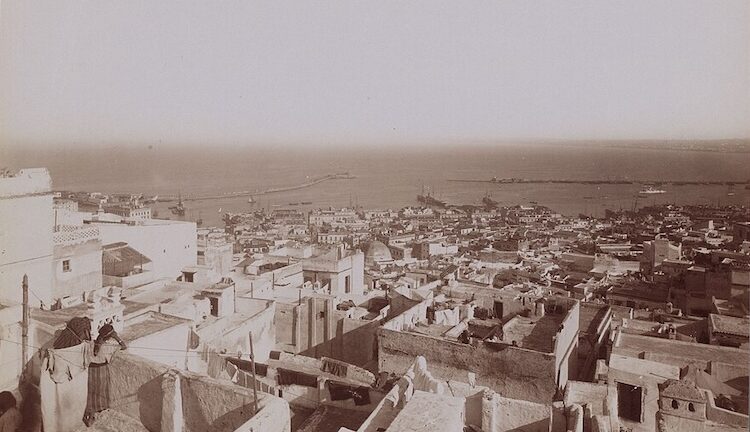
Pontecorvo understands colonialism not merely as foreign rule but as an organization of everyday existence, determining where people may live, how they may move, and whose lives are protected by law. The division between the European quarters of Algiers and the Casbah expresses this structure of domination. The city itself becomes a political instrument, distributing security, vulnerability, and authority along colonial lines.
Here Pontecorvo converges with Frantz Fanon, whose The Wretched of the Earth (1961) describes colonialism as a world divided into opposed zones, where domination is experienced through soldiers, checkpoints, prohibitions, and the constant threat of violence. Revolutionary struggle therefore concerns more than a change of government: it challenges an entire order in which some possess the authority to determine the conditions under which others must live.
Yet Pontecorvo does not conceal the terrible moral ambiguities of that struggle. The film’s depiction of FLN bombings in civilian spaces is among its most disturbing achievements. The camera lingers on ordinary people who will become victims, refusing to transform their deaths into anonymous consequences of historical necessity. Revolutionary violence is neither sanitized nor presented as intrinsically redemptive.
This matters because understanding the conditions that produce political violence is not the same as justifying every act committed in the name of liberation. The deliberate targeting of civilians raises moral questions that cannot be dissolved by invoking the righteousness of a political cause. Pontecorvo’s achievement is to situate such violence within a colonial system without requiring the viewer to regard it as morally innocent.
The same refusal of innocence governs Pontecorvo’s treatment of French counterinsurgency. Intelligent, disciplined, and disturbingly candid, Colonel Mathieu defends torture as necessary to France’s political objectives, exposing a contradiction at the heart of colonial liberalism: a republic committed to liberty and human dignity preserves its authority through practices that violate those very principles. Torture is not an aberration but an instrument of colonial rule. The question is not simply whether France can defeat the FLN, but what it must become to maintain its domination. Pontecorvo exposes the limits of a military victory secured by destroying the principles that supposedly legitimate the victorious power.
Resistance and revolution
This brings us back to One Battle After Another. Anderson’s film depicts a world in which authoritarian forces continually reappear, while those who resist them struggle to preserve their identities, commitments, and relationships. Its characters are caught in a cycle of confrontation, exhaustion, retreat, and renewed confrontation. Resistance becomes a permanent condition of existence.
There is genuine courage in this vision. Anderson refuses the comforting fiction that injustice can be defeated once and for all. He also gives considerable emotional weight to the obligations that survive political disillusionment, particularly Bob’s responsibility toward his daughter. But the film’s realism carries a danger: when struggle becomes endless, it can cease to be understood as a means of transforming the world and instead become the framework within which political life is expected to unfold.
Slavoj Žižek’s critique of ideology helps illuminate this danger. Ideology does not necessarily require that we believe the existing order is just. We may recognize its injustices perfectly well while nevertheless accepting its fundamental coordinates as unavoidable. Indeed, our very opposition to the system can become a source of satisfaction, allowing us to experience ourselves as politically engaged without confronting the possibility that our activity leaves the underlying structures intact. Resistance, in this sense, can become a ritual of opposition. We fight because fighting confirms who we are. The enemy’s return reassures us that our struggle remains necessary. What disappears is the possibility of a political transformation that would render the familiar forms of opposition obsolete.
Alain Badiou approaches the problem from another direction. For Badiou, transformative politics involves an Event: a rupture that opens possibilities the existing order could neither anticipate nor accommodate. Not every uprising constitutes an Event, nor does persistent resistance guarantee transformation. The question is whether political action creates new possibilities or merely reproduces existing antagonisms. From this perspective, The Battle of Algiers depicts something largely absent from Anderson’s film: a revolutionary struggle that transforms the coordinates of political existence. The final demonstrations reveal the emergence of a collective political subject whose actions make colonial rule increasingly untenable. Whether the Algerian Revolution qualifies as an Event in Badiou’s strict sense is less important than the distinction his thought illuminates.
Anderson’s film may portray revolutionary exhaustion rather than endorse it. The political awakening of Bob’s daughter suggests that revolutionary possibilities can survive earlier failures. Yet the question remains: toward what transformation is the next generation struggling? To inherit resistance is not necessarily to inherit a revolutionary horizon.
One of Pontecorvo’s most radical artistic decisions is his refusal to make the revolution ultimately dependent upon a single heroic individual. Ali La Pointe is a compelling protagonist, but his death does not conclude the film because the revolution does not belong to him. Nor does it belong exclusively to the FLN leadership. Its historical force exceeds the intentions and actions of any particular militant.
The final sequences make this visible through the film’s changing cinematic language. The clandestine operations that dominate the earlier narrative give way to images of collective movement. The camera follows crowds filling streets and public spaces, transforming the city that had previously embodied colonial segregation into a site of political self-assertion. The people are no longer merely the population on whose behalf revolutionaries act. They become the agents of their own political appearance.
Here Hannah Arendt’s distinction between power and violence becomes illuminating, despite her differences with Fanon. For Arendt, political power arises when people act together; violence may destroy power but cannot generate the collective legitimacy on which enduring institutions depend. Pontecorvo’s ending dramatizes this distinction. Despite its overwhelming military superiority, France confronts a collective power that cannot be defeated through coercion alone. This does not mean that mass demonstrations are inherently emancipatory or that collective action necessarily produces just institutions. Rather, political transformation requires capacities that cannot be reduced to weapons or the destruction of enemies.
Revolution becomes historically consequential when collective action challenges the legitimacy of the existing order and opens possibilities for organizing common life differently. Pontecorvo’s documentary realism, crowded compositions, and rejection of conventional heroic closure make the people themselves visible as a historical force. Through the changing relationships between bodies, spaces, and institutions, cinema reveals a history no longer organized around the deeds of exceptional individuals.
Beyond national liberation
Yet the achievement of Algerian independence also raises a question that Pontecorvo’s film cannot fully answer. Does the overthrow of colonial domination necessarily bring about the emancipation of those who have been colonized? The distinction is essential. National independence transforms the relationship between a people and the foreign power that governs them. But political sovereignty does not automatically abolish economic exploitation, class hierarchy, patriarchal authority, or the concentration of power within the institutions of the newly independent state.
Indeed, the history of postcolonial societies demonstrates how movements founded upon collective liberation can themselves produce new structures of domination. The revolutionary organization may become the governing party; the struggle for independence may give way to the consolidation of state authority; the language of national unity may be used to suppress the very plurality through which political freedom becomes meaningful. These possibilities do not invalidate the achievement of decolonization. They reveal that liberation and emancipation, although intimately related, are not identical.
Algeria’s own postindependence history illustrates the difficulty. The FLN, which had led the struggle against French colonial rule, became the dominant political organization of the independent state, while conflicts over political authority and the concentration of power complicated the revolutionary promise of collective self-determination.
Here Marx provides an indispensable complement to Fanon. Political emancipation can transform the formal organization of authority while leaving intact the material relations through which human beings remain dependent upon powers they do not control. A society may achieve national sovereignty without creating the conditions in which its members can collectively determine the organization of their economic and social existence.
The revolutionary significance of The Battle of Algiers should therefore not be confused with the suggestion that history reaches its fulfillment in national independence. The film’s achievement is more fundamental: it shows that an order presented as permanent, natural, and militarily invincible can be overturned. That possibility is neither a guarantee of emancipation nor a blueprint for its realization. It is the historical opening within which the difficult work of constructing new social relations becomes possible.
And this is precisely what distinguishes revolutionary transformation from the endless repetition of resistance. The point is not to imagine a final victory after which political conflict disappears. Such a fantasy would merely substitute one form of consolation for another. The point is to recognize that the conditions generating a particular struggle can themselves be changed. A revolution need not end history. It must, however, make possible a history that could not previously be lived.
The battle that must end
The Battle of Algiers remains significant not as a universal model for revolutionary action—Algeria’s struggle was historically specific—but as a challenge to the assumption that resistance must remain trapped within the structures it opposes. We inhabit a political culture in which the necessity of struggle is constantly affirmed, while the possibility of fundamental transformation becomes increasingly difficult to imagine. Organizing, protesting, and resisting may be indispensable, but their continuation is not itself a measure of political achievement.
The question is not whether we possess the courage to fight another battle, but whether we can transform the conditions that made it necessary. Pontecorvo offers no easy answer. Revolutionary violence remains morally troubling, and national liberation does not guarantee emancipation. Yet the film refuses the consolation that nothing fundamentally new can happen. The French army defeats the revolutionaries, but the revolution survives. What appears to be the end of the struggle becomes the beginning of a transformation that the existing order cannot contain.
And so we return to Bob Ferguson, watching a revolution from another time and place. The irony is that Pontecorvo’s film offers what Bob’s political existence seems unable to recover: not the certainty of victory, but the possibility that struggle might accomplish more than its own perpetuation. One Battle After Another reminds us that struggle may never be finally over. The Battle of Algiers reminds us that a particular struggle can end because the world that produced it has changed. The revolutionary task is not simply to keep fighting, but to make possible a world in which we no longer have to fight the same battle.
*Sam Ben-Meir teaches philosophy at the City University of New York, College of Technology. He is the author of Ethical Interanimality: Toward a Relational Philosophy of Nature (Westphalia Press, 2026). (IDN-InDepthNews)