
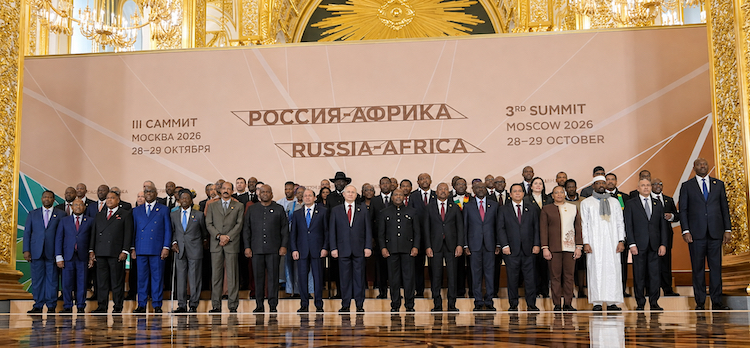
Moscow has widened its political reach, but African governments want investment that creates jobs and reduces dependence as well as grain supplies and security agreements
By Kester Kenn Klomegah*
MOSCOW | 11 November 2026 (IDN) — African delegations came to Moscow for Russia’s third summit with the continent despite Western efforts to isolate the Kremlin. Their presence gave President Vladimir Putin a diplomatic success. The harder question is what African countries will receive from the agreements signed there: financing for factories, dependable electricity and jobs, or another round of promises.
The meeting on 28–29 October produced a cooperation programme for the next three years. But Russia’s political reach still exceeds its commercial presence. African governments can accept Russian offers while continuing to trade, borrow a|nd negotiate with Moscow’s competitors.
Having more partners gives governments alternatives when an offer is too expensive or comes with unacceptable conditions. It does not, by itself, help a local manufacturer obtain credit or a mining community secure a larger share of export earnings. Those gains depend on the terms negotiated and whether they are enforced.
Agreements and their limits
The official summit programme placed trade, technology, energy and human development alongside political cooperation. Delegations from 48 African countries attended. Organisers reported 146 documents signed across the summit and its associated forums, although published accounts differ over how many participating leaders should be counted as heads of state or government.
The document count tells readers how busy the summit was, but not how much new investment it secured. An intergovernmental agreement, a commercial contract and a memorandum expressing an intention to cooperate are different commitments. Combining them into a single total can create an impression of economic progress before financing has been arranged or construction begun.
Comparisons with earlier summits are also difficult. Published agreement counts vary according to which events and types of documents are included. A fuller account would follow the projects announced in 2019 and 2023, identifying those now operating, those still seeking funds and those quietly abandoned.
Egypt’s State Information Service summary lists the principal outcomes as a final declaration, a 2027–2029 action plan and a declaration on civilian artificial intelligence. The economic discussions included industrial cooperation, payment arrangements and greater processing of raw materials within African countries.
The demands are familiar from Africa’s dealings with other foreign partners. African governments have repeatedly been promised that foreign investment will bring technology, skills and manufacturing. Projects that merely extract resources or sell imported equipment may generate revenue without creating the productive capacity those governments seek.
The contracts would tell a more useful story. How much work will local businesses receive? Will jobs last beyond construction? Who pays to repair environmental damage, and where can a government take a dispute? Summit communiqués seldom provide enough detail to answer such questions.
Trade and economic dependence
Russian officials put trade with Africa at approximately $27 billion in 2025 and proposed increasing it to more than $50 billion. That trade matters to the companies and countries involved but remains far below China’s business with the continent.
A January 2026 analysis by Singapore’s NTU-SBF Centre for African Studies put China–Africa trade in 2025 at $348.05 billion. That was almost thirteen times the Russian figure. It also recorded a substantial African trade deficit, showing that a high trade total can coexist with a large imbalance.
Russia has set ambitious targets before. In their 5 November assessment for the Institute for Security Studies, Priyal Singh and Denys Reva note that the target of $40 billion announced at the 2019 summit had not been achieved. They argue that Moscow has nevertheless gained influence through selective commitments, particularly in security, without matching its competitors’ commercial spending.
Attendance in Moscow does not commit a government to following Russia’s lead. Governments can value access to Russian grain, fertilisers, military equipment or specialist technology while maintaining larger economic relationships elsewhere. Their interests differ according to geography, debt, domestic politics and the immediate pressures they face.
Food is one area where Russia has something African importers need. Russian grain can help importing countries meet demand, while fertilisers support agricultural production. Supplies purchased under commercial contracts, however, should be distinguished from donations. Both may matter, but they impose different obligations and serve different purposes.
Imports can prevent shortages without resolving the causes of food insecurity. Conflict, weak transport systems, inadequate storage and a shortage of affordable farm inputs can prevent food from reaching households even when supplies are available internationally. A country may also become more vulnerable if it relies heavily on a small number of suppliers or lacks the foreign exchange to pay them.
The longer-term benefits for agriculture depend on more than the volume of imports. Storage, irrigation, processing and local access to fertilisers can improve domestic production and reduce losses. Investment in those activities would leave farmers better equipped to produce and sell food, reducing the need for repeated imports.
Mining raises much the same question. A mineral concession can yield export revenue while leaving little manufacturing behind. Processing may create more value locally, but requires dependable electricity, transport, skills and access to markets. A promise to process minerals domestically has limited meaning until those conditions and the obligations of investors are specified.
Energy investment and its obligations
At Egypt’s El Dabaa nuclear power plant, cooperation has advanced to construction. Elsewhere, signing an energy agreement may still leave years of negotiations over money, technology and regulation.
Egypt’s Nuclear Power Plants Authority has described El Dabaa as a roughly $30 billion project financed mainly through a $25 billion Russian loan. The loan finances most, rather than all, of the estimated construction cost.
The four reactors will tie Egypt and Russia together long after construction ends. Egypt’s published account of the agreements includes Russian fuel supply, personnel training, assistance with operation and maintenance, and arrangements for storing used fuel.
Egypt stands to gain electricity and trained personnel. It will also have debt to repay and plants to operate safely for decades. The cost to electricity consumers, the independence of the regulator and the ability of Egyptian staff to manage the technology will help determine the project’s value.
Countries with smaller power grids and tighter budgets face additional difficulties. A nuclear cooperation memorandum is an early diplomatic step. It does not establish that a country has selected an affordable reactor, secured financing or developed the institutions necessary to regulate it.
Small modular reactors and floating plants bring their own questions about cost and delivery. Their possible advantages must be compared with their costs and delivery schedules, as well as with alternatives suited to the country concerned. Governments still must establish whether the electricity will be affordable and available when needed.
The purpose of other infrastructure also matters. A port, railway or industrial zone can connect domestic producers to regional markets. It can also function mainly as a corridor carrying unprocessed commodities abroad. The route, ownership structure and businesses served will determine which outcome is more likely.
The African Continental Free Trade Area offers an African framework against which such investments can be assessed. A 2020 World Bank study estimated potential income gains of $450 billion by 2035 under full implementation, with much depending on easier border procedures and lower trade costs. This was a conditional projection, not an achieved gain or a guarantee.
For foreign investors, regional integration changes which projects may be commercially useful. Projects that connect African businesses to neighbouring markets could support industrial development beyond a single bilateral relationship. Separate deals negotiated without regard to regional integration may instead leave countries competing to export similar raw materials to the same external buyers.
Security and sovereignty
Russia’s security relationships carry particular weight because they can produce immediate benefits for governments facing insurgencies or threats to their authority. Arms, training and operational assistance may arrive faster than a factory or an electricity project can be built.
But the interests of an incumbent government and the security of its population are not always identical. A government may become harder to overthrow while villagers remain exposed to violence. Lasting security also depends on forces answering for abuses and national institutions being able to operate without indefinite foreign support.
Describing Russia’s relationship with the Central African Republic as a single exchange of resources for security would require evidence from the underlying contracts. Military assistance, private commercial interests and mineral concessions need to be examined separately before claims about their financial connections can be established.
In the Sahel, allegations of abuses have made that scrutiny particularly urgent. In its 2023 findings on Moura in Mali, the UN Human Rights Office reported strong indications that Malian troops and foreign military personnel killed more than 500 people during a March 2022 operation, most through summary execution. Malian authorities had denied allegations of abuses. The UN’s public briefing did not establish the foreign personnel’s nationality.
The report therefore cannot establish Russian responsibility for those killings. It does show why governments’ accounts of counter-insurgency operations require independent investigation, including access to the communities affected.
Moscow invokes non-interference and the right of African governments to choose their partners. Those principles have considerable appeal in countries with memories of colonial rule and dissatisfaction with subsequent foreign interventions. They do not remove the need to examine how agreements are negotiated or whom they benefit.
Soviet assistance to liberation movements remains part of the relationship’s history. It provides a basis for political goodwill and personal connections among officials educated in Soviet institutions. It cannot by itself establish that a present-day contract offers fair prices, protects workers or strengthens public finances.
The same standard applies to Western, Chinese, Gulf, Turkish and other investors. A partner’s historical narrative is different from the terms of its current engagement. Russia’s criticism of colonial exploitation is relevant to its diplomacy; its commercial practices still require independent examination.
Africa’s room to negotiate
Sovereignty featured prominently in Moscow. In economic affairs, it includes the ability to reject a bad deal or change suppliers without prohibitive costs. A government with several sources of finance may negotiate better terms. It may also accumulate obligations to several creditors without improving its capacity to manage them.
More partners can strengthen a negotiating position only if officials can compare offers, understand long-term liabilities and enforce contracts. Public scrutiny matters because costs may emerge years after the political ceremony, when repayments begin or an agreement restricts future choices.
The African Union became a permanent G20 member in September 2023; membership is no longer an aspiration awaiting Russian support. Its demands concerning the UN Security Council are separate.
The AU’s common position, expressed through the Ezulwini Consensus and Sirte Declaration, seeks at least two permanent African seats with full veto rights, alongside additional non-permanent representation. Support for a greater African presence is diplomatically valuable, but a general declaration does not settle the distribution of seats or the privileges attached to them.
African governments also approach external partnerships from different positions. An established manufacturing economy, a mineral exporter, a country dependent on grain imports and a state experiencing war cannot be expected to have the same priorities. Treating them as a unified bloc obscures the negotiations taking place within Africa as well as those with Moscow.
A published record of the 2027–2029 programme could make progress easier to follow. It would identify funded projects, disclose government guarantees and record contracts awarded to local firms. Readers could then distinguish money committed from money still being sought.
Scholarships and professional exchanges deserve a place in that record. Their value depends partly on whether returning graduates can use their skills, whether qualifications are recognised and whether training supports national plans. Cultural ties may strengthen a relationship, but they should not substitute for evidence about its economic results.
The Moscow meeting confirms that Russia remains a partner many African governments consider worth engaging. It does not establish that Russia has become economically indispensable, nor that participation requires choosing it over other powers.
The summit is over; the negotiations that determine its economic value continue. African firms will gain little from the declarations unless projects receive financing and orders reach local suppliers. Moscow has secured an audience. Whether it can deliver the investment its hosts and guests discussed will become clear in contracts, construction and production.
*Kester Kenn Klomegah focuses on current geopolitical changes, foreign relations, and economic development issues in Africa involving external partners. His well-researched articles are widely reprinted in reputable international media. [IDN-InDepthNews]