
By Jan Servaes
BRUSSELS | 22 November 2026 (IDN) — Arsenic detected in waterways in northern Thailand has prompted authorities to provide clean water to affected communities. Researchers traced some of the contamination to upstream gold mining in Myanmar. Reports of fish with sores in the Mekong have also raised concerns about food safety. Al Jazeera
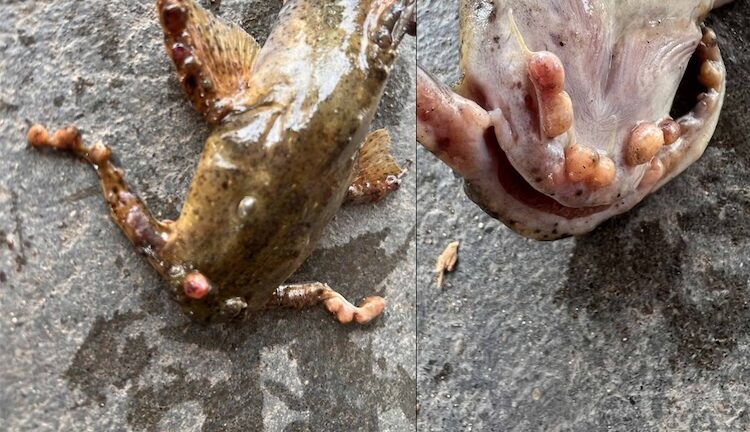
On 16 November, the South China Morning Post reported on fish with visible sores in the Mekong. A few days earlier, environmental activist Aombun Thipsuna—chair of the Association of the Network of Community Organization Councils in the Seven Northeastern Mekong Basin Provinces—shared photos on social media of fish known locally as “pla khae,” which the local population has dubbed “zombie fish.” She told the Thai alternative news outlet Ejan that, since the onset of the COVID-19 pandemic, fishermen have increasingly encountered fish with such deformities.
According to Aombun, the “pla khae” can reach weights of up to 60 kg. As the fish is widely consumed in Thailand, this raises the risk of heavy metals entering the human food chain.
Data from the regional office of the Pollution Control Department in Udon Thani province—which has been conducting measurements in the river since 2023—indicate that concentrations of heavy metals have risen sharply since 2024. In August of this year, arsenic levels in Loei and Nong Khai provinces reached three to four times the Thai standard for surface water, which is set at 0.01 mg per liter.
Aombun and various environmental organizations suggest that the deformities in the fish may be caused by contamination from arsenic and other heavy metals (such as lead, mercury, and cadmium). Researchers traced much of the arsenic-bearing sediment in the Sai River to gold mining in Myanmar. The cause of the fish deformities remains unresolved.
According to findings released by the Department of Groundwater Resources (DGR), nine out of 133 groundwater samples collected in 2026 in the provinces of Chiang Mai and Chiang Rai contained arsenic levels exceeding the standard limit of 0.01 milligrams per liter. In November, Thai officials found arsenic in untreated water from the Sai River at 25 times the drinking-water limit. At a local waterworks in Mae Sai, the level reached 30 times the limit. These rivers flow from areas in Shan State (Myanmar) where gold and rare-earth element mining activities take place.
On November 19, The Nation reported that 17 residents of Nong Khai were referred for further health screenings after tests showed that the arsenic levels in their urine exceeded the reference threshold of 100 micrograms per liter.
Arsenic in drinking water
Arsenic is an element that occurs naturally in minerals and sediments within the soil and rock layers. Its presence in water poses a serious risk; while it can occur naturally in groundwater, it also enters water sources through industrial processes and agriculture. It is tasteless, odorless, and invisible. Standard boiling or chlorination is ineffective; specialized filtration systems—such as reverse osmosis, ion exchange, or adsorption filters—are required.
Changes in underground geochemical conditions can cause these minerals to dissolve, releasing arsenic into the groundwater. Contaminated surface water can also seep through the soil into shallow aquifers, which require special monitoring because communities often rely on wells drilled to these depths.
The World Health Organization sets a provisional guideline of 10 micrograms per litre for arsenic in drinking water. Long-term exposure to inorganic arsenic increases the risk of skin, bladder and lung cancer, among other health effects. Acute poisoning can cause vomiting, abdominal pain and diarrhoea.
Rare earth mining in Myanmar
Myanmar has become one of the world’s largest producers of rare earth elements. Between 2017 and 2024, the country exported more than 290,000 tons of rare earth elements to China, valued at over 4.2 billion US dollars. Nearly 85% of that value was generated following the military coup in February 2021. The US Geological Survey estimates that Myanmar mined the equivalent of 22,000 metric tonnes of rare earth oxides in 2025.
Mining operations are concentrated in Kachin State (within the Pangwa, Chipwi, and Momauk townships) and are expanding into Shan State, where the United Wa State Army controls activities near the Chinese border. In Kachin State alone, nearly 400 mining sites are currently active—an increase of 194% since the military coup of February 1, 2021.
The Armed Conflict Location and Event Data Project ranks Myanmar second, after Palestine, in its global Conflict Index, with more than 58,000 recorded violent incidents since 2020.
Regulatory oversight is limited, in part because different armed groups control or contest the mining areas.
In late 2024, the Kachin Independence Army captured the key Pangwa–Chipwi mining zone from militias affiliated with the junta, while other armed organizations control mining areas elsewhere.
Revenues from rare earth elements have become a significant source of funding for armed groups on all sides of the conflict, creating incentives that work against regulation.
China’s role in processing
The US Geological Survey estimates that China mined the equivalent of 270,000 metric tonnes of rare earth oxides in 2025, about 60 per cent of global production. Producers without access to separation facilities depend on processors, many of them in China. Australia’s Lynas Rare Earths is among the companies with both mining and processing capacity outside China.
Thailand as a transit hub
Thai companies—as well as joint ventures between Thai and Myanmar entities, and between Thai and Chinese entities—import minerals from across the Thai-Myanmar border.
In particular, Thai firms bring in antimony, tin, tungsten, manganese, copper, and lead from the border region, subsequently transporting them to the Laem Chabang container port near Chonburi for shipment to China. This means that private Thai companies play a pivotal role in the import and export of critical minerals.
Consequences for food and agriculture
According to Dr. Suebsakul Kitnukorn, a lecturer in international development at the School of Social Innovation at Mae Fah Luang University, Thailand risks losing over 20,000 hectares of rice-growing land unless the government provides alternative irrigation water and remediates the contaminated soil. He points to agricultural land located in the river basins of the Kok, Sai, and Ruak rivers. In these areas, the continued use of polluted water could lead to an accumulation of heavy metals, eventually rendering the soil unsuitable for farming.
In an interview with Mizzima, he criticized the Ministry of Agriculture and Cooperatives for its lack of coordinated policy, action plans, and funding to address the agricultural impact.
“If farmers continue to use polluted water to irrigate their fields on a daily basis, heavy metals may accumulate in the soil until the land can no longer support agricultural production,” he argues.
Suebsakul pointed to tests conducted between December 2025 and May 2026. These revealed that concentrations of arsenic, lead, or cadmium in 24 crop varieties grown in the subdistricts of Tha Ton and Mae Na Wang (Mae Ai District, Chiang Mai Province) exceeded food safety standards.
The affected crops include cucumbers, Thai round eggplants, mangoes, garlic, Japanese sweet potatoes, passion fruit, sweet corn, small chili peppers, and spring onions.
Suebsakul advocates for the establishment of a committee comprising representatives from government agencies, academia, civil society, farmers, and consumer organizations.
A five-year plan should address the following areas: monitoring contamination in soil, water, crops, and aquatic life; pre-harvest inspections; compensation for farmers; soil remediation; alternative water supplies; and the coordination of budgets and operations across the relevant agencies.
Establishing testing centers in Chiang Rai and Chiang Mai would reduce reliance on centralized laboratories. Furthermore, the disclosure of test results is essential for restoring public trust, he argued.
Responses from China and Thailand
Following protests held in front of the Chinese Embassy in Bangkok in July, the embassy stated that the matter should be investigated based on facts, scientific evidence, and accountability, in order to identify the source of the contamination.
China has indicated its support for closer coordination between Thailand and Myanmar, and urged the two countries to launch a joint investigation.
The embassy adds that protecting the ecosystem of the Mekong River basin is a common interest and a shared responsibility of all nations in the region. Therefore, China has expressed its willingness to strengthen cooperation with other Mekong basin countries regarding water management and environmental conservation, with the aim of contributing to the ecological security of the river basin.
Following a cabinet meeting on November 17, Transport Minister Phiphat Ratchakitprakarn, who chaired the meeting in Prime Minister Anutin’s absence, instructed government agencies to provide clean water to communities affected by toxic pollution in Northern Thailand, specifically in Chiang Rai. Thailand has offered its expertise to Myanmar to help contain the pollution in the Kok and Sai rivers. It was not specified how quickly this plan would be implemented. [IDN-InDepthNews]