By David L. Phillips*
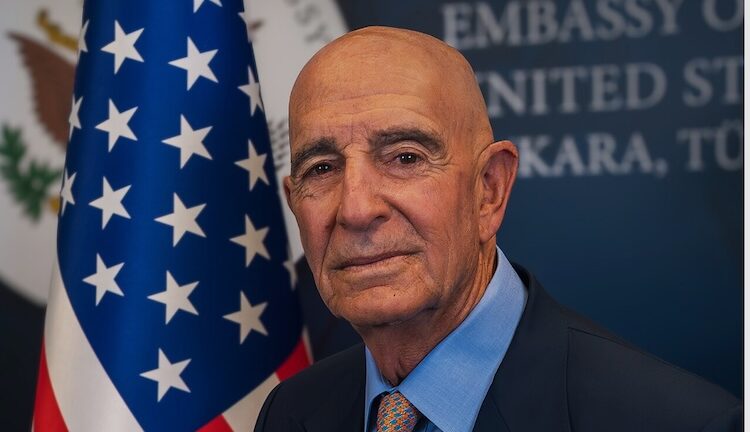
OXFORD, UK | 20 November 2026 (IDN) — Tom Barrack’s handling of U.S. policy towards Syria deserves congressional scrutiny. So do reports that he advocated a role for a business associate’s firm in a major regional oil pipeline project. The House Foreign Affairs Committee should examine whether his diplomatic responsibilities and private business relationships were adequately separated.
An investigation should establish the facts without assuming its conclusion. Questions about impartiality deserve examination even where personal financial gain has not been demonstrated.
The pipeline questions
Reuters reported in October that Barrack promoted TI Capital, founded by his business partner Ziad Ghandour, for the Kirkuk–Baniyas pipeline project. Barrack disclosed a stake in ACD-TI Oakley Investment LLC, a separate property venture managed by TI Capital. Reuters found no evidence that he would profit from the pipeline. The State Department denied that he had a financial interest or role in the project and said he complied with ethics rules. (www.jpost.com
These distinctions matter. A business relationship does not by itself prove misconduct. But neither does the absence of demonstrated personal profit settle every question about an official’s impartiality.
Former White House ethics lawyer Richard Painter described the reported advocacy as “a serious problem” and recommended recusal. His concern centred on participation in a matter involving a business associate, rather than an established financial return from the pipeline itself. University of Minnesota Law School
Congress should establish what role Barrack played, what interests he disclosed and what advice he received from ethics officials. It should also examine whether any authorisation permitted his participation. Barrack and the State Department should have the opportunity to explain their decisions and provide the relevant records.
Diplomacy and private relationships
Promoting investment can be a legitimate diplomatic objective. Syria’s reconstruction and Iraq’s access to export routes are subjects on which American officials can reasonably engage.
The difficulty arises when an official promotes a firm connected to an existing business associate. Public confidence depends on knowing why that firm was advanced, how alternatives were considered and whether the official’s relationships affected the process.
Barrack’s closeness to President Donald Trump makes independent scrutiny particularly important. Access to the president may give an envoy influence, but it cannot substitute for accountability. Congress should be able to distinguish decisions taken to advance U.S. policy from those that might favour private commercial relationships.
The Kurdish question
The pipeline controversy is separate from, but accompanies, a broader question about Washington’s policy towards Syria’s Kurds.
The Kurdish-led Syrian Democratic Forces were a major American partner in the campaign against Islamic State. That partnership creates a responsibility to consider the security and political rights of the communities whose fighters carried much of the burden.
On 10 March 2025, Syrian President Ahmed al-Sharaa and SDF commander Mazloum Abdi signed an agreement providing for the integration of SDF-controlled civilian and military institutions into the Syrian state. Barrack subsequently participated in efforts to implement that agreement. The chronology does not establish that he brokered the original accord. www.reuters.com
Supporting Syria’s territorial integrity is a defensible policy. It does not, however, answer how power should be exercised within its borders. National unity and meaningful protection for Kurdish political and cultural rights should not be treated as incompatible objectives.
Promises and protection
Syria’s transition has been marked by violence and serious doubts about the protection of minority communities. The Congressional Research Service has documented both concerns about the transitional authorities’ conduct and the competing arguments that fragmentation could threaten regional security. EveryCRSReport.com
American policy must contend with those difficulties. Engagement with Damascus may be necessary, but engagement should include scrutiny of its conduct. Commitments to inclusion have little value unless they affect the treatment of people on the ground.
The same applies to arrangements for integrating the SDF. An agreement should be judged by whether it provides credible security, political participation and protection against retaliation—not simply by whether signatures have been obtained.
A case for oversight
Congress should examine both the reported commercial advocacy and the consequences of Washington’s diplomatic choices. These are distinct lines of inquiry: one concerns official impartiality; the other concerns the treatment of a longstanding American partner.
Neither inquiry requires unsupported allegations about personal enrichment, motives or patriotism. Both require documents, testimony and clear answers.
The Kurds have reason to judge Washington by what it does when their interests become inconvenient. If American commitments offer little protection at that point, future partners will take notice.
Barrack’s conduct warrants scrutiny. A congressional investigation would give him an opportunity to answer the concerns and give the public a firmer basis for judging whether U.S. diplomacy served the public interest.
*David L. Phillips is an Academic Visitor at Oxford University. He worked on Kurdish issues as a Senior Adviser to the Bureau of Near Eastern Affairs at the U.S. State Department.
Editor’s Note: The views expressed in this article are those of the author and do not necessarily reflect the editorial position of IDN-InDepthNews.