
By Benoit Lannoo*
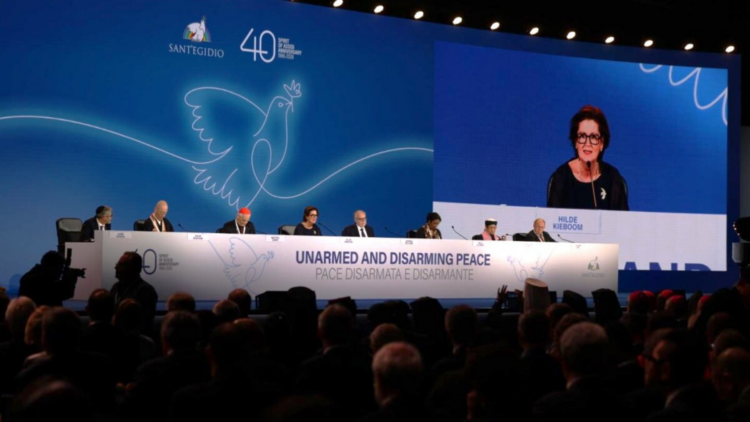
ASSISI. Italy | 27 October 2026 (IDN) — Today, it has been exactly forty years since John Paul II brought together different religions in Assisi for the first time for an interreligious prayer for peace.
In his recently published book (in Italian, French and German) entitled Assisi – The Origins of a Spiritual Globalization, the Roman historian Andrea Riccardi, founder of the Community of Sant’Egidio, points out that even the “iconographic material of Assisi 1986” remains important. He is referring to the emblematic photo of St. Pope John Paul II surrounded by the Dalai Lama and a large number of other leaders of Churches and religions, sitting next to each other on small chairs all of the same size in the square in front of the lower basilica of St. Francis in Assisi. They had just prayed for peace at the same time but all in their tradition and customs.
Alas, for today’s closing ceremony of the 40th Meeting in the spirit of Assisi, the current pope will not be physically present since the doctors have advised him not to travel by helicopter. But Leo XIV will send a message to the festive assembly.
Revaluation of war
The theme for this 40th meeting of interreligious dialogue and prayer for peace is: “A disarmed and disarming peace”. Pope Leo used this expression in his first appearance at the loggia of St. Peter’s Basilica on May 8, 2025, and he repeated it in his message for the World Day of Peace on January 1. After last Sunday’s Angelus, the Pope spoke of the current meeting in Assisi: “Never has it been so obvious that wars not only sow death and destruction but also impoverish and damage the world,” the Pontiff remarked. But in the meantime, “we are witnessing an increase in the number of conflicts,” said Andrea Riccardi Sunday in his opening address to the assembly in Assisi, “as well as a certain revaluation – both ideologically and practically – of war as an instrument in international politics.”
During Sunday’s opening ceremony, the French orientalist and political scientist Olivier Roy once again demonstrated why he is reputed to be one of the leading geopolitical analysts of our time. “These meetings in the spirit of Assisi have often been criticized for dodging the question of truth behind a false unanimity of values,” he said. “Indeed, religions, starting of course with the great monotheistic religions, ask the question of truth, and this is non-negotiable. They defend a dogma – the truth; they defend a community. But suffering in this world knows no dogmas. It is its own truth, a negative truth.”
Regulating war
“The twentieth century, a century of world wars, understood the problem,” according to Roy. “As all war takes place in a global context, it seemed necessary to set up international bodies capable of making peace, or at least capable of regulating war, proposing arbitration, supervising negotiations, and stating the law above the fray. This is how the League of Nations was created, followed by the UN with its specialized agencies, such as the UNHCR, the International Criminal Court, et cetera. It was also in this framework that the European Union has been built.”
Especially since the dissolution of the Soviet Union, “the idea was that political liberalism could and should, in contrast to totalitarian ideologies, set up a kind of perpetual peace on a planetary scale. Western interventions from the Balkans to Iraq and Afghanistan were conducted in the very name of the expansion of liberalism and democracy, which have become the ‘seal of history’. But this ‘armed peace’ was a failure. And it was followed by the very crisis of the institutions that advocated this peace.’
A disarmed peace
It is indeed clear that the consensual discourse on ‘the end of history’ is bankrupt and above all, the failure of the institutions that were supposed to embody it. “Political liberalism is in crisis both at the international level and at the level of states,” Roy observed. “The very idea of a rational international order working for peace is disappearing before our eyes. It is the very idea that the goal of ‘good politics’ is peace and not simply the submission or destruction of the other.”
There no longer seems to be a moral pole above conflicts. “There is a void of speech on peace. There is a vacuum in the will to make peace. Peace is no longer an institutional project. Peace is disarmed,” Roy exclaimed.
Religions must speak out
“And this is where religions can play a role,” according to Roy. “They can fill this void of the word of peace by asserting themselves as a pole of ethical opposition to violence and war, by asserting themselves as a moral counterweight to the cynicism and assumed aggressiveness of political leaders. As warmongers often claim to be religionists, religion no longer has a choice: it is necessary to speak out. Faced with the disappearance of international institutions, religions can speak out, they can in turn be a beacon for all those who are victims of violence and who no longer have ‘protectors’ (states, political parties, institutions, et cetera). And this word counts!”
But Roy is too astute an analyst not to realize that his analysis opens new problems. “First, by speaking out, the ‘Churches’ become or become again political or strategic issues, as we have seen with the American reaction to the pope’s positions challenging the notion of a ‘just war.’ Secondly, an ethical position must not be conditioned on a dogmatic truth. It is necessary to assume a common ethical language that also respects the diversity of beliefs. It is not a question of establishing a catalogue of shared values as a prerequisite for a new moral coalition but of defining an ‘ethical posture,’ a requirement to speak of values, in a word a rejection of … the rejection of values. It is a question of defending the principle of human dignity, without necessarily reducing it to a list of norms based on a dogmatic vision of what human nature would be.”
Form a broad front
The third difficulty is that we must avoid establishing a ‘new consensus.’ “We must know how to speak here to non-believers and avoid presenting religion as a political alternative. We must be wary of the theme of the return of religion. There is certainly a growing demand for spirituality, but it can also go hand in hand with ideological outbursts in which religion is instrumentalised. Perfectly legitimate missionary activity must not be confused with ethical protest. For it is precisely necessary to establish a broad front of all peace resisters.”
The international order can be replaced by an order conducted by ‘the grassroots.’ “Today, peace resisters are mostly outside institutions and political parties. To understand this, we must consider all the microphenomena of resistance to war and violence. Individual initiatives, efforts to find meaning and solidarity locally amid ruins, unknown heroes, and anonymous volunteers. The motivations are diverse: they can be religious commitment but also simple ethical posture. This ethical posture, this protest against moral indifference and cynicism, can unite all people of good will for peace.”
And Roy concluded: “This is why we are in Assisi.”
*Benoit Lannoo is Church Historian committed since decades in Interreligious Dialogue