
By Dr. Asoka Bandarage*
COLOMBO. Sri Lanka | 27 October 2026 (IDN) — Buddhism was first introduced to Sri Lanka in Anuradhapura in the 3rd century BCE by Arahant Mahinda, the son of the Indian Emperor Asoka. For nearly 1500 years, Anuradhapura remained Sri Lanka’s capital and the intellectual and spiritual centre of Theravada Buddhism in Asia. The Anuradhapura civilisation achieved unmatched advances in architecture, engineering and urban planning, still evident in its monumental stupas, monasteries, palaces and sophisticated hydraulic and agricultural systems.
Buddhism was gradually assimilated into Hinduism and had disappeared from India by the 12th century CE. The Chola invasion from India and the sacking and conquest in 1017 CE dealt a heavy blow to Buddhist civilisation, ending Anuradhapura’s role as the island’s political capital. The sacred city has continued to face attacks, including the LTTE massacre of 146 devotees at the Sri Maha Bodhi on Vesak full moon, 14 May 1985. Yet Anuradhapura has survived as one of the world’s oldest continuously inhabited cities and as a sacred site that has attracted Buddhist pilgrims over the centuries.
In the late 19th century, British colonial authorities initiated archaeological surveys and restoration projects in Anuradhapura, with the assistance of Sri Lankan Buddhist monks such as Ven. Naranwita Sumanasara. In the spirit of the 1964 Venice Charter, which emphasises preserving cultural heritage in historical conservation, UNESCO designated Anuradhapura a World Heritage Site in 1982, recognising it as a sacred city and “a living testament to its outstanding universal value and cultural legacy.”
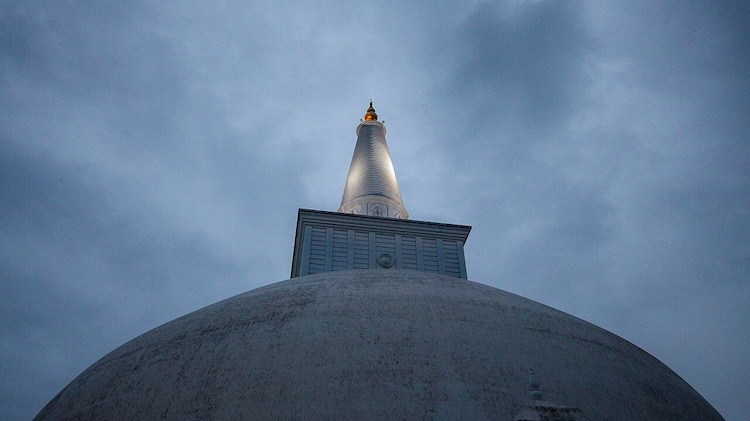
Anuradhapura is a vibrant Buddhist pilgrimage site today, home to extensive sites including the famous Samadhi Buddha statue that former Indian Prime Minister Jawaharlal Nehru described as a representation of the Buddha’s message of peace and tranquillity in a world ridden with conflict. Anuradhapura is also the home to the Eight Sacred Sites, known as the Atamasthana. These include the Sri Maha Bodhi, considered the oldest tree in the world and the direct descendant of the original Bodhi tree under which the Buddha attained enlightenment, and the magnificent Ruwanweli Maha Saya (Great Stupa), which enshrines Buddha relics and was built by King Dutugemunu following his defeat of a Chola invader, King Elara, around 161 BCE.
Development of Anuradhapura
As the number of pilgrims and tourists visiting Anuradhapura continues to grow, essential services need significant improvement. These include clean, accessible public toilets; drinking water and rest areas; waste collection and sanitation; transportation; and accommodation.
In 2021, during the previous Sri Lankan government’s tenure, the Urban Development Authority (UDA) published a detailed Anuradhapura Urban Area Development Plan, 2021–2030, based on the vision of the city as “the Buddhist Heritage Capital of the World.” The 2021 plan committed to a “participatory planning approach” involving citizens and active working parties in the private and institutional sectors.
Following the change of government in 2024, a new Updated Anuradhapura Sacred Area Development Plan was gazetted by the current Sri Lankan government on 27 February 2026. The plan came to light only after media outlets reported that it had been submitted to the Indian Embassy in Colombo on 1 October 2026.
A Debate Over “Living Heritage”
The 2026 Development Plan has raised considerable alarm in the country because it fails to recognise Anuradhapura as a place of ongoing worship, involving daily rituals, offerings, chanting and meditation by thousands of devoted pilgrims. In an interview published in Times of Lanka on October 22, 2026, archaeologist and heritage-management specialist Dr Gamini Wijesuriya points out that the Plan approaches Anuradhapura as a “static archaeological park or a tourist reserve,” rather than as a “living heritage site” with “Outstanding Universal Value,” as designated by UNESCO.
Item 5.1 of the 2026 Plan proposes erecting a security fence around the Ruwanwelisaya, along with six physical entrance checkpoints or gates to the sacred area. Dr Wijesuriya and other analysts fear this would turn “sacred movement into a bureaucratized inspection line,” creating “physical and emotional barriers between pilgrims, monks, and the sacred stupas”, and undermining Anuradhapura’s historically open, welcoming, and peaceful character.
Schedule 02 of the 2026 Plan legalises commercial activities within sensitive areas, permitting commercial guest houses, retail shops, vehicle-repair garages and cattle sheds. This would destroy the sacred city’s quiet, contemplative atmosphere. Revealing its lack of understanding of “living heritage,” item 2.4 of the Plan mandates removing and relocating long-term residents and traditional local families, including hereditary temple caretakers and service communities living in areas designated as “sensitive.” Prioritising commercial and tourist expansion threatens Anuradhapura’s continued role as the foremost place of worship for local Buddhists.
The 2026 Development Plan seeks to expand the Anuradhapura development zone from approximately 20 square kilometres to 38 square kilometres, incorporating “more sacred shrines and places of archaeological value in the new extended sacred ground area.” The leader of the Patriotic National Movement, Dr Wasantha Bandara, has pointed out that this would allow two Hindu shrines within the expanded Anuradhapura sacred area to be included in the development plans. While this would reflect the current Sri Lankan government’s approach of multi-faith inclusivity, it would undermine Anuradhapura’s uniquely Buddhist identity. This concern must be understood in the broader historical context of Indo-Sri Lankan relations and contemporary geopolitical rivalry.
Historical and Geopolitical Context
The Government of India will fund the Anuradhapura Sacred City Development Plan, costing Rs 7.7 billion. When Indian Prime Minister Narendra Modi visited Anuradhapura during an official visit in April 2025, he agreed to assist with a Sacred City development project. The gazetted Plan was therefore submitted to the Indian Embassy in Colombo on 1 October 2026 without adequate consultation with the Buddhist monks of the Atamasthana or other local stakeholders. In a great hurry to receive Indian funding, the Sri Lankan President is seeking to expedite the project, with work due to begin before the end of 2026.
Despite its extensive influence over Sri Lanka and claims to support Buddhism, India has not taken meaningful steps to protect Buddhist temples and archaeological sites in Sri Lanka’s north and east from attacks by ethno-religious separatist groups. Instead, India under Prime Minister Modi appears focused on advancing the concepts of Akhand Bharat (Undivided India) and Hindu Rashtra (Hindu Nation), which would incorporate neighbouring countries such as Sri Lanka into a “Greater India.”
The Ramayana Trail in Sri Lanka, associated with the Ramayana, is based on myth and lacks historical evidence. Yet this tourist venture, initiated by the large neighbouring country and planning to develop fifty Ramayana landmarks and shrines across Sri Lanka, poses a serious threat to Sri Lanka’s Buddhist identity. The proposed development of Hindu shrines in Anuradhapura, mentioned earlier as part of the Ramayana Trail, could bring a massive influx of Indian Hindu tourists and religious practices, overwhelming the sacred city’s Buddhist atmosphere. Sri Lanka’s Buddhist sites, including Anuradhapura, have always been open and welcoming to visitors of all faiths. However, deliberate efforts to undermine Buddhist heritage will only deepen the historical struggle to protect the Buddhist identity of Sri Lanka, and of Anuradhapura in particular.
India’s involvement in Sri Lanka’s domestic affairs, including the development of the Anuradhapura sacred city, extends far beyond culture and identity. India has wielded political and military power over Sri Lanka in both the pre-colonial and post-colonial eras. Yet, in the period immediately following the 2022 economic crisis, India has become a virtual colonising power over Sri Lanka, which has sacrificed its sovereignty by succumbing to political pressure and economic handouts from India.
According to reports in the Indian media, during Prime Minister Modi’s visit to Sri Lanka from 4 to 6 April 2025, seven to ten agreements were signed to strengthen ties in defence, electricity-grid interconnection, a multi-product petroleum pipeline, digital transformation and pharmacopoeial practices. The agreements were signed using the Sri Lankan President’s powers, without debate or approval by the Sri Lankan Parliament. The agreements are so shrouded in secrecy that neither the Sri Lankan public nor the media knows how many pacts were made, what their full contents are, or whether the documents signed are legally binding agreements or merely memoranda of understanding (MOUs), which can be revoked.
The five-year Indo-Lanka Defence Cooperation Agreement is intended to ensure that Sri Lankan territory will not be used in any way that could threaten India’s national security interests. It formally guarantees that Sri Lanka will not allow any third power to use its soil against India.
India is a member of the Quadrilateral Security Dialogue (QUAD), a strategic alliance against Chinese expansion that includes the United States, Australia and Japan. Sri Lankan analysts worry that the defence agreement with India creates a real risk of Sri Lanka being drawn into the QUAD through the back door as a subordinate of India. The United States and its QUAD partner India, as well as China and other powerful countries, want control over Sri Lanka because of its strategic location on the Indian Ocean’s maritime trade routes.
Sovereignty, Identity and Resistance
What we see today is not the emergence of a truly multipolar and just international order, but continued imperialist expansion, aided by local collaboration and prioritising short-term profit and self-interest over collective welfare. This leads to environmental, social and cultural destruction. Efforts to undermine the Buddhist identity of the sacred city of Anuradhapura are part of a broader effort to weaken Sinhala Buddhist national identity, consciousness and political power.
Breaking free from relations of domination and subordination requires fundamentally asserting local economic, political and cultural sovereignty. It calls on people everywhere to wake up, stand up for their rights, speak up and uplift one another through non-violent resistance. People in Sri Lanka who are rising to protect their culture and the sacred city of Anuradhapura are doing just that.
* DrAsoka Bandarage has served on the faculties of Brandeis, Mount Holyoke and Georgetown and is the author of books including Colonialism in Sri Lanka; The Separatist Conflict in Sri Lanka, Sustainability and Well-Being: The Middle Path to Environment, Society and the Economy, Crisis in Sri Lanka and the World and numerous other publications on global political economy and related subjects.www.bandarage.com
Editor’s Note: This article is published as opinion. The views and interpretations expressed are those of the author and do not necessarily reflect the editorial position of IDN-InDepthNews.