
Jewish Mysticism and the Politics of Emancipation
By Sam Ben-Meir*
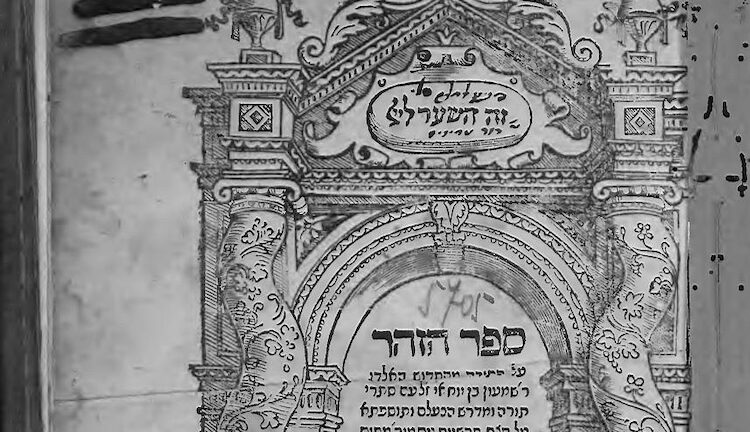
NEW YORK | 30 October 2026 (IDN) — What if the world we hope for is not somewhere in the distant future? What if, in some strange sense, it already exists? This is one possibility opened by the Zohar, the great masterpiece of Jewish mysticism.
Composed in medieval Spain and written largely as a mystical commentary on the Torah, the Zohar would seem an unlikely place to look for radical political ideas. It speaks of God, creation, the soul, good and evil, Scripture’s mysteries, and the hidden structure of reality. It is a profoundly religious work and, in many respects, a profoundly conservative one.
It would therefore be absurd to claim that the Zohar is secretly a work of modern political anarchism. It is nothing of the sort. But that does not mean it has nothing to say to us politically. On the contrary, the Zohar offers a conception of reality that may have surprisingly radical implications: a world that remains unfinished, in which God and humanity are intimately intertwined, in which what happens below affects what happens above, and in which redemption cannot simply be imposed upon the world from somewhere outside it.
What follows is a preliminary exploration of a much larger possibility: that the Zohar can be read as a resource for emancipatory thought, not despite its mystical character but through it. Such a reading would not seek to extract a political doctrine from a medieval religious text, still less to disguise its hierarchical and conservative commitments. It would ask instead whether the Zohar’s understanding of creation, divine life, human becoming, and the relations between worlds might help us imagine forms of freedom that modern political thought has struggled to articulate. The aim is not to discover anarchism already present in the Zohar, but to bring its mystical vision into a critical encounter with the emancipatory possibilities of our own time.
The World That Is Coming
The Zohar’s political possibilities begin, perhaps, with its strange conception of the “world to come.” In a passage near the beginning of the Zohar, beautifully rendered by Daniel Matt in the first volume of the Pritzker edition, the text comments on the words from the Song of Songs, “The blossoms have appeared on the earth.” The Zohar identifies the blossoms with the patriarchs Abraham, Isaac, and Jacob, who existed within the divine mind before entering the created world. They are associated with three of the sefirot, the divine powers or emanations through which the infinite becomes manifest.
The Zohar connects this discussion with olam ha-ba, literally “the world that is coming.” We commonly think of the world to come as the hereafter: another world that begins when this one ends. But the mystical conception is stranger. The world to come is not simply a future reality waiting somewhere at the end of chronological time. In some sense it already is. For us it remains “to come,” but its reality does not depend upon its arriving at some future date.
Suppose we take that idea seriously as a political idea. Every radical politics confronts the accusation that it is utopian. The world it seeks—a world without exploitation, domination and degrading inequality—is dismissed precisely because it does not yet exist. We are told to be realistic: human beings are selfish; hierarchy is inevitable; capitalism may have its problems, but no viable alternative exists. The world we have becomes the measure of every world that could possibly be.
The Zohar suggests another way of thinking about possibility. The world to come need not be a fantasy simply because it is not yet actual. The possibilities of another world may already inhabit this one, concealed beneath forms of life that prevent them from becoming visible. Emancipation, in that sense, does not create its possibility out of nothing. It actualises possibilities already immanent within a world whose existing form has concealed them. The analogy is not between divine reality and some ideal political order, but between two ways of understanding the relation of possibility to actuality. What is already real within the Zohar’s mystical vision becomes, in the political register, a way of thinking about possibilities that remain unrealised without being merely imaginary. This is where Jewish mysticism begins to approach politics.
Jerusalem Above and Jerusalem Below
One fundamental idea of Kabbalah is that what human beings do here below affects what occurs in the divine world above. Human beings are not merely spectators before a completed God and a completed creation. Their actions participate in the drama of creation itself.
The Zohar expresses this idea with extraordinary force in its discussion of Jerusalem. God addresses the earthly Jerusalem in its desolation and declares, in effect, that just as the people do not enter Jerusalem below, God will not enter Jerusalem above. Elsewhere the Zohar speaks of a heavenly Jerusalem corresponding to the earthly one. The divine presence will not enter the former until the latter has been rebuilt.
The theological implications are startling. We ordinarily imagine God as complete and self-sufficient, standing above history: the world may need God, but God certainly does not need the world. The Zohar complicates that picture. Something remains incomplete above because something remains incomplete below. Human action affects divine life. In some sense, God has turned responsibility over to us.
This does not mean that the authors of the Zohar intended “earthly Jerusalem” to signify a modern egalitarian society. To read them that way would be an obvious anachronism. But we can ask what happens if we take earthly Jerusalem as the figure of a reconciled human community. The result is a remarkable political theology. Redemption cannot simply descend from above. The world cannot be repaired by the unilateral exercise of sovereign power—even divine sovereign power. Something must happen here, among us, within the relations through which human beings constitute their common world. God cannot simply be conceived as complete and external to the becoming of the world. Reality is unfinished. So, perhaps, is God.
A distinction is necessary here between Ein Sof, the infinite and ultimately unknowable divine reality, and the sefirot, the dynamic powers through which divinity becomes manifest. Ein Sof is not incomplete or dependent on human action; rather, the unfolding life of the sefirot can be disrupted or restored by what happens in the human world. Divine incompleteness, in this sense, does not signify a deficiency in the infinite itself, but an unfinished process of manifestation and reconciliation.
Revolution and Tradition
None of this makes the Zohar a politically progressive book in the contemporary sense. Quite the contrary. It can be extraordinarily severe. Its sexual morality in particular can strike the modern reader as deeply conservative. Masturbation is compared with murder and associated with demonic forces; sexual relations are governed by strict religious prohibitions. We should not hide such passages in order to manufacture a politically convenient Zohar. But neither should we assume that revolutionary thought must discard everything inherited from tradition.
Here the German-Jewish anarchist Gustav Landauer becomes an indispensable interlocutor. Landauer, murdered in 1919 during the suppression of the Bavarian Soviet Republic, developed an anarchism quite different from the caricature of anarchism as the destruction of every institution and inherited form. He insisted that human beings need forms of association and traditions that bind them together. “We need form, not formlessness,” he wrote. “We need tradition.”
In his Paths in Utopia (1949), Martin Buber observed that Landauer had described Walt Whitman as combining seemingly contrary impulses: the conservative and the revolutionary, individualism and socialism. Buber suggested the same could be said of Landauer himself. A useful idea emerges here: revolutionary conservation. Revolution need not mean erasing the past and beginning again from zero. It can mean distinguishing between those inherited forms that sustain domination and those capable of nourishing freer forms of life. The latter are not merely preserved. They are recovered, transformed and made to live differently.
Such a conception also describes how we might read the Zohar today. We need neither submit to everything it teaches nor dismiss it as an artefact of medieval religion. Instead, we can ask what possibilities remain buried within it—what still lives, though it may appear dead.
The Unfinished Human Being
The Zohar’s conception of the human soul provides one answer. It distinguishes three principal dimensions of the soul: nefesh, ruaḥ, and neshamah. Nefesh, the life-force, is the lowest. Ruaḥ, spirit, represents a higher level. Neshamah, associated with divine breath, is higher still. What matters is that these are not simply three faculties that every person possesses in precisely the same way from birth. In the Zohar, the higher dimensions of the soul represent possibilities of spiritual development. The ordinary human being is not the finished human being.
The historian of Jewish mysticism Gershom Scholem emphasised this distinctive feature of Kabbalistic psychology. Medieval thinkers could draw upon older tripartite theories of the soul, including Platonic ones, but the Kabbalists transformed them. The higher levels of the soul become states attained through spiritual and moral development.
Of course, there is tension here. The Zohar conceives spiritual development hierarchically, whereas an emancipatory politics seeks to overcome relations of domination. But the political significance of this conception need not lie in its hierarchy. It lies instead in the understanding that human beings are not fixed or complete beings, but can become something other than what they presently are. What the mystical tradition understands as spiritual ascent can thus be reinterpreted politically as the transformation of human capacities through new forms of collective life.
This conception of human becoming has consequences that extend beyond the spiritual domain. Emancipation cannot consist merely in rearranging institutions while leaving unchanged the people who continually reproduce those institutions. If human beings are unfinished, then transforming society must also involve transforming the capacities, habits, and relationships through which human beings constitute their common world.
Here the connection with Landauer becomes especially illuminating. Landauer’s most famous political insight was that the state is not simply a thing—a gigantic machine standing outside us and imposing itself upon us. The state is also a relationship, a particular way in which human beings behave toward one another. This changes the meaning of revolution.
If the state were simply a building, an army, a parliament or a collection of bureaucratic offices, revolution might consist in capturing or destroying those things. But if the state also exists in our relations with one another, then abolishing institutions while preserving the forms of human behaviour that sustained them will merely reproduce domination under another name.
For Landauer, however, revolution is not merely a matter of dismantling existing relations. It also involves creating new ones. The task is not to wait until the state has been overthrown to begin building a different society, but to establish forms of communal life, cooperation, and mutual responsibility within the world as it exists. The new society must begin to take shape in the midst of the old, not as an ideal imposed upon reality from without, but as a possibility brought into existence through the transformation of everyday relations. In this sense, revolution is not simply an event that will occur at some future moment. It is a process already underway wherever human beings begin to live together differently.
This is also where Landauer’s thought approaches the anarcho-communist tradition, which envisions not merely abolishing the state but overcoming capitalist property relations through common ownership, voluntary association, and mutual aid. Political freedom cannot be secured while the material conditions of life remain organised through exploitation and economic dependence. The transformation of society must therefore extend to production, distribution, and everyday life. Freedom is not simply something individuals possess independently of one another; it is something they make possible together.
But this raises a difficult question: How can people whose desires and habits have been shaped by domination create a society that is not itself dominating? No institutional blueprint can answer that question on its own. People must become capable of different relations. Yet this does not mean humanity must first be perfected and only afterwards become free. That would merely invite another form of domination, in which some enlightened authority undertakes to manufacture the new human being. The transformation must occur reciprocally. New human beings become possible through new relations, even as new relations require human beings capable of sustaining them. The transformation of the self and the transformation of society therefore cannot finally be separated.
Still, relationality is not emancipatory in itself. Domination, too, is a relation: enslaver and slave, ruler and subject, exploiter and exploited are bound together through relations that reproduce their inequality. What matters is the character of the relations we establish and sustain—whether they diminish our capacity to act or enlarge it, whether they subordinate us to one another or make possible a freedom that we can realise only together. The political significance of a relational conception of reality lies not in any guarantee of emancipation, but in recognising that the relations through which domination persists are also those through which another world can begin to emerge.
And here we return to the Zohar. Above and below, human and divine, present and future, self and community: again and again, what appears separate turns out to exist through relation. Perhaps this is where the deepest affinity between Jewish mysticism and anarcho-communism lies—not in some hidden medieval anticipation of modern revolutionary movements, but in the possibility of transforming the relations that constitute our world, without imagining a sovereign power outside it imposing a finished order.
This is only a beginning. A more sustained political reading of the Zohar would have to explore its understanding of exile and redemption, the fragmentation and restoration of divine life, the relation between masculine and feminine powers, and the extraordinary significance it assigns to human action within the cosmic order. It would also have to confront those elements of the text that resist emancipatory interpretation: its hierarchies, exclusions, and often severe moral prohibitions. The question is not whether the Zohar can be made to speak with one voice, but whether its tensions and contradictions might themselves become productive for a radical political imagination. Such a project would seek neither to redeem the Zohar from its history nor to subordinate it to a ready-made political theory, but to discover what new possibilities of collective life might emerge from a critical encounter with its mystical vision.
The world is unfinished. The human being is unfinished. Even divine life, in the Zohar’s astonishing vision, is not indifferent to what happens below. Redemption therefore cannot simply be something done to the world. It must happen within the relations that constitute the world. Landauer gives this mystical intuition a political form. If the state is reproduced in relations among people, another society becomes possible only as other relations become actual. Revolution then ceases to mean merely capturing the centre of power. It means creating forms of life in which that centre is no longer necessary.
And perhaps this is what the strange expression olam ha-ba can still teach us. The world to come is not merely another world waiting for us somewhere beyond this one. It is this world becoming otherwise.
*Sam Ben-Meir teaches philosophy at the City University of New York, College of Technology. He is the author of Ethical Interanimality: Toward a Relational Philosophy of Nature (Westphalia Press, 2026). (IDN-InDepthNews)