
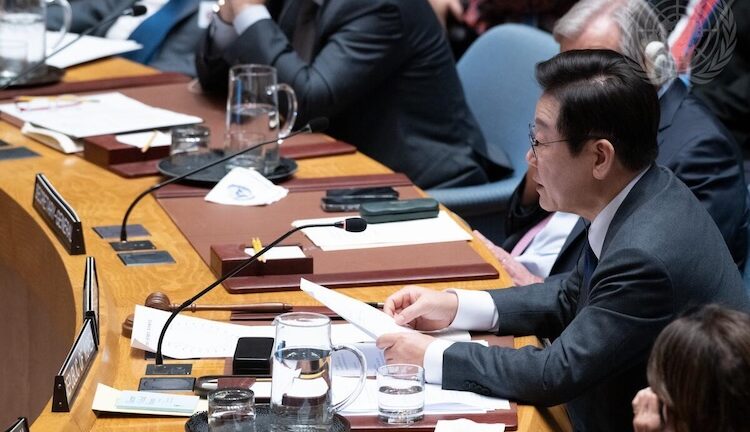
The technology has moved from laboratories and boardrooms into the chamber responsible for international peace and security
By Ramesh Jaura
BERLIN | NEW YORK | 24 September 2026 (IDN) – The United Nations Security Council has spent most of its history discussing wars, peacekeeping missions, sanctions and threats posed by armed groups. Its meeting on artificial intelligence on 23 September therefore marked unfamiliar territory. Technology executives and specialists were invited to explain how increasingly powerful computer systems might affect international peace and security.
Their warnings were stark. Systems are developing faster than governments can understand or regulate them. Used carelessly, or deliberately misused, they could assist cyberattacks, manipulate public opinion, identify military targets and accelerate decisions during an international crisis.
None of this requires a machine to take over the world. The more immediate danger lies in governments, armed forces, intelligence agencies, criminal networks, and private companies using new technology with little public scrutiny.
Modern warfare already depends heavily on data. Computer systems examine satellite images, track troop movements, guide drones, and identify patterns that human analysts might miss. That speed is attractive to military planners, but it may also leave political leaders with less time to determine whether an apparent attack is real.
The risk becomes especially serious when nuclear weapons are involved. An erroneous warning, a manipulated image or a misinterpreted military movement could trigger decisions that cannot be reversed. Human control over nuclear command systems should never be surrendered.
Fabricated video and audio present another danger. A convincing recording purporting to show a president announcing an attack or a military commander ordering mobilisation could circulate worldwide before specialists established that it was false. During a tense confrontation, even a short delay in verification might provoke retaliation.
The Security Council is right to discuss these risks. Whether it can agree on meaningful restrictions is another matter. Several permanent Council members lead technological development. They are investing heavily in military and intelligence applications and are unlikely to accept rules they believe would weaken their strategic position.
The nuclear comparison is tempting but incomplete. Nuclear weapons require rare materials, identifiable installations and elaborate delivery systems. Software crosses borders instantly. Private companies are doing much of the most advanced work, with budgets and technical resources that exceed those available to many governments.
An international agreement would have to examine computing capacity, safety tests, training methods and the behaviour of advanced systems. Companies might regard such information as commercially confidential. Governments could classify it as a matter of national security. Yet leaving the field to a handful of powerful states and corporations would be still more dangerous.
The United Nations offers something no company or national regulator can provide: a forum in which nearly every country has a voice. This matters because the effects will not be confined to the United States, China or Europe.
Many developing countries fear becoming dependent on systems designed abroad, trained on data gathered from their populations and controlled by companies they cannot regulate. They may bear the costs of disrupted employment, distorted information and intrusive surveillance without sharing fairly in the benefits.
Secretary-General Antonio Guterres has called for a multilateral system to assess risks, exchange information and establish common safeguards. Such an arrangement would need independence and reliable technical expertise. Another advisory panel producing reports that governments can ignore would achieve little.
A modest beginning would still be worthwhile. Governments could agree that decisions involving nuclear weapons must remain under direct human control. They could notify one another of serious technological incidents affecting international security and prohibit systems that select and attack human targets without meaningful supervision.
The debate has arrived late, but not too late. Governments must now decide whether they are prepared to exercise restraint before a serious accident, or deliberate abuse, forces them to confront the consequences.
Source note: This analysis draws on the UN Security Council proceedings and Reuters reporting of 23 September 2026.
Image caption: The UN Security Council meets to consider artificial intelligence and its implications for international peace and security. (IDN-InDepthNews)