
By Reihshan Deen*
COLOMBO, Sri Lanka | 28 September 2026 (IDN) — In Plato’s Phaedrus, Socrates recounts a discussion between two Egyptian gods: Theuth, said to have invented writing, and Thamus. Thamus disapproves of Theuth’s invention, stating that it “…will create forgetfulness in the learners’ souls, because they will not use their memories; they will trust to the external written characters and not remember of themselves.
“[Writing] is an aid not to memory, but to reminiscence, and you give your disciples not truth, but only the semblance of truth; they will be hearers of many things and will have learned nothing; they will appear to be omniscient and will generally know nothing; they will be tiresome company, having the show of wisdom without the reality”.
Proponents of artificial intelligence point to this passage to dismiss those anxious about its adoption: every technological advance has had its naysayers, even something as beneficial and now as fundamental as writing. Such an argument may fail to soothe or sway detractors, simply because Thamus was, in fact, correct. Writing indeed replaced the need to remember things; techniques for memorising huge troves of information and the traditions that used them, such as passing down epic poems, stories, and history by word of mouth, faded with the rise of the scribe.
Those who doubt the loss need only to look within our own lifetimes to see something similar happen, albeit on a much smaller scale: not so long ago it was commonplace to have several phone numbers memorised, yet now, since those numbers are saved within the phone itself, the need and the ability to commit them to memory have disappeared.
Even if the extensive use of memorisation diminished because of writing, the argument could be made that reduced reliance on memory allowed us to focus our mental energies elsewhere, particularly on higher-order and abstract thought that only writing could allow. It is much easier to process complicated ideas in writing, and to make fewer errors while doing so – consider how difficult or indeed impossible it would be to do mathematical calculations without mistake in one’s head.
Surely, then, the same can be said of AI, that it will free us so that we may accomplish greater things?
When Thinking Becomes the Shortcut
But free us from what, and to do what, exactly? Generative AI can now produce reams of ever-improving text in response to even the most basic prompts. The outputs are mostly accurate and logically valid, giving the semblance of human intelligence. In fact, not only can routine and mundane writing tasks be automated, but so can more complex work like essays, journal papers, and articles that would otherwise require substantial thought and research. Therein lies the problem.
As with memorisation after the invention of writing, whatever skills we no longer need fall into disuse, and eventually vanish – similar to muscles that, without exercise, atrophy (the “use it or lose it” principle). Think of information we rote memorised and abilities we developed for certain school subjects as children that, after many years of disuse, we can neither recollect nor perform. Now, with AI, thinking itself is made redundant, and consequently the capacity to think would decay. While it is true that every tool ever devised has been invented to save human effort, whether physical or mental, the breadth of what AI can “save” is so encompassing that it could remove the entirety of cerebral action and risk the deterioration of the cerebral organ.
What is left for humans to do when a capable AI replaces all ingenuity, comprehension, and creativity? Is our role to consume AI-generated content that Big Tech algorithms serve us mindlessly?
Perhaps it would be worth reflecting on how remarkable human thought is. Biologically, it is mysterious: countless nerve cells, linked with each other, form a tangled web of deep connections in the brain. Through them, chemically induced electric pulses travel, taking our sensations of the world and creating the perceptions of our mind.
These linkages are not immutable; they strengthen or weaken with use. Nerve cells wire and rewire, building and rebuilding connections between them, especially during learning. We cannot, however, pinpoint certain thoughts to particular wiring; consciousness appears to emerge from the brain, greater than the sum of its physical parts.
The Mental Work Behind Understanding
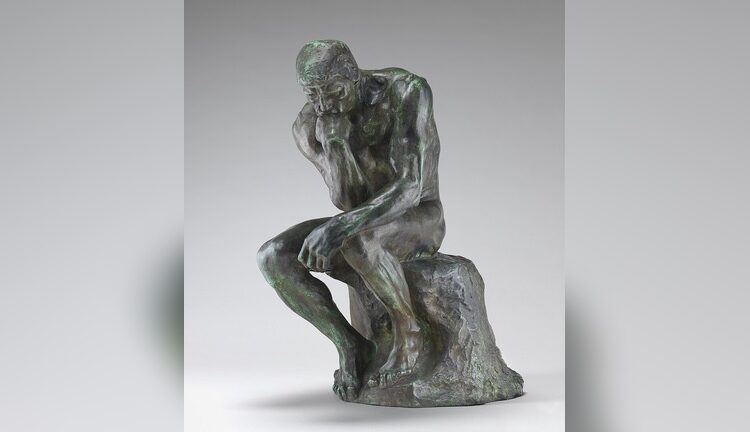
No less mysterious, but as astonishing is the act of thinking itself. To think, to ponder, to consider, to contemplate – they all roughly mean devoting some time to turning over something in one’s head, which at times can involve picturing something in the mind’s eye. To do this, we turn our attention inwards, so much so that we become oblivious to the outside world. Indeed, when we are deep in thought, we may gaze off into the distance, but no longer observe what our eyes actually see – almost like a momentary blindness. In this way we think, and through thinking, we comprehend.
To understand something is to make it familiar, to grasp its meaning, hold it in your mind, and make or realise new connections to other ideas. That is often how we learn new things, by relating them to things we already know. Such a process does take effort, and the more difficult a notion, the more time and energy is needed to meditate on it – but the greater the growth in understanding and more lasting the learning as a result. The muscle analogy is, here again, apt: just as we build strength and endurance when we (within reasonable limits) physically strain ourselves through exercise, so do we learn and grow when we mentally strain ourselves.
Alas, we do not experience this when we take the AI shortcut. There is no turning over in one’s head, no picturing with the mind’s eye, no familiarisation, no connecting with old ideas – no thinking by the human. There is no learning either; by taking away “hard” tasks, we remove the training needed to help us eventually accomplish them. As we no longer try, we no longer improve ourselves, and no longer gain competence in certain things. Instead, we train ourselves to depend on AI, and like Theuth’s disciples, we will generally know nothing, having the show of wisdom without the reality. To lose faculties such as research would be to our detriment.
When Research and Creativity Are Outsourced
The internet is a modern wonder, allowing us access to practically all knowledge. Yet we are nudged to stop searching the internet, to look through webpages and evaluate their trustworthiness ourselves to find our answers, and instead to use AI, which looks up and answers our questions for us. When we prevent ourselves from doing even the most basic research, we no longer learn how to ask the right questions or judge sources of information. In the end, this makes it easier to fall prey to misinformation and disinformation orchestrated by bad actors, often assisted by AI. As the sci-fi novel Dune put it, “Once men turned their thinking over to machines in the hope that this would set them free. But that only permitted other men with machines to enslave them”.
Thinking, by itself, is an incredible phenomenon; equally miraculous is our ability to convey our thoughts to others. Human communication is a meeting of minds, a rendezvous of memories, impressions, cogitations. Art is one such form; the written word, painted image, and composed music are mediums through which what was in another person’s mind is transmitted to our own, sometimes long after the creator’s lifetime. This, too, is now under threat from AI. Whom are we communing with when we gaze upon AI-generated art? Is artistry something humans should neglect and allow to wither away?
I did not use AI to help me write this article. It was not easy, but I believe I am better for having struggled to clarify and order my thoughts, and for finding the right words to express my ideas. Increasingly, however, I come across writing that bears the tell-tale signs of AI (styles such as snappy headings and bullet points; formulations such as “that’s not X, it’s Y”, et cetera). One wonders whether their human “authors” find themselves better for it. The ultimate irony is that some people no longer even fully read a given text, but instead rely on AI summaries. We are now at a point where AI produces text to be read by AI, with no human involvement whatsoever.
AI critics are often derided as Luddites, a term for those opposed to technological change that originated from early 19th-century England, where handicraftsmen banded together under the supposed leadership of a man named Ned Ludd to smash the textile machines that replaced their labour. Like Thamus, however, the Luddites’ grievances were real: artisans had no place in a world of factories and mass production, and the class subsequently disappeared.
The substantial production increases the Industrial Revolution brought about by unlocking new energy sources and saving immense amounts of labour, nevertheless, helped humanity progress, eventually leading to modern standards of living and quality of life. Perhaps it is because machines did not completely replace what it meant to be human; we would do well to remember that.
*Reihshan Deen has an MSc in Economics from KU Leuven, a Master in Conflict and Peace Studies from the University of Colombo, and an MA (Hons) in Economics from the University of Edinburgh, and can be reached at reihshan.deen@gmail.com. (IDN-InDepthNews)