By Jan Servaes
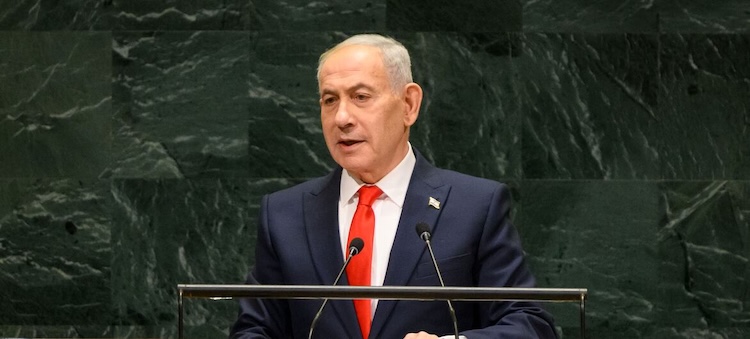
BRUSSELS | 29 September 2026 (IDN) — During his speech to the UN General Assembly in New York on 24 September, Israeli Prime Minister Benjamin Netanyahu used a visual aid. He displayed a pager resembling the devices used in the deadly pager attacks that Israel carried out in Lebanon in 2024.
An arrest warrant for ‘war crimes’ was issued against Netanyahu in 2024 by the International Criminal Court (ICC) in The Hague; however, he has not yet been arrested.
In contrast, Palestinian leader Mahmoud Abbas had to address the General Assembly via video link that same day, as the United States had—for the second consecutive year—denied him a visa to attend the UN summit in person, violating obligations the US undertook under the host country agreement.
Abbas highlighted Israeli attacks on the operations of the UN agency for Palestinian refugees (UNRWA) in Jerusalem and the West Bank, stating that the undermining of the agency’s work has led to a severely deteriorated humanitarian situation in those areas. “What is the international community waiting for to protect the Palestinian people?” he asked.
Genocide in Gaza
Israel is committing genocide in Gaza. This is the conclusion of the International Association of Genocide Scholars—the largest international association of genocide experts—in a resolution from August 2025—but also the UN’s independent international commission of inquiry for the Occupied Palestinian Territory (including East Jerusalem) and Israel, in a report dated 16 September 2025. The OHCHR urges Israel and all states to fulfil their legal obligations under international law to put an end to the genocide and to punish those responsible for it.
Explicit statements by Israeli civilian and military authorities and the pattern of conduct of Israeli security forces indicate that the acts of genocide were committed with the intent to destroy the Palestinians in the Gaza Strip, in whole or in part, as a group.
“The commission finds that Israel is responsible for committing genocide in Gaza,” said Navi Pillay, chair of the commission. “It is clear that there is an intent to destroy the Palestinians in Gaza through acts that meet the criteria of the Genocide Convention.”
“Responsibility for these atrocities lies with Israeli authorities at the highest level; for nearly two years now, they have orchestrated a genocidal campaign with the specific intent to destroy the Palestinian group in Gaza,” Pillay stated.
“The commission also finds that Israel has failed to prevent and punish genocide, having neglected to investigate acts of genocide and to prosecute alleged perpetrators.” The report is based on all the commission’s previous investigations, as well as on factual and legal findings regarding attacks in Gaza by Israeli forces and the actions and statements of Israeli authorities during the period from 7 October 2023 to 31 July 2025. The commission’s findings rest on a thorough analysis of the underlying genocidal acts (actus reus) and the intent to commit genocide (dolus specialis). Pasted text
Western Laxity
And yet, the response of Western governments—including Belgium’s—has often fallen short of the pressure critics argue should be brought to bear on Israel.
Belgium filed a declaration of intervention in South Africa’s genocide case against Israel before the International Court of Justice on 23 December 2025. Yet measures intended to exert pressure have remained mired in political disagreement and delay.
The divisions became particularly visible over 13 Palestinian students and researchers in Gaza who had received scholarships to study at Belgian universities. In September 2026, Belgium’s coalition government failed to agree on their evacuation.
Foreign Minister Maxime Prévot withdrew his proposal after a coalition partner opposed it unless the government also reached agreement on unrelated migration issues. The dispute exposed the difficulty Belgium’s government has faced in translating its stated concern over Gaza into agreed action.
Censorship of History
Antoon De Baets—a Flemish professor emeritus of ‘History, Ethics and Human Rights’ at the University of Groningen in the Netherlands and co-host of the Network of Concerned Historians—recently published an interesting monograph to put this issue in perspective: Censorship of History.
The right to freedom of expression and information plays a prominent role in the Universal Declaration of Human Rights, adopted in December 1948. It formed the basis for a binding provision in the International Covenant on Civil and Political Rights, adopted in December 1966 and currently (as of April 2026) ratified by 175 states. International human rights courts have repeatedly affirmed that freedom of expression, as defined in the Covenant, encompasses robust rights to express critical opinions about the past (including history, memory, tradition, and heritage) and to seek historical truth through research, exchange, and debate in the public interest.
This robust right is supported and reinforced by various other human rights, such as freedom of thought, opinion, association, and peaceful assembly, as well as the right to education and scientific research. De Baets examines this issue in three interrelated ways: theoretical, empirical, and semantic. The book pays extensive attention to the legal aspects applicable to many cases of historical censorship since 1945.
Historical censorship is the systematic, unlawful control over the content or exchange of specific historical facts or opinions by parties other than the authors—usually the government, but also colleagues, superiors, sponsors, providers of source material, institutions, or pressure groups. This is the classic form of historical censorship.
Although the right to freedom of expression is universal, he argues, it is not absolute: it can be restricted under certain conditions because the boundary between censorship and the restriction, suspension, or prohibition of free speech is generally ill-defined. Pasted text
Preventive and Punitive Censorship
Censorship of history takes the form of pre-publication and post-publication censorship and manifests in many ways: explicit or implicit; overt or covert; direct or indirect; formal or informal; official or unofficial; targeted or diffuse; public or private; regulatory or administrative.
With the first type of censorship, opinions are curtailed before they are expressed: this is “pre-publication censorship” or “preventive restriction.” Examples include: archives being purged or kept secret unlawfully; manuscripts being rewritten without the author’s informed consent; media being denied permission to publish; the internet being shut down; bureaucracy, hard-to-find documents, limited opening hours, etc.
Pre-publication censorship was a structural feature of dictatorships, but so-called ‘democratic’ regimes—such as the USA under Trump—have also evolved in that direction.
With the second type, opinions are restricted in an impermissible manner after they have been expressed: this is “post-publication censorship.” Publications are banned, lectures are disrupted, talks are boycotted, and sanctions are imposed on authors. These censorship measures—whether successful or not—are visible and can deter not only the speakers and authors but also their audiences. This form of intimidation is known as the ‘chilling effect’ of censorship.
However, De Baets argues that under international human rights law, censorship is understood entirely from the perspective of the state: state censorship amounts to a failure by the state to fulfil its obligation to respect the rights of individuals under its effective control.
Censorship by private parties amounts to a failure by the state to prevent such censorship and to meet its obligation to protect these individuals’ rights. Pasted text
Propaganda, Disinformation and Freedom of Expression
De Baets distinguishes between two phenomena closely related to the censorship of history: historical propaganda (termed “positive censorship” by Stephen Spender) and the abundance of information (termed “reverse censorship” by Tim Wu).
Historical propaganda has long coexisted with censorship. For example, many regimes have appointed propaganda historians to (re)write their official historical narratives.
Abundance, by contrast, is a recent trend. By shifting focus from information producers to distributors and users, the concept of abundance rests on the premise that—unlike in the past—information is plentiful; consequently, there is less need to suppress the creators of problematic information than to divert public attention away from them.
This “reverse censorship” feeds the public disinformation. “Flooding the zone with shit”—a term used by Steve Bannon to explain Trump’s communication strategy—is a politically motivated technique employing bots or anonymous accounts to inundate the public with supposedly widely accepted disinformation. The aim is to drown out or discredit unwanted information, silence its authors, or confuse and distort the information ecosystem. Paradoxically, freedom of speech is here weaponised to control expression.
The 2025 edition of the United Nations’ Global Risk Report ranks “mis- and disinformation” fourth among the twenty-eight major global risks, and first among risks currently escalating into a crisis that could collapse social cohesion. The report identified it as the most critical global vulnerability.
A censorship apparatus generally aims to sow fear and confusion among the population so effectively that external control becomes unnecessary. The desired outcome is self-censorship—the most efficient and widespread form of censorship, in which repressive norms are internalised.
Many historians now accept that their work is inevitably imbued with the political in the three senses outlined by De Baets: most of their facts and all their concepts and opinions are value-laden; responsible historiography ultimately depends on respect for and protection of the core political values that underpin it; and part of the core mission of historiography is intrinsically political—namely, to contribute to society’s identity over time without abandoning or lowering its scholarly standards.
Therefore, merely fulfilling the role of historian is in itself a political act in any society. An apolitical or ‘objective’ stance is thus detrimental, according to De Baets. (Incidentally, in my view, the same applies to the journalist.)
“Old-style censorship is not dead: it is a virus that lies dormant when inactive. It has resurfaced in ways that can only surprise those who underestimate its complexity and diversity. Today, it has been joined by new, unprecedented strategies. Against this bleak backdrop, mapping the history of the censorship of history—identifying and understanding its mechanisms and instruments, and commemorating its victims and those who resisted it—is more necessary than ever to safeguard a robust right to freedom of expression regarding the past.” (IDN-InDepthNews)
Reference
Antoon De Baets (2026), Censorship of History, Cambridge University Press, Cambridge, 90pp.
DOI: 10.1017/9781009272520