By Kester Kenn Klomegah*
MOSCOW | NEW YORK | 30 September 2026 (IDN) — At the 81st UN General Assembly in New York, Russian Foreign Minister Sergey Lavrov reiterated Russia’s objection to South Africa’s exclusion from the forthcoming G20 summit in the United States, while emphasising the importance of multilateral institutions and the place of Africa in the emerging international order.
Lavrov described in some detail Russia’s assessment of the current state of relations with the United States. His remarks also touched on broader questions confronting Africa and other countries of the Global South and East as they seek to strengthen the multilateral foundations of the international system and counter what they regard as neocolonial practices.
Who decides who attends?
The 2026 G20 Leaders’ Summit is scheduled for Miami, Florida, on 14–15 December. The United States has invited Russian President Vladimir Putin to attend, an invitation US Secretary of State Marco Rubio confirmed after talks with Lavrov on the sidelines of the UN General Assembly.
The invitation has prompted renewed discussion about diplomatic engagement with Russia. But Lavrov argued that invitations to a G20 summit should be viewed differently because members participate in the group on an equal footing.
Explaining Russia’s position at his UN press conference, Lavrov said an invitation from the country holding the rotating presidency should essentially inform a G20 member of when and where the meeting is taking place rather than determine whether that member is entitled to participate.
Lavrov said he had raised South Africa’s exclusion directly with Rubio. He argued that it was improper for the United States, as the holder of the G20 presidency, to exclude South Africa while inviting Poland.
Lavrov stressed that expanding the G20 requires consensus among its members, and that no collective discussion had addressed removing South Africa and replacing it with Poland. In Russia’s view, he said, Washington had therefore exceeded the authority attached to the rotating presidency.
The dispute is particularly significant because the Johannesburg Leaders’ Declaration of November 2025 reaffirmed the G20’s commitment to operating based on consensus, with all members participating on an equal footing in its events, including summits.
South Africa’s place at the table
Notwithstanding the complexities of international diplomacy, Russia’s position has centred on South Africa’s right to representation at the G20. Russia and South Africa are both BRICS members and share a commitment to a more multipolar international order.
South Africa’s participation also has wider significance for Africa. Its presence at the G20 gives the continent an important voice in discussions on global economic governance, although the African Union has itself been a permanent G20 member since 2023.
South Africa remains a full G20 member. Pretoria maintains that it has the right to participate in the Miami summit. At the same time, International Relations and Cooperation Minister Ronald Lamola has said the country will not attend without an invitation and will not call for a boycott of the meeting.
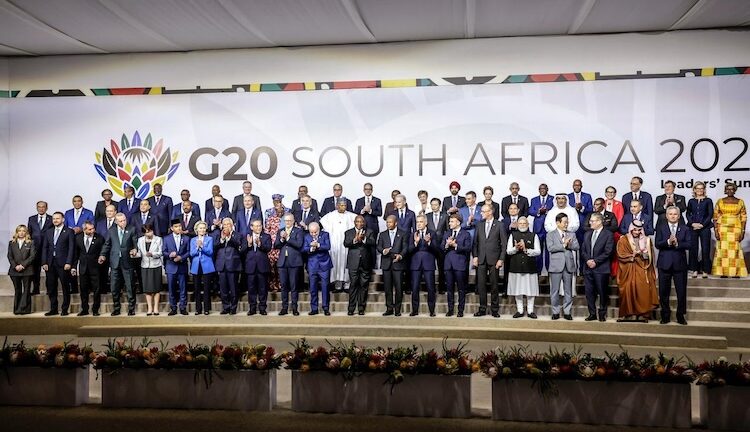
The controversy follows South Africa’s own G20 presidency in 2025.
Johannesburg’s precedent
ip of South African President Cyril Ramaphosa, the Johannesburg summit adopted a 122-paragraph Leaders’ Declarfocusedcusing on solidarity, equality and sustainability, alongside issues including climate resilience, debt and development.
The summit, held on 22–23 November 2025, was the first G20 Leaders’ Summit on the African continent.
It was also marked by diplomatic friction. The United States did not participate in the summit amid sharply deteriorating relations with South Africa and disagreements over Pretoria’s G20 agenda, including its emphasis on climate change and global inequality. Argentina attended at the ministerial level but later said it had not joined the final declaration.
Despite the United States’ absence, the summit proceeded with its agenda and adopted the declaration.
The Johannesburg meeting placed particular emphasis on issues affecting developing countries and the Global South, including climate-related disasters, sovereign debt, energy transition and critical minerals.
A forum for the world’s major economies
The G20 brings together the world’s major advanced and emerging economies to coordinate international economic policy.
It consists of 19 countries together with the European Union and the African Union. The group has no permanent secretariat, and its presidency rotates annually among its members. The Presidency
The dispute over South Africa’s participation in Miami therefore raises a question extending beyond relations between Pretoria and Washington: how much discretion does the country holding the rotating presidency have over the participation of an existing member?
For Moscow, the answer is clear. Lavrov maintains that the presidency does not confer the authority to decide which full members may attend a G20 summit. South Africa, for its part, remains ready to participate should an invitation be extended.
The disagreement is likely to remain part of the diplomatic debate ahead of the Miami summit in December.
*Kester Kenn Klomegah is a veteran journalist, policy researcher, and business consultant. His work focuses on international relations, geopolitics, and Africa’s economic developmenshifting t amid globa shifts. His writing regularly appears in leading international publications. [IDN-InDepthNews]
m