By Mohamud Hure*
DOHA, Qatar | 26 June 2026 (IDN) — The morning war arrives, a child learns a different kind of lesson: which road is safe, which silence means run, how much can be carried and what must be left behind. Somewhere in Sudan or eastern Congo this year, a girl folded that knowledge into a small bag and walked away from a classroom she may never enter again. She did not call it courage. To her, it was simply the morning she had to leave.
This is the quiet bravery that World Refugee Day was made to honour. The 2026 theme, “Until Everyone Is Safe,” arrives heavy with meaning: we are marking 75 years since the 1951 Refugee Convention, the promise the world made that no one fleeing war should ever face it alone. Refugee Week names the same spirit in a single word — Courage. For a displaced child, courage is not a slogan. It is the conscious decision to begin again in a new language, in an unfamiliar place, and to ask the basic childhood question: when can I go back to school?
Seventy-five years on, our answer is still insufficient.
The Hidden Crisis
By the middle of 2025, around 122 million people had been forced from their homes, roughly one in every 67 people alive. Conflict drives most of it, but climate shocks increasingly do too, turning failed harvests and floods into fresh waves of displacement. The two crises no longer take turns. They compound, and children feel the collision first.
Nowhere is that clearer than in Africa, and nowhere is it more overlooked. When the world pictures a refugee, it pictures a border being crossed. But the majority of Africa’s displaced never do so. They are the internally displaced, uprooted inside their own countries, beyond the reach of the headlines and often statistical analysis. Sub-Saharan Africa is now home to 31.7 million internally displaced people, close to 40% of the global total. They are the largest part of this emergency and the part we are most likely to forget.
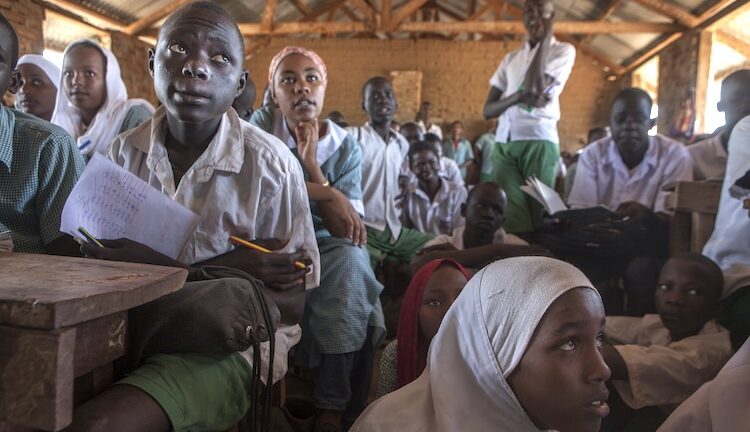
Behind those millions are classrooms emptying in real time. In Sudan, some 13 million school-age children are now out of school, more than three in four of the country’s children. Across the Central Sahel, conflict has shuttered more than 11,000 schools, and Burkina Faso has a million children locked out of school by insecurity. A displaced child does not merely experience a pause in education. Left unaddressed, she has encountered the end of it.
A Promise Under Strain
Here, we have to be honest about who carries the weight. The countries hosting the most displaced people are rarely the richest; far more often, they are among the poorest, absorbing millions while their own schools and budgets are already stretched thin. The Global Compact on Refugees gave this imbalance a hopeful name, “responsibility sharing”, the idea that the world would shoulder the burden together. In 2026, that promise looks increasingly like wishful thinking.
Humanitarian funding has been cut deeply and abruptly, full stop. UNHCR began 2025 needing US$10.6 billion and, by mid-year, had received barely 23% of that amount. As much as US$1.4 billion in essential programmes have been frozen or cancelled, and up to 11 million displaced people stand to lose assistance, a gap widened by the dismantling of major donors such as USAID. Education is almost always the first service cut and the last restored. Schools for displaced children are closing today, not because the need has eased, but because the funding has run out.
Investing in the Future
This should alarm finance ministers as much as humanitarians, because the arithmetic is brutal. Africa has the youngest population on earth, the demographic dividend the rest of the world covets. But a dividend is only paid to those who invest. Educate a displaced child, and you gain a teacher, a nurse, a trader, a taxpayer. Deny her a classroom, and that potential curdles into cost: a young person reaches adulthood with neither literacy, skills, nor a certificate to earn a living, nor safe passage from childhood into anything stable. The damage compounds at every stage, as she never gets to transition from primary into secondary, or from school into work. A child who never enrols cannot transition at all. She eventually vanishes from the register and, too often, from the economy that needs her.
This is what sits beneath one of the most sobering numbers in education today. There are now 273 million children and young people out of school worldwide, and sub-Saharan Africa accounts for the largest share at 39%, more than any other region. Among refugee children, the picture is grimmer still: almost half of the roughly 12.4 million children of school-going age are not in school at all. Displacement is no longer one factor among many in this crisis. It is fast becoming the decisive one.
A Proven Approach
None of this is destiny. The out-of-school crisis is not a drought or an earthquake; it is the sum of choices, and choices can be made differently. That conviction is the reason the Education Above All (EAA) Foundation exists. We have built our work around precisely the children that escape every other system: the unregistered, the displaced, the girl who left her classroom in a hurry. Working hand in hand with governments and partners, EAA Foundation has helped enrol more than 14.8 million out-of-school children into quality primary education, including over 4.7 million refugees and internally displaced children.
The method is deliberate and unglamorous. Working with partners like UNHCR and others, including governments, we count the children no one is counting, dismantle the barriers that keep them out — cost, distance, missing documents, language, the particular obstacles facing girls — and then do the harder thing: help them stay, and learn. It will not, by itself, solve a crisis this large. But it proves the crisis is solvable.
Keeping Our Word
So what must change as the Convention turns 75? Governments must protect education budgets and bring displaced children, refugees and IDPs alike into education. Donors must treat education in emergencies as the life-saving intervention it is, and reverse cuts before another generation falls into the abyss. And civil society must keep these children visible, above all, the internally displaced, who have no border crossing to announce their need.
“Until Everyone Is Safe” cannot mean only a roof and a ration. A child is not safe while her future is quietly stolen, one school year at a time. Real safety is a desk, a teacher, a name on the register. That is the courage this anniversary asks of us, not the courage to flee, which children already show every single day, but the courage, at last, to keep our word.
*Mohamud Hure is an education and humanitarian professional with over 17 years of experience working in refugee and crisis-affected settings, characterised by significant institutional and resource limitations. His work is rooted in firsthand experience as a teacher and school leader in large refugee camps in Kenya. It has since evolved to include designing and managing complex education programmes at global and regional levels with organisations such as UNHCR, the Mastercard Foundation, and, currently, Education Above All (EAA), where he serves as a Senior Education Specialist with the Educate A Child (EAC) programme. His work focuses on improving access, quality, and inclusion in education, with a particular interest in supporting displaced learners and strengthening the systems that serve them. [IDN-InDepthNews]