
By Sam Ben-Meir*
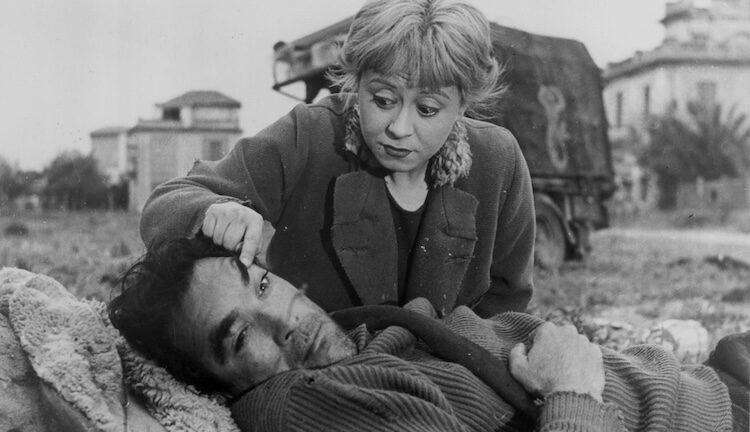
NEW YORK | 26 June 2026 (IDN) — Seventy years after its release, La Strada (1956) remains among the most unsettling achievements in the history of cinema. Its endurance has little to do with nostalgia, neorealist pedigree, or even the magnetism of Giulietta Masina’s performance—though all of these matter. What gives the film its lasting force is something more severe: its refusal to reconcile suffering with meaning, and its insistence that ethical recognition often arrives only after the possibility of repair has vanished. La Strada endures because it tells a truth we remain unwilling to face—that there are forms of damage that cannot be redeemed, and awakenings that come too late to save anyone.
The film is often described as “humanist,” but this term obscures more than it clarifies. Nothing is reassuring here, nothing that restores faith in the moral arc of the universe. If La Strada is tragic, it is so in the most austere sense: not because fate crushes greatness, but because ordinary brutality proceeds unchecked, indifferent to what it destroys. Its world is not governed by malevolence so much as by moral inertia. And that, perhaps, is what makes it timeless—and newly timely.
Zampanò’s World
Zampanò’s defining feature is not cruelty, though he is cruel; it is a certain metaphysical stance toward the world. His travelling act—breaking chains with brute force—is not merely a performance but an ontology made flesh. The world, for Zampanò (Anthony Quinn), is something to be endured, overpowered, or resisted. Every encounter is implicitly adversarial. Others appear either as obstacles or as tools. Vulnerability registers as humiliation. Pain becomes proof of reality. Zampanò does not simply perform strength; he organises reality around it.
This is why his closest cinematic parallel is not a villain but a boxer—most notably Jake LaMotta in Raging Bull (1980). Like LaMotta, Zampanò approaches the world as though it were a ring. Every relation is structured by domination or submission. Intimacy is indistinguishable from violence. The refusal of vulnerability is not a moral failing but a condition of survival within a world experienced as perpetually hostile. What both figures reveal is not individual pathology so much as a way of being that mistakes endurance for authenticity and punishment for truth.
Yet where Scorsese allows LaMotta a grim survival, Fellini is more merciless. Zampanò’s awakening comes not only too late—it comes after he has destroyed the very possibility of another way of living.
The Philosophy of Il Matto
The tight-rope walker—Il Matto—is often misread as comic relief or moral conscience. In fact, he is something far more significant: the film’s philosophical hinge. He represents not goodness as such, but an alternative ontology—a different way of inhabiting the world.
Il Matto’s act is the inverse of Zampanò’s in every respect. He does not conquer gravity; he negotiates with it. His survival depends not on force but on balance, timing, and attentiveness. Where Zampanò’s strength seeks mastery, the tight-rope walker practices responsiveness. His humour is not cruelty but distance—a refusal to absolutise suffering, a way of holding pain without allowing it to define reality entirely.
This difference matters. Il Matto embodies a world that is precarious but inhabitable. Meaning, for him, is not imposed through domination but emerges through relation. Risk is acknowledged rather than denied. His famous assertion—that even a pebble has a purpose—is not sentimental metaphysics but desperate, fragile ontology. Meaning is not guaranteed; it must be sustained through care.
Crucially, Il Matto does not oppose Zampanò through moral superiority. He exposes another possibility. And this is precisely why he is intolerable.
Zampanò does not kill the tight-rope walker because he is insulted. He kills him because Il Matto reveals that the world does not need to be lived as combat. He reveals that suffering is not the final criterion of truth, that attention might replace force, that meaning might arise without domination. For Zampanò, whose entire being is organised around resistance, this is unbearable. The murder is thus not a crime of passion but a metaphysical annihilation. Zampanò destroys not merely a man, but the possibility of another way of being. The violence is not random; it is defensive. It is the desperate act of an ontology that cannot tolerate its own contingency. In this sense, La Strada is not a moral parable but a tragedy of competing metaphysics. What perishes is not innocence but receptivity itself.
Gelsomina’s Tragedy
Gelsomina stands between these two worlds, and her destruction is the film’s most devastating insight. She is not simply a victim of abuse, nor an allegory of innocence. She is a being whose openness to meaning exceeds the world’s capacity to protect her.
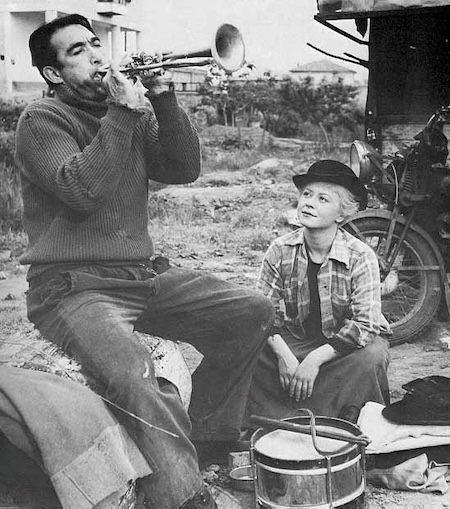
Gelsomina’s gestures—her music, her silences, her rituals—are attempts to orient herself within a hostile environment. She intuits, long before she can articulate it, the truth of Il Matto’s metaphysics: that meaning is relational, that existence calls for responsiveness, that even the smallest things matter because they are addressed to someone.
But this openness is precisely what renders her vulnerable. Under Zampanò’s regime of brute necessity, receptivity becomes unbearable. What might have flourished under care collapses under indifference. Gelsomina’s breakdown is not weakness; it is the predictable consequence of forcing fragile meaning to survive in a world organised entirely around endurance.
Here, the film’s tragic truth sharpens: not all goodness is resilient. Some forms of life require protection. And the world, more often than not, offers none.
Recognition Too Late
Zampanò’s final breakdown—alone on the beach, howling into the night—is often misread as redemption. It is nothing of the sort. His recognition does not undo what he has done. It arrives only after Gelsomina is dead, after Il Matto has been destroyed, after the possibility of transformation has vanished.
This is the film’s most merciless claim: recognition without responsibility is not salvation but torment. Zampanò’s tears do not redeem him; they condemn him to a knowledge that can no longer matter. Unlike LaMotta, who is granted a future in which to rehearse contrition, Zampanò is left with nothing—no one to address, no relation through which meaning might be restored. The tragedy of La Strada is not that Zampanò suffers, but that he finally understands why—and understands it too late.
La Strada remains painfully contemporary because the structures it exposes have not disappeared. Precarity, instrumental relationships, emotional illiteracy masquerading as toughness—these are not relics of postwar poverty but organising features of modern life. What has changed is not the world the film depicts, but our tolerance for naming it as tragic.
Indeed, what makes La Strada newly urgent is that Zampanò’s adversarial orientation no longer appears as an individual pathology but as a recognisable social posture. The world he inhabits—a world in which every encounter is a contest, every concession a defeat, and every vulnerability a liability—has become increasingly visible in our political life. In recent years, American politics has given this stance a public vocabulary: a mode of address that treats governance as combat, cruelty as candour, and domination as authenticity. What La Strada shows, with devastating clarity, is not merely the moral cost of such a worldview, but its metaphysical poverty: a life reduced to endurance, incapable of relation, and therefore incapable of meaning.
A Film That Still Speaks
Fellini offers no consolation. There is no moral balance sheet, no assurance that suffering will be redeemed by insight. Instead, the film leaves us with a more disturbing possibility: that ethical clarity often arrives only when nothing remains at stake. That judgment, when it comes too late, is indistinguishable from complicity.
This is why La Strada resists the anniversary celebration. It does not commemorate endurance; it indicts it. It does not teach us how to survive the world, but asks whether we are capable of inhabiting it otherwise—and what it costs when we are not.
In the end, La Strada offers one of cinema’s most devastating insights: that cruelty requires no ideology, hatred, or justification. It requires only permission—the permission to continue as before. The film’s tragedy lies not in the inevitability of suffering, but in the fragility of meaning in a world that refuses to attend to it.
La Strada endures because it refuses the consolations we have learned to expect from suffering. It offers no assurance that pain will be redeemed by insight, no promise that recognition will arrive in time to matter. Instead, it leaves us with a more devastating possibility: that ethical clarity often comes only after the conditions for ethical action have been destroyed. Zampanò’s final anguish is not the beginning of justice but its aftermath—the sound of understanding echoing in a world where no one remains to answer it. Seventy years on, the film still wounds because it tells us something we would rather not know: that the gravest moral failure is not cruelty alone, but the willingness to go on as before—and to call it realism—until recognition arrives when nothing remains to risk.
*Sam Ben-Meir teaches philosophy at the City University of New York, College of Technology. He is the author of Ethical Interanimality: Toward a Relational Philosophy of Nature (Westphalia Press, 2026). [IDN-InDepthNews]