
By Jonathan Power
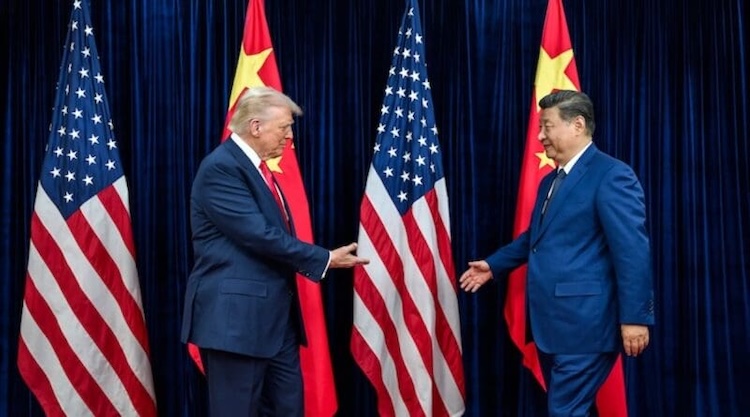
LUND, Sweden | 20 May 2026 (IDN) — Both the US and China over the last few decades have messed things up. President Donald Trump has been vicious in his attacks, over trade and, in his first term, over the Coronavirus, which he blamed on China. Last week, during his visit to Beijing, he changed gears and became an admirer of China.

Until a few days ago, Trump played into a very old-time visceral fear of the “yellow peril”, which not so long ago was a minority feeling in America. But he has managed to whip up a broad swathe of public opinion against China. The Democrats (and much of the media) have followed him. Not just Joe Biden, the Democrats’ last president, but also leftist senators, Bernie Sanders and Elizabeth Warren, even though their attacks are less pointed.
This goes nowhere. What’s the point of it? In the end, the US will lose. China has a population four times as large. Before long, it will begin to match the US’s income per head, at least in its eastern, more developed and more populated parts. Its high technology is already ahead of the West’s in many areas. Its military budget is increasing.
A Clash of Civilisations?
Where does this hostility come from? The late Harvard professor Samuel Huntington, famous for his book “The Clash of Civilisations,” in which he predicted war between the Islamic world and the West, also wrote about the gulf between the US-led West and Chinese civilisation, which he believed was set for a violent head-on collision.
“Americans see government as a necessary evil”, writes Graham Allison, another Harvard professor, “and believe that the state’s tendency toward tyranny and abuse of power must be feared and constrained. For the Chinese, the government is a necessary good, a fundamental pillar that ensures order and prevents chaos… China’s equivalent of ‘give me liberty or give me death’ would be ‘give me a harmonious community or give me death.'”
Both countries believe they are number one in the world. Both have an extreme superiority complex. Both think they are exceptional. But, unlike China, the US has sought to prevent the emergence of a “peer competitor” that could challenge its own military dominance. (These days, this is aimed against Western Europe and Russia as well as China.)
America wants to export its concepts of democracy and human rights. China, as Henry Kissinger noted, does “not export its ideas but let others come to seek them”. China believes the US promotes these virtues as a tactic to undermine its form of government. (Interestingly, there are human rights courses at some Chinese universities that are independent in content, even though they have been cut back over the last decade.)
Cultural Difference
Then there is a profound cultural difference. Americans tend to focus on the present and too easily forget the lessons of the past—as with the Korean War, the Vietnam War, the Iraq wars and the war in Afghanistan. The novelist Gore Vidal has noted his country should be called “The United States of Amnesia”. The Chinese are more historically minded and often think in terms of decades or generations.
China has not gone to war since 1979. For its part, the US has attempted regime change around the world 72 times. Nor has China funded or supported proxies or armed insurgents since the early 1980s. According to Fareed Zakaria, “That record of non-intervention is unique among the world’s great powers”.
China and the UN
Beijing is now the second-largest funder of the United Nations’ peacekeeping operations. It has deployed nearly 2,000 peacekeepers, more than all the other permanent members of the Security Council combined. This highlights the remarkable shift from a radical agenda of spreading revolution to a conservative concern for stability. It has become a guardian of the international status quo. Had someone predicted this in 1972, few would have believed it possible”. China has come a long way since the aggressive days of Mao Zedong, whereas the US appears in some ways to have gone backwards.
Trump’s case against China on the Coronavirus, military posture, and trade is wildly exaggerated. It needs to stop being made. During Trump’s first term, US Secretary of State Mike Pompeo said the West must keep China in “its proper place”. This gets us exactly nowhere.
The presidential trip to Beijing last week showed another (new) side of Trump- trying to win Chinese friendship. This, if nurtured properly, could become a watershed moment in the relationship between the US and China. If that fails, Trump will return to being counterproductive. Nothing could be more damaging to the peace of the world. [IDN-InDepthNews]
Copyright: Jonathan Power.