By Jan Servaes
BANGKOK | 16 May 2026 (IDN) — Following the arrest of Venezuelan leader Nicolás Maduro and the death of Iranian Supreme Leader Ali Khamenei in a military attack, US President Donald Trump has hinted that Cuba could be his next target. In a presidential decree dated 26 January, 2026, he declared that Cuba poses “an unusual and extraordinary threat” to US national security, citing ties with hostile actors such as Russia. The decree also authorised the imposition of import tariffs on goods from third countries that sell or supply oil to Cuba—a measure Cuban leaders warned would put further pressure on the country’s economy.
The decree came just weeks after the Trump administration announced it would take control of Venezuelan oil exports and halt deliveries. Venezuela has traditionally been a major oil supplier to Cuba, and the change forced the Cuban government to take emergency measures to address the fuel shortage during what experts call the island’s worst economic and energy crisis in decades. Following the American ousting of Maduro, which Cuban President Díaz-Canel condemned, Trump said: “Cuba will be a subject we will eventually discuss, because Cuba is currently a failing nation.” His US Secretary of State, Marco Rubio, the son of Cuban exiles and an outspoken critic of the Cuban government, obviously agrees. Yet, Trump seemed to evade the idea of direct intervention in Cuba. On 4 January 2026, he told journalists, “I think it will collapse on its own. I don’t think we need to take action.”
However, Trump’s rhetoric has hardened in recent months. In late February, a day before he started the war on Iran, Trump floated the idea of a “friendly takeover” of Cuba. And on 16 March, Trump told reporters at the White House: “I believe I will have the honour of taking over Cuba.”
While American and Cuban officials negotiate the deteriorating situation in Cuba, the Trump administration is reportedly attempting to oust Miguel Díaz-Canel as president without pushing for broader regime change or action against members of the Castro family. — (However, Cuban leader Raúl Castro was recently indicted on 14 May.) — In his characteristic ‘bully’ style, Trump claimed in March: “Take over Cuba. I mean, whether I liberate it or take it over. I think I can do whatever I want… They are currently a very weakened nation.”
“We will always strive to avoid war,” Díaz-Canel said in a rare interview with Newsweek in early April. “We will always work for peace. But if military aggression occurs, we will strike back, we will fight, we will defend ourselves, and should we fall in battle, then dying for the fatherland is living.” In the same interview, Díaz-Canel also said that finding a way out of the diplomatic impasse between the two countries is “difficult.” “This is an asymmetrical relationship between Cuba and the United States,” he said, “the United States has always played the role of aggressor, and the small island of Cuba has always been the nation and the country that has suffered under this aggression.”
Russia and China
Without mentioning Trump by name, Russia responded to what it considered “an artificially fueled atmosphere of confrontation” in Cuba and reaffirmed its support for the Caribbean nation. “We express our serious concern regarding the escalation of tensions surrounding Cuba and the increasing external pressure on the Island of Freedom,” said the Russian Ministry of Foreign Affairs in a statement on 17 March. “We strongly condemn attempts at gross interference in the internal affairs of a sovereign state, intimidation, and the use of unlawful, unilateral restrictive measures.” The Russian ministry added that Cuba’s “unprecedented challenges” were “a direct consequence” of the American action against the island and that Russia “will continue to provide Cuba with the necessary support, including material aid.”
Relations between Cuba and Russia have been strong since the Cuban Revolution of 1959. Academics Armando Chaguaceda and Cesar Santos write in the Center for European Policy Analysis (CEPA) that the situation in Cuba is now worrying for Russia, because the regime in Havana “offers the Kremlin serious support in its work for global illiberalism.” Lavrov met his Cuban counterpart in Moscow as recently as late January. Popular Russian political commentator Ruslan Pankratov wrote in January in ‘Moskovsky Komsomolets’ that “the global South would see the fall of Cuba as definitive proof of the inability of Russia, China, or anyone else to function as an alternative center of power.”
In Asia, Africa, and Latin America, everyone will understand one simple thing: cooperating with ‘multipolarity’ is risky because it cannot protect its allies against American pressure. However, we have not reached that point yet.
The BRICS platform, established by Brazil, Russia, India, China, and South Africa, officially admitted Cuba as an associate member in January 2025. Consequently, Cuban Foreign Minister Bruno Rodríguez was able to condemn the threat of direct military aggression and the energy blockade imposed by the United States against his country during the BRICS summit on 14 May, 2026, with the necessary backing from other BRICS members. Mexico and Canada, among others, are also offering assistance. “Canada is standing by the people of Cuba during this difficult time. Our support will be delivered directly to the most vulnerable to meet the urgent need for food and nutrition and to provide immediate relief,” stated Randeep Sarai, the Canadian Minister for International Development.
And China is not holding back either. China was Cuba’s second-largest trading partner after Venezuela. A large-scale ‘solar energy revolution’, supported by China, is now expanding across the island, CNN reports. Imports of Chinese solar panels and batteries have risen sharply over the past year, from approximately $3 million in 2023 to $117 million in 2025. Cuba and China are therefore collaborating on an ambitious national renewable energy project to build 92 solar parks by 2028. Cuban President Díaz-Canel opened the first solar park in February 2025, and there are now about 50 solar parks online across the island. Renewable energy now accounts for about 10% of Cuba’s electricity production, up from about 3% in 2024.
Humanitarian crisis
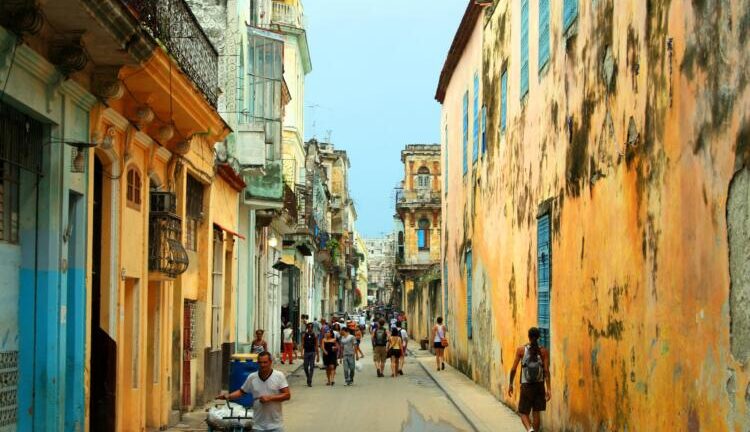
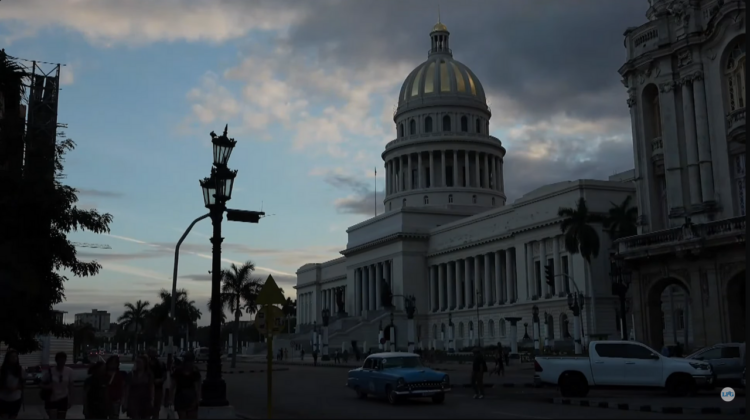
However, due to the US oil blockade, Cuba remains deprived of fuel, plunging 10 million people in the country into an increasingly deep humanitarian crisis. Power outages are already common on the island, but recent fuel shortages have led to widespread and severe power interruptions, the worst in decades. In March alone, Cuba’s national electricity grid collapsed up to three times. These power outages forced hospitals to cease operations and schools and businesses to close. Shortages of cooking gas, gasoline, and diesel have also put pressure on transportation, the food supply, and even diesel-powered water pumps. Cubans describe dealing with power failures, rushing to cook, do laundry, and charge their appliances, while food—if they can even afford it—spoils quickly when refrigerators run out of power. Garbage and rotting food pile up in the streets because the fuel shortage overburdens waste collection, and the heat and mosquitoes have become unbearable without electric fans. Moreover, the energy crisis has led to sky-high inflation, including rising food prices, and a rapidly devaluing Cuban peso.
As early as February, the United Nations called Trump’s fuel blockade unlawful and stated that it “hinders the Cuban people’s right to development and undermines their rights to food, education, health, water, and sanitation.”
The Cuban human rights group Cubalex, which focuses on Cuban exiles, reported that the number of protests or expressions of resistance on the island rose from 30 in January to 229 in March.
According to Reuters, large-scale protests broke out on May 13 and 14. Hundreds of angry Cubans streamed into the streets in various working-class neighbourhoods, blocked roads with burning piles of garbage, banged on pots and pans, and shouted “Turn on the lights!” and ¡El pueblo, unido, jamás será vencido! (“The people, united, will never be defeated!”).
“The Cuban revolution defies the Monroe Doctrine”
The relationship between the United States and Cuba has been strained for decades. This is discussed in detail once again in the book “On Cuba: Reflections on 70 Years of Revolution and Struggle” by Noam Chomsky and Vijay Prashad, published in 2024. To remove any doubt about their sympathies, Chomsky and Prashad included a short foreword by Cuban President Miguel Díaz-Canel. He praises the authors for their “characteristic courage, honesty, and erudition” in their analysis of Cuba.
The book makes use of released documents that irrefutably demonstrate that American hostility toward Cuba since 1959—which includes, among other things, an invasion via intermediaries, terrorism, assassinations, and psychological and economic warfare—has little to do with the actual or alleged human rights violations and authoritarianism in Cuba. Chomsky and Prashad, for example, quote from a 1964 report by the Policy Planning Council of the US Department of State: “The simple fact is that Castro represents a successful resistance against the United States, a denial of our entire policy toward the Western Hemisphere of nearly a Century and a half.” They then rightly note: “The dating is virtually exact. It refers to the Monroe Doctrine of 1823. The Cuban Revolution defies the Monroe Doctrine.”
The authors show how the US has treated Cuba as a virtual colony since its founding in 1776. They cite Theodor Roosevelt’s 1904 speech to Congress, in which he emphasised that if countries dared to “not maintain order” or “not pay their debts,” the US would intervene militarily. This became the Big Stick policy, which viewed American domination as a moral necessity. Cuba’s resistance always aroused fear in the US that other countries would pursue their own independence, a fear that never materialised. The authors cite fourteen examples of American interventions in Latin America over eight years, from 1906 to 1914.
The authors refer to many casual threats directed at Cuba throughout history. For instance, US Secretary of State Alexander Haig said in 1981: “Just give it to me, and I’ll turn that damned island into a parking lot.” After Cuba had supported the liberation fighters in Angola who were resisting apartheid in South Africa, Secretary of State Henry Kissinger said, “We must humiliate them”, and “if we decide to deploy military force, it must succeed. There must be no half measures.” Documents show that President Reagan considered military intervention in the 1980s. It is clear that the absence of resistance and the full authority of the US constitute “the beginning and the end of their foreign policy.”
The authors describe in detail how the US government decided from day one that it had to use “all possible means” to “weaken Cuba’s economic life.” In 1960, upon his departure from the country, US Ambassador Philip Bonsal defined the US policy “with its Latin American and NATO allies” as “tightening of economic sanctions, massive increase in democratic propaganda, strengthening and encouragement of Cuban opposition, and termination of diplomatic relations.” What was never explained was the secret action that began immediately after the Revolution’s victory. The authors describe how the British government had agreed to sell weapons to Cuba, but that this was subsequently called off after CIA chief Allen Dulles made it clear that “it could force the Cubans to ask the Soviets for weapons.” Such a step, Dulles noted, “would have an enormous effect” and enable Washington to portray Cuba as a security threat to the entire continent.
The authors discuss the Bay of Pigs invasion, Operation Mongoose, the Cuban Missile Crisis, CIA-organised terrorist attacks intended to hasten “an open rebellion and overthrow of the communist regime,” and other coup attempts. Their analysis of Haiti and Cuba makes it clear that if the US had succeeded in overthrowing the Cuban revolution after 1959, the fate of Cuba today would mirror that of Haiti.
Chomsky and Prashad argue that the hardline Cuban-American lobby and its excessive influence on election politics in Florida, along with geographical proximity to Cuba, are the primary reasons why US policy toward Cuba remains ossified (except during Obama’s second term), even after the end of the Cold War.
They also discuss the Clinton-era Strategic Command defence document, which Chomsky calls the ‘madness theory’. It stated: “That the US can become irrational and vindictive when its vital interests are attacked should be part of the national image we project… It is beneficial (to our strategic position) if some elements appear to be possibly out of control.”
The US’s aggressive policy is not merely due to an aversion to Cuba, but is part of a foreign policy doctrine applied wherever American hegemony is contested, the authors argue. Successive US administrations have deployed all means to stop such opposition, from fines by the Office of Foreign Asset Control and placing countries on the list of states that support terrorism, to the illegal financing of counter-revolutionary terrorist groups and the military.
The book reminds us that Biden, as a presidential candidate in his first term, promised to “immediately reverse the failed Trump policies that have harmed the Cuban people.” To date, no explanation has been given as to why he broke that promise. Not only did he fail to lift the scandalous classification of Cuba as a state that supports terrorism, but he also allowed a malicious social media campaign from Florida in 2021 to attempt to overthrow the Cuban government.
“On American Imperialism in relation to Cuba”
Chomsky and Prashad compile a wealth of facts and arguments that you will not find in the mainstream media. They expose the vindictiveness of American policy towards Cuba, purely because the country defied Washington and dared to fight for an alternative socialist model that, despite its difficulties and the blockade, has a solid foundation. They write: “We know of no other case in world history of a small country being practically swallowed up by the most powerful state in the world, which attempts to destroy it but still manages to survive—and not only survive, but in many ways even be successful.”
For reviews of “On Cuba”, see here and here. Mikael Wolfe, Associate Professor of History at Stanford University, believes that “although this sharp criticism of American policy is justified, the book’s brief analysis of the internal dynamics of Cuban socialism made me wonder whether a more accurate title would not be ‘On American Imperialism in relation to Cuba’. A deeper analysis of the internal developments in Cuba might have enriched the authors’ conclusions.” However, at the same time, he also acknowledges that “The authors rightly praise Cuba’s impressive achievements in the field of social development and international solidarity, such as the deployment of soldiers to combat apartheid in southern Africa and doctors on missions to disadvantaged areas in many countries (including many wealthier countries). The United States has fiercely opposed these solidarity missions.” [IDN-InDepthNews]