
Choosing Bullets or Bread?
This article was first published on https://rjaura.substack.com/
BERLIN | 16 May 2026 (IDN) — In 2025, the global order revealed a sharp paradox. Armed conflicts, geopolitical rivalry, and military preparedness drove world military spending to an unprecedented $2.887 trillion. Meanwhile, hunger tightened its grip on the most at-risk populations. Two-thirds of all people facing acute food insecurity—about 266 million—were concentrated in just ten countries, most ravaged by conflict.
This convergence of escalating militarisation and deepening hunger is not coincidental. It shows a world formed by conflict, inequality, and political priorities that favour security through force over human survival. Data from the United Nations and the Stockholm International Peace Research Institute paints a sobering picture: a global system where resources for war expand even as the capacity to feed the world diminishes.
The Geography of Hunger: Conflict as the Epicentre
The latest Global Report on Food Crises supported by UN agencies, the European Union, and international partners, confirms a considerable shift in global hunger. It is no longer diffuse or episodic but concentrated, persistent, and increasingly structural.
In 2025, 266 million people across 47 countries experienced high levels of acute food insecurity, according to the UN news report. More striking is the concentration: Two-thirds of these people live in just ten countries, as highlighted in the same report.
These include Afghanistan, the Democratic Republic of Congo, Sudan, South Sudan, Yemen, Syria, Nigeria, Pakistan, Bangladesh, and Myanmar, according to the UN news report on global hunger.
These are not random locations. They are overwhelmingly conflict zones or fragile states defined by political instability, violence, and economic collapse.
Conflict persists the single largest driver of hunger, accounting for more than half of all severe food insecurity cases globally, according to the UN-backed assessment.
This concentration denotes a dangerous transformation. Hunger is no longer a temporary humanitarian emergency but is becoming entrenched in protracted crises. As one UN assessment noted, food insecurity today is “persistent and recurring,” a structural feature of conflict-affected societies rather than an episodic shock.
From Crisis to Catastrophe
The deepening severity of hunger is visible in the emergence of famine conditions. In 2025, famine was declared in both Sudan and Gaza, an alarming development not seen in previous editions of the global report.
Across multiple regions 1.4 million people faced catastrophic hunger, and 35.5 million children were acutely malnourished, nearly 10 million severely so, according to the UN humanitarian data.
Multiple reinforcing shocks are compounding the crisis: armed conflicts; climate extremes such as drought and heatwaves; economic instability and inflation; and declining humanitarian aid.
Humanitarian funding for food assistance fell sharply in 2025, with a 39% drop in food-sector funding and at least a 15% decline in development assistance, according to the UN analysis.
The implications are clear: even as hunger intensifies, the global response is weakening.
Climate, Conflict and the Weakness of Food Systems
Beyond war, climate change accelerates the breakdown of food systems. Extreme heat, erratic rainfall, and environmental degradation reduce crop yields, kill livestock, and undermine fisheries.
A recent UN-linked report warned that global food systems are being “pushed to the brink” by rising temperatures, threatening the livelihoods of over a billion people.
In parallel, geopolitical shocks such as disruptions to fertiliser supplies due to conflict raise production costs and threaten future harvests.
The result is a dangerous feedback loop:
- Conflict disrupts production and supply chains.
- Climate change reduces agricultural resilience.
- Economic shocks limit access to food.
- Hunger fuels instability and further conflict.
The Rise of Global Military Spending
While hunger deepens, global military expenditure continues its unrelenting climb. According to SIPRI, world military spending reached $2.887 trillion in 2025, marking the 11th consecutive year of growth.
Key trends include a 2.9% real-term increase over 2024. Military spending is equivalent to 2.5% of global GDP, the highest since 2009 constituting a 41% increase over the past decade.
Even more revealing is the regional distribution of this growth: Europe: +14%, Asia and Oceania: +8.1%,;United States: –7.5% (a temporary decline linked to reduced Ukraine aid). But the decline in US spending did not reduce global totals. It was offset by rising expenditures elsewhere, especially among US allies and conflict-affected regions.
The Power Triangle: USA, China and Russia
The concentration of military power corresponds to the concentration of hunger, though in reverse.
The three largest military spenders: the United States, China, and Russia. Together, they accounted for $1.488 trillion, or 511% of global military expenditure. This concentration underscores a global system dominated by great-power competition, where strategic rivalry drives defence budgets upward.
China’s military spending continued its long-term expansion, rising 7.4% to $336 billion, while Russia increased its spending to $190 billion, equivalent to 7.5% of its GDP.
Meanwhile, the United States remained the largest spender at $954 billion, despite its temporary decline.
Europe’s Rearmament and Asia’s Strategic Build-up
Europe’s surge in military spending reflects a severe geopolitical shift driven by war and insecurity. It reached $864 billion in 2025. Germany alone increased spending by 24%, exceeding NATO’s 2% GDP target for the first time since 1990.
These developments are detailed in SIPRI’s European expenditure findings.
In Asia and Oceania, regional spending reached $681 billion. Growth was the fastest in over a decade.
Countries such as Japan, India and Taiwan are expanding their military capabilities amid growing uncertainty over security arrangements and regional equilibrium.
The Militarisation of Insecurity
The simultaneous rise in hunger and military spending is not a coincidence. It reflects how insecurity is defined and addressed globally.
States are responding to insecurity mainly through military means: increasing defence budgets; expanding armed forces; and funding advanced weapons systems
Yet the root causes of insecurity—hunger, poverty, climate change and inequality—remain underfunded.
This disequilibrium elicits critical questions:
- Can military strength compensate for human vulnerability?
- Does increased militarisation enhance or undermine sustained stability?
Evidence suggests excessive military spending can crowd out investment in social and economic development, limiting states’ capacity to tackle the underlying drivers of instability.
The Burden of War: Hunger as Collateral Damage
The relationship between conflict and hunger is evident and devastating.
War disrupts agricultural production, supply chains, markets and trade routes, and humanitarian access.
In countries like Sudan, Yemen, and Syria, food systems have been deliberately dismantled because of years of conflict. In some cases, starvation has been used as a weapon of war.
At the same time, global disputes exert broader repercussions:
- Rising energy prices increase food costs.
- Fertiliser shortages reduce crop yields.
- Market disturbances limit food availability.
Ongoing conflicts in the Middle East have triggered a “triple shock” of energy, food, and economic instability, threatening millions in developing countries.
A World of Contradictions
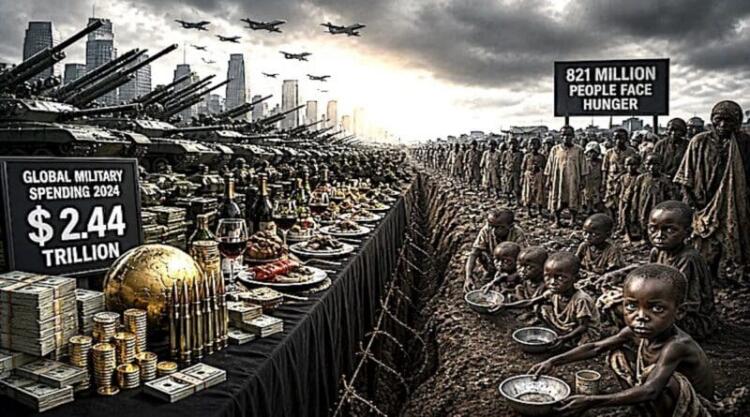
The contrast between military spending and hunger is stark:
- $2.887 trillion spent on the military
- Hundreds of millions are unable to access basic food.
A fraction of global military expenditure can transform food systems, strengthen resilience, and prevent famine.
Yet political priorities remain focused on security defined in narrow, state-centric terms.
This shows a deeper contradiction in the global system:
- Security is pursued through armament.
- Survival depends on food, climatic stability and economic opportunity.
The Decline of Multilateral Response
The growing concentration of hunger in conflict zones also emphasises the limitations of the current international system.
Multilateral institutions, especially the United Nations, are struggling to respond effectively due to:
- Funding shortfalls
- Political divisions among major powers
- Increasing complexity of crises
Geopolitical competition is weakening international cooperation.
The result is a fragmented global response to hunger, even as military coordination and alliances expand.
Rethinking Security in the 21st Century
The present trajectory raises fundamental questions about the meaning of security in the modern world.
Traditional security systems emphasise:
- Territorial defence
- Military capability
- Strategic protection
But the realities of the 21st Century demand a wider perspective that includes:
- Food security
- Climate resilience
- Economic consistency
- Human well-being
Without dealing with these dimensions, military strength alone cannot ensure stability.
Toward a More Stable Global Order
Data from the UN and SIPRI suggest an urgent need to rebalance global priorities. To turn this urgency into substantial change, policymakers can pursue concrete steps that directly address the imbalance between military spending and food security.
First, governments could establish mandatory budget allocation targets, setting a minimum percentage of national budgets to be invested in food systems and humanitarian aid, benchmarked against current levels of military expenditure.
Second, at the international level, countries could negotiate agreements requiring a portion of reductions in military budgets—such as through bilateral arms reduction treaties—to be earmarked for joint investments in food security and sustainable development projects.
Third, the creation of an international fund for food system robustness, financed by a modest levy on arms sales or transfers, might ensure a stable pool of resources for the most at-risk regions.
Finally, policymakers can advocate for transparent tracking and public reporting of military versus humanitarian spending, increasing accountability and fostering a shift in political priorities. By implementing mechanisms like these, global leaders can move beyond rhetoric and lay the foundations for an equitable and humane international order.
Key areas for action include:
- Investing in Food Systems
Greater investment in agriculture, infrastructure and resilience can reduce vulnerability to shocks and prevent crises.
- Strengthening Humanitarian Response
Reversing the decline in funding for food assistance is pivotal to addressing immediate needs. To make this possible, policymakers can consider a range of innovative funding strategies.
These include establishing multilateral financing mechanisms, such as pooled international funds dedicated to food security; encouraging public-private partnerships that leverage private-sector investment in humanitarian relief; and championing global pledging conferences where countries and philanthropic organisations make concrete commitments.
Additionally, applying small transaction taxes or voluntary solidarity contributions on select financial activities could generate new streams of humanitarian revenue. Harnessing new digital technologies and fintech platforms may also improve disclosure and attract broader citizen support for emergency food funds.
- Addressing Conflict
Resolving conflicts remains the most effective way to reduce hunger, given the strong link between war and food insecurity. To advance this goal, policymakers can prioritise diplomatic cooperation, including supporting inclusive peace negotiations and local mediation efforts that tackle the grievances of affected groups.
Promoting economic cooperation between rival groups, investing in conflict-sensitive development projects, and supporting community-driven reconciliation initiatives are proven strategies to break cycles of violence.
International partners can further incentivise peace by conditioning certain types of aid on progress in conflict resolution and by backing multilateral missions that monitor ceasefires or facilitate dialogue. By committing to diplomatic, economic, and peacebuilding measures at both national and regional levels, governments can help tackle the root causes of conflict-driven hunger and advance lasting stability.
- Reassigning Resources
Redirecting a small portion of military spending toward development could have far-reaching consequences. Governments can operationalise this shift through a range of practical mechanisms. For example, national legislatures can pass budgetary amendments or create earmarked funds that automatically allocate a fixed percentage of military expenditures to domestic development or international food assistance initiatives. On the international stage, countries could negotiate compacts that set joint targets for redirecting portions of future military budget growth toward sustainable development goals.
Furthermore, multilateral institutions such as the United Nations or regional bodies may facilitate agreements requiring each member state to contribute a share of defence savings to collective food security funds. These mechanisms grant concrete pathways for translating political commitments into enforceable, long-term resource shifts that address both immediate humanitarian needs and longer-term resilience.
A Choice Between Guns and Bread
The world sits at a crossroads. On one path lies continued militarisation, rising defence budgets, and deepening geopolitical rivalry. On the other hand, investment in human security: food, health, and sustainable development.
The current trajectory reveals that the balance is tilting toward the former.
Yet the consequences are increasingly visible: a world where hunger is concentrated, persistent and worsening, even as resources for war expand.
The juxtaposition of $2.887 trillion in military spending and 266 million people facing acute hunger is not simply a statistic—it is a moral and political indictment of global priorities.
Ultimately, the question is not whether the world has the resources to end hunger. It clearly does. The question is whether it has the will to choose bread over bullets.
In this decisive moment, policymakers have the power and responsibility to act decisively. It is time for concrete commitments: allocate a fixed share of budgets to food security, embed food system endurance in national and international agendas, and establish global mechanisms to track and transparently report on the balance between military and humanitarian spending.
Only through bold, coordinated policy choices can we shift the global order toward one that honestly values life and stability over conflict and crisis. The window for change is open. The world’s leaders must step through it—now.
About the author: Ramesh Jaura is affiliated with ACUNS, the Academic Council of the United Nations, and an accomplished journalist with sixty years of professional experience as a freelancer, head of Inter Press Service, and founder-editor of IDN-InDepthNews. His expertise is grounded in extensive field reporting and comprehensive coverage of international conferences and events. Subscribe for free or pay and stay updated. [IDN-InDepthNews]