By Darini Rajasingham-Senanayake*
COLOMBO, Sri Lanka | 30 June 2026 (IDN) — America’s war of choice on Iran has spread across the Indian Ocean World and maritime Silk Route. Starved of oil and gas, South and Southeast Asia’s emerging economies have seen their local currencies fall against the ‘exorbitantly privileged’ Petrodollar as public and private debt has increased amid soaring energy costs.
The US Fifth Fleet’s occupation and blockade of Indian Ocean trade routes targeting the Strait of Hormuz has shown the importance of the 1971 United Nations (UN) declaration of the ‘Indian Ocean as a Zone of Peace’ — for global security and prosperity.
55 years ago, the United Nations General Assembly (UNGA) led by the World’s first woman head of state, Prime Minister Sirimavo Bandaranaike of Ceylon, declared the Indian Ocean a ‘Zone of Peace’. Resolution 2832 (XXV1) affirmed that the vast Indian Ocean, together with the airspace above and the subjacent ocean floor, is, for all time, a “Zone of Peace”.
The bold resolution by the world’s first woman head of state 55 years ago has never been more relevant: De-militarizing and de-colonizing the Indian Ocean in line with UNGA Resolution 2832 is vital to sustain and deepen the fraying 60-day peace pause between Iran and the United States brokered by Pakistan and Qatar.
The Indian Ocean World’s maritime Silk Route, where Iran, formally Persia, sits, was the home of the world’s oldest and wealthiest sea-based trade system. For millennia, the Silk Route of the Seas, wherein the Straits of Hormuz is an integral part, connected the coastal regions and hinterlands of the Supercontinent of Asia with Africa and Europe– long before the US came into existence across the Atlantic Ocean in the “new world.
European invaders of the Indian Ocean World fought bloody battles to access, control, and colonise Indian Ocean sea lanes from the 17th century onward, much like the US today, which seeks to toll Indian Ocean shipping, wage hybrid economic warfare, and stymie the Asian 21st Century.
Strategic islands and waterways like the Malacca Straits and Hormuz were vital to control of Indian Ocean supply chains and trade routes, in order to access and loot the great wealth of Asian civilisations, particularly, Persia/Iran, India and China.
Indeed, to this day, the Indian Ocean remains fully decolonised. Distant water fishing states or non-Indian Ocean countries, France, Spain, Japan, Taiwan PRC etc. are some of the biggest looters of Indian Ocean fisheries with industrial trawler fleets according to data from the Indian Ocean Tuna Commission. Meanwhile, littoral states’ fisheries remain underdeveloped and “artisanal; dependent on Foreign Aid for de-industrialisation.
It was hence too that UNGA Resolution 2832 (XXV1) establishing the Indian Ocean Zone of Peace was spearheaded by the world’s first woman head of state, the Socialist Prime Minister Sirimavo Bandaranaike of Ceylon back in 1971 during the Cold War amid great power rivalry between the Soviet Union/Russia and the US.
Ceylon, now Sri Lanka, is geo-strategically located at the centre of the Indian Ocean World’s trade routes and supply chains. Hence, the country was perpetually in the crosshairs of great-power rivalry and subject to neocolonial projects, most recently by the International Monetary Fund (IMF), which has upended economic sovereignty and Energy policy autonomy in the Eurobond-debt-trapped country.
United Nations Mandate and IOZP
The Declaration of the Indian Ocean as a ‘Zone of Peace’ (IOZP), 55 years ago, has never been more relevant to global security, growth and decolonisation, which are Core Mandates, albeit seemingly forgotten at the UN.
The UNGA IOZP Resolution sought to ensure that the world’s busiest trade routes would be free of foreign bases, militarisation, and nuclear weapons during the long Cold War between the US and the Soviet Union/Russia. The great power rivalry had undermined development and decolonisation while driving proxy wars in Asia, Africa and South America.
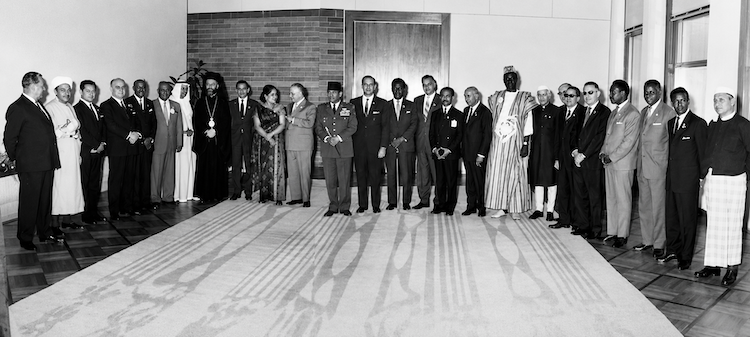
Ceylon’s Sirimavo Bandaranaike was aided by stalwarts of the Non-Aligned Movement (NAM) and the Global South: President Julius Kambarage Nyerere of the Republic of Tanzania in the western reach of the Indian Ocean later joined to co-sponsor UN Resolution 2832 (XXVI). It was a time of Afro-Asian, South-South cooperation. [i]
India’s Prime Minister Indira Gandhi of the Congress Party was a close friend of Ceylon’s Bandaranaike and a supporter of Palestine, unlike the current pro-Israeli Modi regime in New Delhi.
UNGA Resolution 2832 called upon big powers to enter into consultations with the littoral States of the Indian Ocean with a view to halting escalation of their military presence, and to eliminate all bases, military installations and logistical supply facilities, nuclear weapons, and other weapons of mass destruction.
In this context, should not UN Secretary General Antonio Guterres invoke the IOZP at this time to aid and deepen the tenuous peace agreement between Iran and the US? However, Guterres has preferred to focus on twin global ‘polycrisis’ narratives- pandemic health and Anthropocene climate disinformation.
The IOZP Declaration was made when Burma’s U Thant was the highly respected UN Secretary General and Asian Buddhist Principles of Panchaseel (5-principle virtues in Sanskrit), underpinned NAM diplomacy. Indeed, the current UNSG would do well to call on US President Trump to remove the US Fifth Fleet “Armada,” led by the aircraft carrier Abraham Lincoln, from the Indian Ocean to shore up the fraying peace agreement between Iran and the US at this time.
Priorities of the next UNSC: Return to Core Mandate amid New Cold War
The current US invasion and occupation of the Indian Ocean, far from America’s shores in the Atlantic and Pacific Ocean in order to blockade the Strait of Hormuz and starve Asian countries of energy, violates UNGA Resolution 2832.
The US has used the rhetoric of a ‘free and open Indo-Pacific” and ‘freedom of navigation’ ironically to militarise and blockade Indian Ocean trade routes and reroute energy supply chains to control markets, benefit corporate interests and prop up the Petrodollar as the BRICS de-dollarize.
President Trump’s alternating sanctions on Russian and Iranian oil seem designed to destabilise energy markets and sales. South and Southeast Asian countries, meanwhile, have been forced to buy expensive US oil and gas, thereby buttressing the Petrodollar, rather than sourcing cheaper oil from Asian neighbours and paying in local currency.
It is vital that the US cease and desist from aggression and occupation of Indian Ocean trade routes and plans to levy tolls from ships in the Indian Ocean. Rather, the US Armada would best return to the Atlantic Ocean, from which it came, to restore the Indian Ocean as a ‘Zone of Peace’ as envisaged by the world’s first woman head of state.
However, it appears that the legacy of Prime Minister Sirimavo Bandaranaike’s declaration of the IOZP has been forgotten at the UN, ironically, even as its corridors buzz with debate over the gender of the next UN Secretary General, as the current UNSG’s term thankfully draws to an end.
It is increasingly clear that the gender of the next UNSG is irrelevant to making the UN relevant again. What is clear at this time is that the next UNSG should be from the Global South and a strong voice for Economic Justice for the Global South. Likewise, the priority of the next UN Secretary General would be to streamline the organisation and its agencies, literally cull the fat, in order to focus on Core Mandates of de-colonisation, peace and security.
Anxieties of the American Empire: Undoing Indo-Pac Com
The UN has evolved as a behemoth in recent times with proliferating development and humanitarian agencies funded and controlled by corporate interests wedded to Disaster Capitalism and the Deep State. The current UN Secretary General Antonio Guterres, meanwhile, prefers to talk up ‘global polycrisis’ narratives of climate disaster that mask geoengineering and weather warfare, and health emergency while sidestepping their real causes, including awkward subjects like Gain-of-Function research, Covid-19 origins in biowarfare labs, directed energy weapons and geoengineering for weather warfare in the fake Anthropocene.
A firm voice for peace, decolonisation and Economic Justice for the Global South is needed from the august body and is solely missed the world over at this time. The UN seems to have abandoned its primary mandate of peace, security and de-colonisation at this time.
This too has enabled and emboldened the current attempt by Washington to occupy and colonise the Indian Ocean, and levy tolls on ships plying the maritime silk route. This, ironically, despite President Trump’s and his MAGA base’s preference for American isolationism and anti-immigrant policies.
Does the US attempt to toll ships in the Indian Ocean reflect deep-seated insecurities of a declining Empire in an increasingly multipolar world, also given the history and geography of the Supercontinent of Asia?
The Americas are separate from the Supercontinent of Asia by the vast Atlantic and Pacific Oceans. The US is geographically distant from ‘Mackinder’s heartland’ — the interconnected landmass of Asia, Africa, and the European Peninsula, traversed by ancient and modern land and maritime Silk Routes, and the growth hub of the world. As a multipolar world emerges, enabling the next Asian Century, is the US anxious about its global relevance, given its distance from the earth’s heartlands and population centres?
Are Washington’s imperial anxieties the reason US intelligence think tanks sought to reinvent the world’s oceanic geography and history by coining the “Indo-Pacific” neologism and partitioning the Indian Ocean World? And is the tide turning? The US Indo-Pacific Command recently dropped the “Indo” and reverted to Pac Com.
From Greenland to Chagos Islands: With a little help from Andy Burnham
When the Indian Ocean was declared a Zone of Peace in 1971, the United Kingdom and the US had forcibly displaced the native population of the Chagos Islands to build the huge Diego Garcia military base. Chagos Islands, called the British Indian Ocean Territory (BIOT) by some, had been colonised at a time when Britannia ruled the waves. That was an era of British imperialism when the vast Indian Ocean was referred to as a ‘British Lake’ or Pond.
Today there’s news that President Trump seeks to buy the occupied Chagos Islands from Mauritius, much like he sought to purchase Greenland from Denmark. The huge environment-polluting US-UK Diego Garcia military base is located due southwest of Sri Lanka and the Maldives.
US Purchase of the Chagos Islands would no doubt need help from the latest British Prime Minister, Andy Burnham, who supported Tony Blair’s Iraq war adventure in search of non-existent weapons of mass destruction before doing a volte face.
It was from the Diego Garcia military base that US missiles recently targeted Iran across the Indian Ocean, and US aeroplanes flew bombing missions over Afghanistan during America’s global war on terror. It was only in March 2019 that the International Court of Justice (ICJ) ruled that the UK and US occupation of the Chagos Islands was illegal under international law.
Any sale of the Chagos Islands would also require the Modi Government in New Delhi to turn a blind eye to US-led hyper-militarisation of the Indian Ocean. The land-locked Modi regime in north India appears to have turned its back on the Indian Ocean-facing South Indian Dravidian States– Tamil Nadu, Kerala, Andhra, and Karnataka — whose seamen constitute the majority of Indian sailors who have perished due to the US blockade of the Strait of Hormuz.
Foreign Minister Jaishankar has ignored the IOZP declaration, which was supported by Congress Prime Minister Indira Gandhi 55 years ago. Dr Jaishankar has preferred to sign up to the US-led new ‘security architecture’ in the Indian Ocean and related environment-polluting war games such as the Malabar exercises, which saw whales and dolphins dying en masse in Sri Lanka in 2022. The new US-led military security architecture of the Indian Ocean, clearly targeting China and Iran, includes the QUAD (India, Japan, Australia, and the US) in the eastern part and I2U2 (Israel, India, the UAE, and the US) in the western Indian Ocean.
India remains excluded from the white racist nuclear submarine club, AUKUS comprised of Australia, UK and US, targeting China and the Indian Ocean World.
From Chagos Islands to Sri Lanka
Spearheading the UNGA declaration of the Indian Ocean as a ‘Zone of Peace’ in 1971, Ceylon’s Sirimavo Bandaranaike was acutely aware of the geostrategic location of her country for control of Indian Ocean trade and energy supply chains.
Sri Lanka was called an ‘unsinkable aircraft carrier’ and valuable real estate in the Indian Ocean. Although the wealthiest country in South Asia by all metrics except the exorbitantly privileged US dollar, Sri Lanka is now ensnared in a Eurobond debt trap. It was forced to stage a sovereign default, enabling the Washington Consensus (IMF and WB) to upend Economic Sovereignty and Energy Policy Autonomy by controlling the Central Bank as the US Cold War in the Indian Ocean heated up in 2022. Because of its geostrategic location, the country has long been an aid-dependent OECD ‘donor darling’.
Geostrategic Sri Lanka is once again clearly in the crosshairs of big-power rivalry, given Chinese investments in the teardrop island, particularly the Hambantota Port, which the US Central Intelligence Agency has deemed a “String of Pearls” harbour.
Thus, in the first week of March, to kick off the illegal war on Iran and the Indian Ocean world, the US torpedoed an Iranian frigate, killing 85 sailors in the seas of Sri Lanka. The Sri Lanka Navy was able to save some of the survivors of the sunken IRIS Dena and provided humanitarian rescue to mitigate the US war crime in Sri Lanka’s maritime Exclusive Economic Zone.
Yet there were few protests when US Assistant Secretary of State for South and Central Asia, Paul Kapur, declared the Sri Lanka Navy a partner of the US Indo-Pacific Strategy last week on board a gifted frigate.
Kapur, a member of the weaponised Indo-American Diaspora, delivered Satellite communications technology and 10 helicopters, Trojan horse gifts, no doubt to help the US war machine to surveil, monitor and torpedo as necessary Indian Ocean shipping lanes from Sri Lanka in the next bout of war on Iran and China once the 60-day pause is done.[ii] All this begs the question: would the SL Navy be partners to future US war crimes in the Indian Ocean henceforth?
Meanwhile, the Fake Left National People’s Power regime in Colombo has kept a deadly, deathly silence about US war crimes in the Indian Ocean – betraying Socialist Prime Minister Sirimavo Bandaranike’s bold vision for Peace at the centre of the Indian Ocean World.
It is nevertheless to be hoped that Prime Minister Dr Harini Amarasuriya may try to live up to the legacy of her predecessor who declared the ‘Indian Ocean a Zone of Peace for all time’ with great prescience. The UN and Foreign Ministry of Sri Lanka should host an International Conference to mark 55 years of IOZP this December 16, given its relevance to Global Peace and Security amid renewed attempts by some NATO countries to occupy and colonise the Indian Ocean World.
*Dr Darini Rajasingham-Senanayake is a social and medical anthropologist with expertise in international development and political-economic analysis. She was a member of the International Steering Group of the North-South Institute project: “Southern Perspectives on Reform of the International Aid Architecture”. [IDN-InDepthNews]
[i] https://polsci.institute/international-relations/non-aligned-movement-theory-practice-impact/
[ii] https://island.lk/us-declares-sln-its-indo-pacific-partner/