
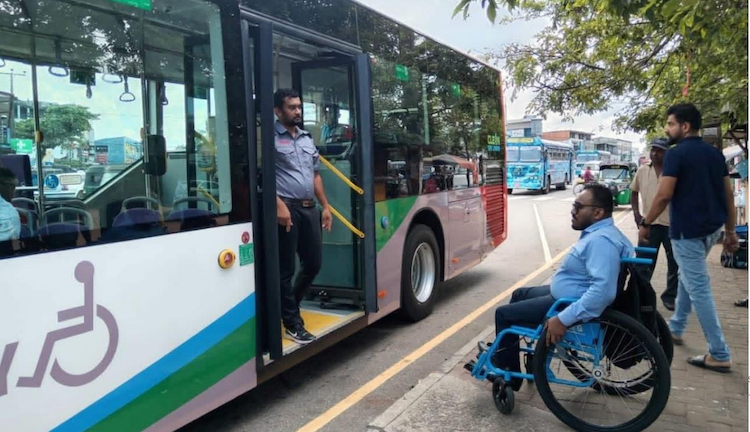
A schoolboy commuter’s memories of Sri Lanka in the 1980s and 90s — and a look at the country’s new Metro Bus service.
By Feroz Deen*
COLOMBO | 24 October 2026 (IDN) — In the 1980s and 90s, catching a bus in Sri Lanka was an adventure. Getting on was a struggle, never mind getting a seat. As teenagers, hanging on the footboard of a bus was the equivalent of a Sathutu Uyana jet ride at Viharamahadevi Park — the only theme park many Sri Lankan kids had access to back then.
As I grew older, I realised how dangerous — and potentially fatal — riding on the footboard could be. I would never encourage anyone to do it today.
On the bus, passengers smoked despite signs prohibiting it. It was a time when smoking was taken much more lightly. I remember a friend of mine, arrogant as only a teenager can be, telling off an older man for lighting up. Nobody was quite sure who had won.
On the way home from Wesley College, Borella Junction was the big stop. The driver wouldn’t move until he had collected his quota of passengers. And if another bus tried to overtake, the Grand Prix would begin.
The bus brought its own cast of characters. There was the travelling vendor shouting “topi, cigarette, vadai” as he squeezed down the aisle. There was the blind duo singing virindu, improvised folk verse, to the beat of a hand rabana. And now and then you would see some bloke slapped for trying to pick a pocket — or for rubbing against a woman in a jam-packed bus.
Then there was the conductor, the other great character. He screamed at passengers to pack in like sardines. He never gave back your change unless you asked, so we learned always to carry the exact fare. There were no electronic tickets and often no ticket at all.
And I’m not sure if this was a world first, but Sri Lankan conductors shouted their destinations to anyone within earshot: “Nugegoda! Maharagama! Kottawa, Kottawa!” He sounded like a man selling vegetables at the Sunday pola.
It was chaos, and sometimes it was a party. I wouldn’t wish it on any commuter today.
A very different bus
Sri Lanka’s bus system is now being overhauled, with the Metro Bus service operating on seven routes in the Western Province. A total of 122 air-conditioned, low-floor buses are now in service.
I smiled when I read the route list because CM01 and CM02 both pass through areas familiar from those school days. The junction where my driver once waited for his quota now has buses operating to published timetables.
Officials say a new digital system links buses and drivers, offering route and schedule information and real-time tracking.
The shouting conductor is also on his way out. Passengers can use digital payment systems as well as cash. A bus that tells you where it is on an app would have seemed like science fiction to a schoolboy back then.
Will it work? Will it last?
Early signs on the first question are encouraging.
One daily commuter told The Morning that the service was more comfortable than ordinary public transport, praising the scheduled departures and less crowded environment. However, the new system has also generated friction with existing private operators.
On the second question, I’m less sure.
Police are investigating a series of collisions and incidents involving private buses and Metro buses. Authorities have said some cases may have involved deliberate obstruction or damage, though investigations and court proceedings are continuing.
Nothing should be assumed before the investigations are completed.
But to anyone who remembers the old bus Grand Prix, the dispute has a familiar ring.
The question every government should be asked
Sri Lankans know what can happen when buses become entangled in politics.
On 9 May 2022, hundreds of supporters of then Prime Minister Mahinda Rajapaksa arrived by bus at his official residence in Colombo. Violence followed after government supporters attacked anti-government demonstrators. Later that day, dozens of buses used to transport Rajapaksa supporters were torched or damaged across the country, while two buses were pushed into Beira Lake.
The buses became targets because of what they had been used for.
That raises a question for every government, including the present NPP administration: will public transport remain a service for commuters, or will buses once again be used to ferry political crowds?
The lesson of May 2022 is about how buses are used. Keep them for commuters and out of party politics, and they have the best protection a public service can have: the public’s goodwill.
I can’t tell you whether the new system will last. But I know how I’ll judge it.
When a conductor — or an app — hands me my change without being asked, I’ll believe Sri Lanka has changed not only its transport system, but its old bus culture.
Until then, I’ll keep the exact fare ready.
*Feroz Deen is a former broadcast journalist based in Colombo. (IDN-InDepthNews)