
By Katinka Weinberger and Mizuho Okimoto-Kaewtathip*
BANGKOK | 23 October 2026 (IDN) — Eradicating poverty in all its forms is one of the most pressing development challenges across Asia and the Pacific. While the region has made remarkable progress in reducing poverty over recent decades, multiple and overlapping crises have exposed the fragility of these achievements and highlighted how easily gains can be reversed.
Poverty is a dynamic phenomenon shaped by structural drivers that reinforce vulnerability and widen inequalities across societies and generations. Economic growth has been the main driver of poverty reduction in the region, but inequality has weakened its impact and undermined the full benefits of this progress. Inequalities slow economic progress and trap many countries in chronic poverty patterns that can persist across generations.
In our region, poverty is shaped by the intersection of human capital deficits, environmental degradation and climate change, digitalisation and demographic transition. These interconnected challenges widen disparities across income, gender, age, disabilities, geographic location and occupation. At the same time, geopolitical dynamics, volatile global markets and pressures on development financing further constrain the policy choices available to many countries.
The Asia-Pacific region bears a double burden of climate hazards and multidimensional poverty. Among the MPI poor across the region, 67% are exposed to heat, 72% to floods and 80% to air pollution. These overlapping risks weaken livelihoods, erode resilience and trap people in chronic poverty.
Share of Multidimensional Poverty Index (MPI) poor population exposed to climate hazards across Asia-Pacific region

Source: ESCAP calculations based on aggregated estimates from Oxford Poverty and Human Development Initiative (OPHI)
Poverty is not coincidental; it is an outcome of policy choices. Deficits in human capital are a cumulative result of underinvestment in education, health and nutrition, and institutional gaps that limit equitable access to essential services. Climate vulnerability reflects decisions on mitigation, adaptation and access to protection against risks. Digital divides stem from choices on infrastructure, regulation and access. Economic security of households is also shaped by how countries engage with global markets and navigate fiscal constraints.
A rights-based approach to poverty
As such, reinvigorating a rights-based approach to poverty reduction resets the focus on supporting policy choices that enable people to live with dignity, build secure livelihoods, access opportunities and exercise agency over their lives. Recognising people as rights holders and poverty as a multidimensional challenge shifts attention from addressing symptoms to tackling the structural drivers of exclusion, vulnerability and inequality. Securing this momentum is critical, given the multiple crises that could reverse support for the most essential needs, exacerbating vulnerability and human insecurity.
At the heart of the renewed momentum for a rights-based approach to poverty are integrated policy actions that concurrently address economic, social and environmental objectives. Integrated policy approaches are particularly important in a region where climate change, digitalisation and demographic transitions increasingly intersect with existing inequalities and vulnerabilities. Such interventions maximise policy coherence and impact, bringing systemic changes for collective well-being. When people are empowered to set priorities, negotiate terms, and co-design policies that directly affect their well-being, policy choices optimise impact and reinforce social cohesion.
ESCAP’s Social Outlook for Asia and the Pacific 2026 provides several recommendations towards building stronger synergies across policies in support of human rights-based approaches to poverty reduction:
- Invest in human capital across the life course. Expanding equitable access to quality education, universal healthcare and food security provides strong foundations for human capital development and helps break the intergenerational cycles of poverty amid intersecting shocks.
- Build inclusive, comprehensive and future-fit universal social protection systems to reduce poverty, ensure income security and help individuals meet their basic needs throughout the life course. Multifaceted programmes that combine cash transfers with livelihood support, skills development, financial inclusion and employment programmes are much-needed solutions to tackle economic uncertainty and spending pressures.
- Design and implement effective job strategies through re-skilling and upskilling, improve employment terms, and remove barriers to job markets to unlock contributions from informal workers, women, youth, persons with disabilities, and persons outside the labour force.
- Leverage cooperatives and the Social and Solidarity Economy to strengthen community resilience, expand economic opportunities, build human and social capital and enhance resilience to climate and environmental shocks.
A rights-based approach to poverty reduction will also require stronger data systems to measure, analyse, disaggregate and monitor progress to guide inclusive policy design and ensure that policies respond to changing risks and vulnerabilities. Regional collaboration is central to translating shared regional solutions into nationally adapted and evidence-based policies and implementation plans. This ensures that progress toward poverty eradication is inclusive, resilient and sustainable.
Poverty eradication remains achievable. But achieving it will require renewed commitment to policy choices that place people, dignity, resilience and inclusion at the centre of development. Only then can the region ensure that progress is shared by all and that future generations are not trapped by today’s inequalities and vulnerabilities.
*Katinka Weinberger, Chief, Socioeconomic Transformations Section, Social Development Division, ESCAP, and Mizuho Okimoto-Kaewtathip, Expert, Inclusive Social Development, Social Development Division, ESCAP
—
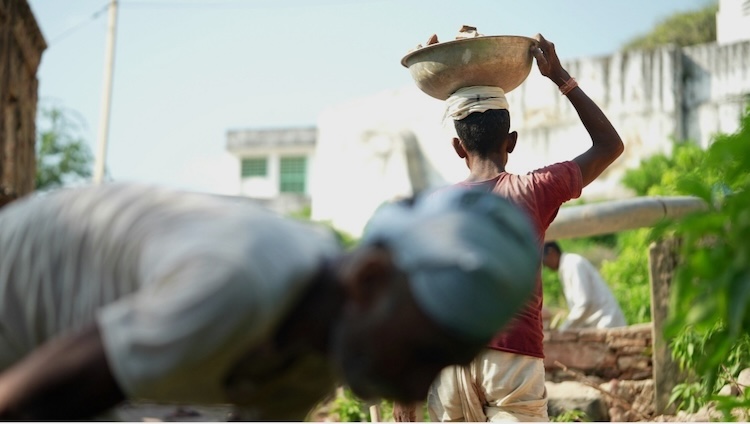
Caption: Workers in Rajasthan, India, are working in heat. Environmental degradation and climate change have complicated poverty alleviation. Policymakers need to build social capital and enhance resilience to climate and environmental shocks.
Credit: Unsplash/Mayur Tela
Source: https://unsplash.com/photos/a-man-carrying-a-bowl-on-his-head-Esr95JMPks0