
By Jan Servaes
BRUSSELS | 18 July 2026 (IDN) — Traditional American historiography is often criticised for presenting simplistic, one-dimensional portraits of historical figures and events, thereby concealing complex realities and controversial aspects. Traditional historiography therefore tends to gloss over events and the broader struggle of marginalised groups, and to glorify a select few key figures.
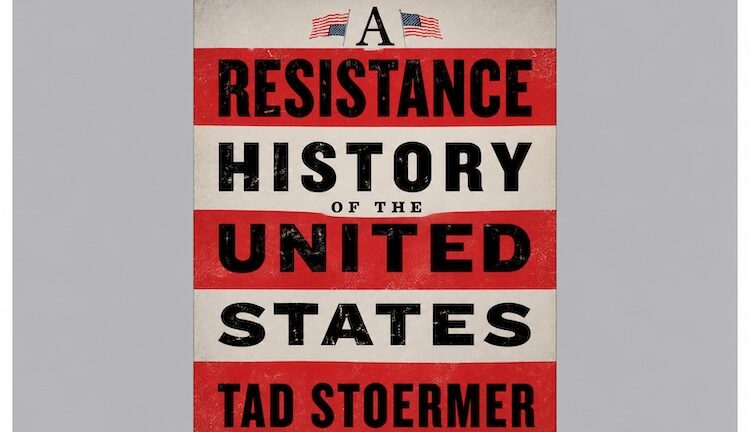
Tad Stoermer’s ‘A Resistance History of the United States‘ challenges this type of traditional historiography by emphasising the role of resistance in shaping American history.
“This is a resistance history of the United States — a history of how people forced change against institutions built to prevent it and how those institutions adapted to contain the changes resisters achieved” (p. 1).

Tad (Taylor) Stoermer is a veteran of the U.S. Army. He earned degrees from Harvard University, Johns Hopkins University, and Tulane University School of Law, and a doctorate in history from the University of Virginia, where he specialised in the American Revolution.
He taught at renowned historical academic institutions such as Harvard, Virginia, Colonial Williamsburg, Brown, and Yale. Stoermer also played a key role in digital history initiatives and was part of an Emmy-winning team for the documentary “The Global Economy” in 2013.
As a film and digital media editor, Stoermer bridges the gap between scholarship and media, ensuring that sound historical analyses reach a broad audience. With over 600,000 followers on TikTok, Instagram, and YouTube, he is one of the most followed public historians online. His work has become a reliable source for anyone seeking to debunk misinformation and expose the carefully crafted nostalgia, moral evasions, and institutional silence in American history. His work confronts the past on its own terms, without the comforting filters that make it easier to ignore hard truths. The documentary “The Good Americans” and this book are excellent examples of this.
The complexity of power and oppression
For Stoermer, resistance is essential for understanding American history because it exposes the complexity of power and oppression rather than a simple story of progress. Stoermer argues that the version of American history most people learn has been sanitised and turned into an instrument of power. It is shaped to reassure those who benefit from the status quo and to conceal the complex reality of oppression and resistance.
Stoermer emphasises that the true historical significance lies in the actions of those who resist authority, and underscores the importance of rediscovering these stories to address current injustices.
According to Tad Stoermer, American history is therefore not a reassuring story of steady progress or a collection of wise founders. It is a battlefield of memory and myth, a story constantly being rewritten by those in power to justify their authority and erase the voices of those who resist.
Stoemer therefore focuses on the often-overlooked stories of resistance to oppression. He advocates a fairer, more confrontational approach to public historiography. The book criticizes how mainstream historiography often presents a simplified version of events, which reassures those in power and conceals the reality of oppression.
In nine chapters, Stroemer examines the moments when people refused to accept the narratives intended to justify them. Resistance to abuse of power took many forms: the rebellion of the indigenous population led by the sachem Metacomet (1676), a rebellion that grew into “relatively the deadliest war in American history for the colonists,” a war that schoolbooks would rather forget in favor of rosy stories about the first Thanksgiving; the women and men in Salem who refused to confess to witchcraft (1692); the Black Loyalists who seized their own freedom during the American Revolutionary War (1783); the Antifederalists who forced through a Bill of Rights to limit the power of nationalists. Later generations continued their resistance on new ground: Ona Judge’s escape from slavery, Henry David Thoreau’s challenge to the state, the clandestine networks of the Underground Railroad (1850), and the uncompromising determination of John Brown and the Six, whose actions pushed the nation toward a civil war and paved the way for the radical Republicans’ struggle to build a new republic from the ruins.
Debunking Myths
The book effectively debunks popular myths surrounding major historical events by exposing their complexity and contradictions. According to Stoermer, the American Revolution is one of the clearest examples of how myth replaces truth. It was not a unified call for freedom, but a contested and complex struggle.
It challenges romanticised versions of history and focuses on the complexity of oppression and the active role of ordinary people in the fight against injustice. According to Stoermer, resistance is the true driving force behind American history. The figures that matter most are not those who signed declarations or held office, but those who defied power without waiting for permission.
Stoermer therefore calls upon public historians to actively engage with the past, to challenge distorted narratives, and to place the voices of the oppressed at the centre.
Truth over ‘balance’
Stoermer rejects the idea that public history must strive for ‘balance’. After all, not all viewpoints are equally valid. Telling the truth often means challenging the stories that offer people comfort. And that can be dangerous.
But it is essential. Public historians must expose propaganda, challenge distorted narratives, and be clear about the facts – especially when those facts debunk patriotic myths or sugarcoated versions of slavery and racism.
Institutions will not save us
The most important lesson of the history of resistance, he says, is that power and institutions do not collapse on their own. They must be forced to surrender. There is no return to a lost normal. People are waiting for leaders to rise and for institutions to correct course. But the institutions have failed, the opposition has surrendered, and authoritarianism will not stop unless it is forced to stop.
“This is what history teaches us time and again. And it is what people would rather not hear.”
Public history, as Stoermer describes it, is therefore not a neutral space. The way we tell stories in museums, classrooms, historical sites, or on social media helps determine who is in power today. Stoermer emphasises critical thinking, empathy, and the need to face uncomfortable truths.
The role of historians
Stoermer’s larger project is to make American history harder to misuse: not by replacing one mythology with another, but by paying closer attention to what people actually did, what they risked, what they misunderstood, and what their choices still reveal about power in the United States.
Historical locations, or social media, help determine who is in power today. Stoermer emphasises critical thinking, empathy, and the need to face uncomfortable truths. He has influenced a generation of public historians, museum staff, and educators by advocating for academic freedom and the importance of telling stories that institutions have often avoided. Historians, he believes, must not merely document resistance; they must put it into practice. That means exposing lies, refusing to soften the past, and telling the stories of those who stood in resistance.
Resistance History Toolkit
The book concludes with a ‘Resistance History Toolkit’ (pp. 324-354) in which the nine principles elaborated above are listed once again:
Principle #1: Beware False Prophets – Learn to Recognise False Resistance
Principle #2: More Weight – Refuse to Validate the Lie
Principle #3: My Enemy’s Enemy – Your Ally Doesn’t Have to Be Pure
Principle #4: Force the Fight, Even when you’re Losing
Principle #5: Resistance is a Lifetime, Not a Moment
Principle #6: Ideas Matter – Know What You’re Fighting For, Not Just What You’re Against
Principle #7: Forge the Chain – Build the Infrastructure: Individual Courage isn’t Enough
Principle #8: Arming the Ghosts of Freedom – Whatever it Takes
Principle #9: Seize the Day –When Resistance Achieves Power. Use it.
“The history in this book isn’t about the past. It is about the patterns that recur whenever authority abuses itself, and about whether people decide to submit or resist. Those patterns are playing out around you right now. The only question is whether you’re ready to see them – and what you’ll do when you do” (p. 354).
In short
Tad Stoermer’s ‘A Resistance History of the United States’ is a bold and necessary correction to traditional contributions on American history. Stoermer’s view of history is neither comfortable nor neutral. It is a call to action.
Stoermer offers a framework for understanding the complexity of the American past and the ongoing struggle for justice. A source of inspiration for those fighting for democratic rights against authoritarianism. His concluding words serve as both a warning and an encouragement: “Stay steadfast. Stay responsible. And above all, stay alert.”
Reference
Tad Stoermer (2026), A Resistance History of the United States, Steerforth Press / Penguin Random House, 358 pp. ISBN: 978-1-58642-436-7 [IDN-InDepthNews]