
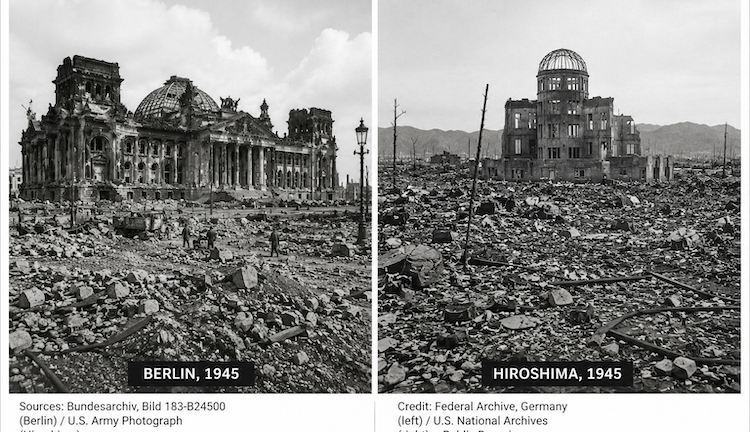
From Defeat to Dependence
Eighty years after World War II, Germany and Japan—once defined by constitutional restraints on military power—are rebuilding their armed forces as the international order grows increasingly uncertain. Their transformation is reviving old debates about war, memory, nuclear weapons and the fragile foundations of global stability.
By Ramesh Jaura
This article was first published on rjaura@substack.com
BERLIN | 9 June 2026 (IDN) — On a grey autumn afternoon outside the Reichstag, Germany’s parliament, a small but determined crowd gathered beneath overcast skies. Some carried banners calling for negotiations and diplomacy instead of additional weapons deliveries. Others held signs bearing a slogan familiar to generations of peace activists since the Cold War: Frieden schaffen ohne Waffen—creating peace without weapons.
Many among them had marched before. Some had protested against NATO missile deployments in the 1980s. Others had rallied against the Iraq War or campaigned for nuclear disarmament. Now they stood alongside a younger generation concerned that billions of euros earmarked for defence might come at the expense of housing, healthcare, education or climate action.
Their motivations differed, but beneath them lay a common anxiety: the fear that Germany could be moving toward a future in which military power once again occupies a central place in national life.
Nearly 9,000 kilometres away, a similar unease was taking shape in Tokyo.
Outside Japan’s National Diet, elderly survivors of Hiroshima and Nagasaki stood shoulder to shoulder with students carrying placards defending Article 9 of the Japanese Constitution. For decades, this clause renouncing war has served as the moral cornerstone of postwar Japan. Labour activists, constitutional scholars, peace advocates and civic groups joined the gathering, sending a clear message to a government that is rapidly increasing defence spending and expanding military capabilities amid rising tensions across Asia.
The scenes unfolding in Berlin and Tokyo reveal two parallel stories converging at a pivotal moment in history.
One is the story of governments responding to a world that appears more dangerous and unpredictable than at any time in recent decades. The other is the story of citizens who fear that, in confronting those dangers, their countries may be dismantling the very restraints that helped define them after World War II.
This tension lies at the heart of one of the most significant—and least fully understood—transformations in contemporary international politics.
Eighty years after the defeat of Nazi Germany and Imperial Japan, the two nations that became global symbols of constitutional restraint are rearming at a pace unseen in generations.
In Germany, the government has created a €100 billion special fund for the Bundeswehr and has committed to meeting NATO’s target of spending at least 2 per cent of gross domestic product on defence. The programme includes the purchase of F-35 fighter aircraft, the modernisation of tanks and air-defence systems, and deeper participation in European military-industrial projects.
Japan is undertaking an equally dramatic shift. Tokyo has launched the largest expansion of its defence capabilities since 1945, increasing military expenditure by more than 20 per cent over five years and acquiring long-range strike capabilities for the first time in the postwar era. The government has also concluded new security agreements with partners, including the United States, Britain and Australia, while strengthening the Self-Defence Forces in response to China’s military rise, North Korea’s missile programmes and growing uncertainty about the future balance of power in the Indo-Pacific.
Yet this story is about far more than military budgets, tanks or missiles.
It is also a story about memory, identity and power.
Countries that once defined themselves by rejecting militarism are now confronting a world in which military strength has once again become a central currency of international politics.
Germany’s Chancellor Friedrich Merz, born in 1955, and Japan’s Prime Minister Shigeru Ishiba, born in 1957, belong to the first generation of leaders governing their countries without any personal memory of war, occupation or postwar reconstruction. They inherited the lessons of World War II rather than experiencing them directly.
That distinction may be more consequential than it first appears.
For much of the postwar era, Germany and Japan represented remarkable political experiments. Both achieved prosperity without militarism, influence without great military power and security through alliances, diplomacy and economic integration. Their success was so striking that many assumed the model would endure indefinitely.
Today, that assumption is under unprecedented strain.
Constitutions Born from Defeat
Germany and Japan emerged from the devastation of World War II carrying similar burdens of history, yet they adopted constitutional frameworks that reflected different interpretations of what had gone wrong.
Germany’s Basic Law, enacted in 1949, was drafted amid the ruins of a nation that had brought catastrophe upon Europe and itself. Its architects were determined to ensure that dictatorship, militarism and aggressive war could never return. Democratic safeguards were woven deeply into the political system. The constitution prohibited preparations for wars of aggression and placed exceptional emphasis on human rights, parliamentary accountability and the rule of law.
At the same time, Germany’s Basic Law did not ban armed forces.
Its authors concluded that military institutions were not inherently dangerous. The real danger, they believed, emerged when military power escaped democratic oversight and civilian control.
Japan’s constitution reflected a more radical conclusion.
Article 9 famously renounced war as a sovereign right and declared that “land, sea and air forces, as well as other war potential, will never be maintained.” Few constitutional provisions anywhere in the world have acquired such profound symbolic significance.
For many Japanese citizens, Article 9 became far more than a legal clause. It evolved into a national pledge that the horrors of Hiroshima, Nagasaki and wartime militarism would never be repeated.
Yet strategic realities eventually compelled both countries to adapt.
West Germany established the Bundeswehr in 1955 after joining NATO. Japan created the Self-Defence Forces a year earlier, arguing that self-defence remained an inherent right of any sovereign state.
Even then, an important distinction remained.
Germany’s constitution was fundamentally anti-aggression.
Japan’s constitution was fundamentally anti-war.
That difference continues to shape political debates today.
When German leaders advocate stronger armed forces, they operate within a constitutional framework that already accepts the legitimacy of military power under democratic control. Japanese leaders, by contrast, must continually explain how expanding military capabilities can remain consistent with both the letter and spirit of Article 9.
The question has never entirely disappeared. It has simply become more urgent.
Adenauer and the Question Nobody Wanted to Ask
The story of postwar Germany is often told as a narrative of reconciliation, economic recovery and democratic restraint. Less often acknowledged is the extent to which some of Germany’s founding leaders worried about the risks of strategic dependence.
No figure embodied that dilemma more clearly than Konrad Adenauer.
Today, Adenauer is remembered as the statesman who anchored West Germany firmly within the Western alliance, championed European integration and helped transform a defeated nation into a respected democracy. Yet he was also a hard-headed realist who understood that the Cold War was not merely an ideological contest between capitalism and communism. It was a struggle shaped by power, alliances and, increasingly, nuclear weapons.
By the mid-1950s, the nuclear age was rapidly reshaping international politics. The United States and the Soviet Union possessed expanding atomic arsenals. Britain had joined the nuclear club, while France was moving steadily in the same direction.
West Germany, positioned on the fault line between East and West, faced a troubling reality. If a major conflict erupted, German territory would likely become the principal battlefield, even though decisions about war and peace would be made elsewhere.
Adenauer found that prospect deeply unsettling.
During discussions with President Dwight Eisenhower and senior American officials in Washington, he repeatedly explored ways in which West Germany could participate more directly in NATO’s nuclear planning and strategic decision-making. He supported proposals for multinational nuclear arrangements within the alliance and encouraged discussions about European frameworks that might preserve a future nuclear option.
His views often alarmed contemporaries.
When Adenauer described tactical nuclear weapons as “a further development of artillery,” critics accused him of trivialising the unprecedented destructive power of atomic warfare. Yet the remark reflected something more complex than casual acceptance of nuclear weapons.
At its core, Adenauer was grappling with a question that remains relevant today:
How much sovereignty does a nation truly possess when its ultimate security depends entirely on decisions made by others?
The Soviet Union viewed such discussions with deep suspicion. For Moscow, any potential German role in nuclear strategy was profoundly disturbing. Memories of the Nazi invasion remained vivid throughout the Soviet leadership, and the prospect of a technologically advanced Germany acquiring influence over nuclear weapons raised fears that history might one day repeat itself in a new form.
Historians continue to debate the precise significance of those concerns. Nevertheless, many agree that what became known as the “German nuclear question” contributed to the diplomatic momentum that eventually produced the Nuclear Non-Proliferation Treaty (NPT) in 1968.
The treaty emerged from multiple anxieties. Policymakers feared a worldwide cascade of nuclear proliferation. China’s emergence as a nuclear power heightened those concerns. Washington and Moscow were also searching for ways to stabilise an increasingly dangerous arms race.
Yet Germany was never far from the calculations of either superpower.
Both the United States and the Soviet Union wanted assurances that nuclear weapons would not spread to technologically sophisticated states capable of developing them relatively quickly.
In that sense, Adenauer’s ambitions illuminated one of the central dilemmas that the NPT was designed to address.
The problem he identified has never entirely disappeared.
It has simply evolved.
Today, Germany remains firmly committed to the Non-Proliferation Treaty and relies on NATO’s nuclear-sharing arrangements rather than pursuing an independent nuclear capability. Yet the underlying question Adenauer raised continues to resonate whenever Europeans debate strategic autonomy, nuclear deterrence or the long-term reliability of American security guarantees.
The issue is no longer whether Germany should possess nuclear weapons.
The issue is whether a nation can ever feel fully secure when the ultimate instruments of its defence remain under someone else’s control.
Living Under the American Umbrella
For most of the postwar era, Germany and Japan avoided confronting many of the strategic dilemmas that had troubled leaders such as Adenauer.
The reason was simple: both lived under the protection of the United States.
American troops remained stationed on their soil. The U.S. nuclear umbrella served as the ultimate guarantor of security. In Europe, NATO provided collective defence for West Germany. In Asia, the U.S.-Japan alliance fulfilled a similar role.
The arrangement allowed both nations to devote extraordinary energy and resources to economic growth rather than military competition.
The results were remarkable.
Germany emerged as Europe’s economic powerhouse. Japan became one of the world’s leading industrial and technological giants. Factories, universities and export industries flourished while defence spending remained comparatively restrained. The postwar generations that grew up in both countries came to regard military conflict among advanced industrial democracies as increasingly unlikely, if not unthinkable.
The end of the Cold War appeared to confirm that assumption.
When the Berlin Wall fell in November 1989 and the Soviet Union collapsed two years later, many believed they were witnessing not merely the end of a geopolitical confrontation but the beginning of an entirely new era.
The world seemed to be moving in a single direction.
Democracy was expanding. Global trade was accelerating. International institutions were growing in influence. Economic interdependence appeared to be replacing traditional power politics.
For Germany, the moment felt almost transformative.
Reunification restored national unity. The European Union deepened integration across the continent. Former Cold War divisions gradually faded. Many policymakers came to believe that Europe’s future would be shaped less by military power than by economic cooperation and shared prosperity.
Trade became more than an economic instrument.
It became a strategic philosophy.
Successive German governments cultivated close commercial ties with Russia, convinced that economic integration would encourage moderation, strengthen mutual interests and reduce the likelihood of future conflict.
Japan pursued a comparable logic in Asia.
Despite unresolved territorial disputes and regional tensions, Tokyo increasingly relied on trade, investment and economic diplomacy as pillars of its security strategy. Prosperity and interdependence were expected to create incentives for stability that military competition could not.
For a time, the approach appeared successful.
Economic globalisation expanded at an unprecedented pace. Supply chains stretched across continents. Markets became deeply interconnected. Many policymakers concluded that major-power conflict had become too costly, too irrational and too disruptive to occur.
For decades, Germany and Japan believed they had found a formula for prosperity without militarism and security without great-power competition. The end of the Cold War appeared to validate that belief. Yet history had not ended. It was only waiting for its return. [IDN-InDepthNews]
Original link:
https://rjaura.substack.com/p/germany-japan-and-the-return-of-military
Related links:
https://www.eurasiareview.com/09062026-germany-japan-and-the-return-of-military-power-part-i-analysis/