
By Sam Ben-Meir*
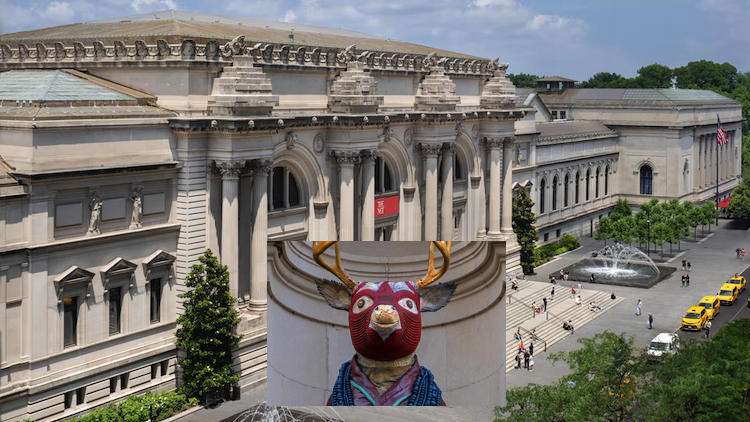
NEW YORK | 2 June 2026 (IDN) — Approaching the Metropolitan Museum of Art, one encounters not heroes, founders, or allegories of civilizational ascent, but animals—four of them—standing upright against the stone authority of the façade. A squirrel, a coyote, a deer, and a hawk occupy the Genesis Facade, not as emblems, mascots, or decorative anomalies, but as presences that interrupt the museum’s habitual grammar of meaning. They do not announce themselves as symbols to be decoded. They stand. They endure. They look back.
This is already a provocation. Museums, especially those clad in neoclassical stone, are designed to absorb what confronts them. Everything that enters is ultimately made legible, classified, neutralised. Jeffrey Gibson’s animals resist that fate—not by spectacle or outrage, but by a quieter, more destabilising force: refusal. They refuse metaphorical domestication. They refuse to be folded neatly into the museum’s narratives of culture, progress, or universal human achievement. Their presence unsettles not because it is exotic or unfamiliar, but because it is insistently, unassimilably near.
The title of the work, The Animal That Therefore I Am, invokes Derrida’s late meditation on animality, exposure, and the violence of philosophical classification. Derrida famously begins with a moment of discomfort: standing naked before his cat, seen without reciprocity, without the protective abstraction of “the Animal” as a general category. That moment fractures the philosophical confidence that thought—and ethical standing—begin with human self-consciousness. Gibson’s sculptures do not illustrate that argument; they radicalise it. They do not show animals as figures in a philosophical drama. They stage the drama again, at architectural scale, and refuse to resolve it.
Derrida’s Gaze and the Refusal of Human Mastery
These animals are monumental, but their monumentality does not derive from domination. They are upright, but not human; adorned, but not theatrical; anthropomorphic only to the degree necessary to unsettle the boundary they approach. Their textiles, beads, feathers, shells, and masks draw on Indigenous visual languages, yet they resist the comfort of ethnographic framing. This is not heritage displayed for recognition. It is a relation asserted without explanation. The regalia does not translate animal life into human meaning; it thickens animal presence until it becomes difficult to look at without unease.
That unease matters. The sculptures do not offer the viewer the pleasure of identification. One does not see oneself mirrored back in these figures. Instead, one confronts something closer to an accusation—but an accusation without language, without demand, without moral instruction. The animals do not ask for empathy. They do not solicit care. They simply persist, forcing the viewer to reckon with the fact that the hierarchy of seeing—human above, animal below—has been quietly but decisively interrupted.
Neighbours at the Threshold of Culture
The choice of species intensifies this disruption. These are not distant, exotic creatures imported from a mythic elsewhere. They are animals native to the region surrounding the museum itself. Neighbors. Co-inhabitants. Beings whose lives have always unfolded alongside human settlement, often invisibly, often violently displaced. Their proximity collapses the fiction that “nature” exists somewhere else, safely cordoned off from culture. The animals on the façade do not arrive from outside history; they emerge from it, bearing its scars without narrating them.
Placed against the Met’s neoclassical architecture—an architecture inseparable from imperial accumulation, extraction, and the fantasy of universal mastery—the sculptures perform a displacement that is easy to underestimate. They do not attack the institution. They do not mock it. They do something more unsettling: they expose its contingency. The stone columns, the symmetry, the promise of permanence—all of it begins to look provisional when confronted by beings whose lives have endured precisely without such guarantees.
Ethics Beyond Human Exceptionalism
This is where the work becomes dangerous. The animals do not simply expand the museum’s moral horizon; they threaten its ontological assumptions. They suggest that meaning does not originate in human culture and radiate outward, but arises in dense, vulnerable fields of interdependence that precede and exceed institutional frameworks. Ethics, in this register, does not begin with law, rights, or rational deliberation. It begins with exposure—with the fact that living beings are already entangled, already implicated in one another’s survival. Not because we extend recognition outward, but because we have never stood outside the web of living relations to begin with.
Yet Gibson’s work refuses the consolations of a flattened posthumanism. These animals are not interchangeable nodes in a network. Each remains irreducibly specific — a distinct way the world takes shape from within itself. The hawk’s elevated stillness does not mirror human vision; it hints at a perceptual economy fundamentally alien to us. The deer’s ceremonial posture is not innocence but vigilance shaped by centuries of being hunted. The coyote does not perform trickster mythology; it embodies adaptability forged under pressure. The squirrel’s industrious presence resists sentimental translation into virtue. Difference is not erased in the name of relation; it is sharpened.
Here the Derridean echo becomes unstable. Derrida’s moment of exposure begins with human vulnerability before the animal gaze. Gibson’s animals return that gaze without reassurance. They do not promise ethical clarity. They do not confirm that recognition will save us. If anything, they suggest the opposite: that recognition arrives too late, after damage has already been done, after separations have hardened into systems. The animals do not redeem philosophy’s failure to think animal life. They stand as evidence of its consequences.
Survival Without Reconciliation
Nor does the work allow the viewer to retreat into ecological optimism. There is no fantasy here of harmonious coexistence waiting to be recovered. The figures are beautiful, but their beauty is severe, even austere. Their scale confronts rather than consoles. Their stillness does not calm; it presses. One senses not balance, but endurance under strain. These are not images of reconciliation but of survival without guarantee.
By placing these animals at the threshold of the museum, Gibson transforms the act of entry itself. One does not pass cleanly from the living world into the realm of culture. One is stopped. Addressed. Seen. Before encountering masterpieces, one encounters beings whose lives have been systematically excluded from the category of meaning that museums exist to preserve. The encounter precedes interpretation. It cannot be mastered by it.
In this sense, The Animal That Therefore I Am does not merely decorate the Met’s façade; it compromises it. The sculptures force the institution to host a question it cannot resolve: whether culture can continue to understand itself as separate from the lives it has rendered invisible, instrumental, or expendable. The animals do not demand inclusion. They expose the violence implicit in the very idea of inclusion.
The Fragility of Humanism
What becomes unstable, then, is not only the museum’s authority but the humanism that underwrites it. The façade has long presupposed a silent hierarchy: culture above nature, reason above instinct, the human as measure and custodian of meaning. Gibson’s animals do not argue against this order; they render it visibly fragile. Their upright forms do not elevate them into humanity, nor do they descend into symbol. Instead, they inhabit a threshold that exposes the category “human” as historically contingent rather than ontologically secure. The animals do not ask to enter our world. They suggest that the world was never ours to delimit.
Gibson offers us not a moral lesson but a condition. Ethics appears here not as guidance but as disturbance—as the unsettling realisation that we were never alone, never autonomous, never sovereign. The animals do not tell us what to do. They do something far more dangerous: they refuse to let us forget where we already stand—implicated, exposed, and already past the illusion of innocence.
*Sam Ben-Meir is an assistant adjunct professor of philosophy at City University of New York, College of Technology. [IDN-InDepthNews ]