By Daniel Tesfa, Shim Masha, Joëlle Stocker and Mirjam van Reisen
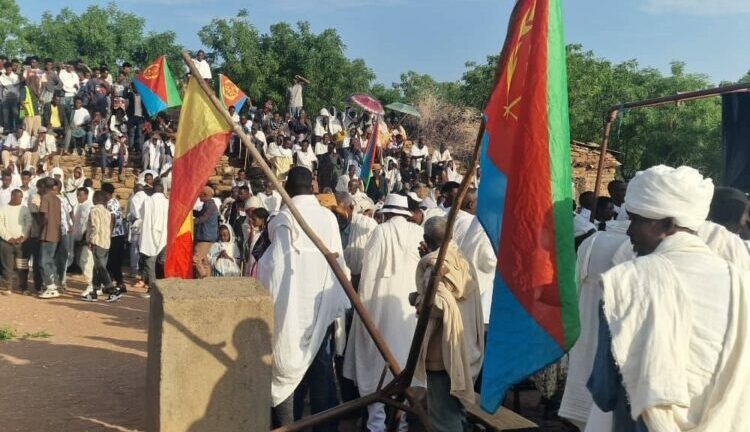
MEKELLE, Ethiopia | 28 April 2026 (IDN) — Four years after the war in Tigray (Ethiopia) ended with the cessation of hostilities by the Pretoria Agreement, the Tigray People’s Liberation Front (TPLF), who represented the Tigray regional state in the agreement, has moved to reinstate the mobilisation of youth and resources. Reports from various local administrations and veteran fighter networks indicate renewed campaigns urge former members of the Tigray Defense Force (TDF), who were demobilised in the early months of the agreement’s implementation, to return to their respective military units.
Local Testimonies: Between Mobilisation and Resistance in Tigray
As the TPLF advances its renewed campaign of youth and resource mobilisation, testimonies from across Tigray reveal a contested social landscape marked by fear, resistance, coercion and competing visions of survival. Our team conducted interviews and observations in Adwa, Enticho, Edega Arbi and Aksum in Central zone; Hadnet locality in Hawzen town in Eastern zone; Neqsege Wereda Administration in Southern zone and Shire located in Northwestern zone of Tigray. The research was conducted from between 9 March to 11 April, with parents whose children may be mobilised. All names have been changed for security reasons. The authors conducted, translated and analysed the material collected.
Refusal, Fear, and Flight: A Parent’s Dilemma in Central Tigray
In Edaga Arbi Wereda, Central Tigray, a father, Teklay Meressa, described how mobilisation efforts have directly confronted community resistance. Speaking in an interview conducted on 29 March 2026, he recounted a tense meeting organised by TPLF cadres:
The TPLF cadres were sent to mobilise the community… But we rejected that we wouldn’t send our children to the armed struggle. We will no longer put our children into war… so you can continue in power. (Teklay Meressa, interviewed on 29 March 2026)
The meeting showed parents divided. While some parents showed initial compliance, others rejected the mobilisation. According to participants who attended the meeting, it ended in protest. Teklay emphasised that geographic constraints, being located in central Tigray, limit escape options, intensifying pressure on families:
They have deployed the army and police to register our children who are over 15 years old for recruitment… If they want to, they can arrest us, but we will not give our children to war anymore. (Teklay Meressa, interviewed on 29 March 2026)
Despite force being utilised in the mobilisation, parents are refusing to offer their children to the purpose of war and have protested the mobilisation.
The impact of the mobilisation on education has been immediate. Teklay’s children, aged 17 and 15, stopped attending school after reports of registration campaigns targeting students. “I couldn’t tell them to go to school when they were under such threat.” Going to school would make the children an easy target, if round ups were used for mobilisation of the youth. Teklay was fearful, the children would be mobilised by force.
In order to avoid any exposure to the risk of mobilisation, Teklay sold his ox, his primary livelihood asset, and sent his children to Addis Ababa on 20 March 2026: “They have rented a house there [in Addis Abeba] so that they escape these bad days… As long as my children are safe, [for me] being arrested is fine”, he stated. His account reflects a broader pattern: families with limited options making costly decisions to protect their children. By doing so they risk (legal) repercussions.
“Signs of War Everywhere”: Community Distress and Rejection of Ximdo Alignment
In Ahferom Wereda, another resident, Arefe Welday, described a pervasive atmosphere of fear and uncertainty. Interviewed on 10 April 2026, he linked mobilisation efforts to broader preparations for conflict:
Children over the age of 15 are being registered… The tabia leadership, police and soldiers are pressuring us to bring our children. The things that we observe… are signs of war. (Arefe Welday, interviewed on 10 March 2026)
Mobilisation extends beyond human resources to material extraction. According to Arefe, households are required to contribute grain, cash, and food items. “They have ordered 25 kg of grain, 500 birr, lentil and eggs to be collected…”
These demands come amid unresolved trauma from the previous war. Arefe said:
While we are still in mourning for our children who died during the Tigray war, how could we be expected to endure another war these days? (Arefe Welday, interviewed on 10 March 2026)
His sons have quit school and they are staying in house as the TPLF cadres started registering the youth in the secondary school.
As a parent, we are expected to be happy that your children have grown up, but practically we, rather, are worried that our children have grown up to be mobilized for war. … I don’t even know when my sons would resume their class as the teachers are also lately in protest in this week as they were not paid their salaries. (Arefe Welday, interviewed on 10 March 2026)
What worries Arefe the most is where he should hide his sons to escape being mobilised:
Those who can afford the costs, they are sending their children to Addis Ababa. I could not financially afford to send them to Addis Ababa because they have no family to receive them in Addis Ababa. (Arefe Welday, interviewed on 10 March 2026)
Arefe also rejected the notion of strategic alignment with Eritrea, the neighbouring country of Tigray (Ethiopia), which allied with Ethiopia in the 2020-2022 war. This alignment is referred to as “Ximdo”. Arefe argued that past alliances resulted in violence against Tigrayan civilians:
We still don’t want to go into partnership with what they called Ximdo with Shaabia [the Eritrean leadership]… who did all attempts to destroy us alongside Ethiopia. (Arefe Welday, interviewed on 10 March 2026)
Instead, Arefa wants to see political dialogue:
As long as we are part of the Ethiopian nation, there should be a mechanism where we can achieve peaceful resolution through dialogue and return our displaced people to their homes. (Arefe Welday, interviewed on 10 March 2026)
Arefa reflects the voice of many in Tigray who want peace to be maintained.
Recall, Coercion, and Incentives: A Veteran’s Perspective
In Axum, Mesfin Hedera , a former member of the TDF, described systematic efforts to recall demobilised fighters. Speaking on 31 March 2026, he noted that former combatants are being contacted directly. Although he is among those who were demobilised in the first round of Disarmament, Demobilization, and Reintegration (DDR), Mesfin stated “My former division has contacted me recently… many of my friends are getting phone calls to return to their former divisions.”
According to Mesfin, the recall process combines incentives and threats. “Officials are telling us that the returning members will be the first to be allocated land and job opportunities… those who flee… are ‘traitors’” he added.
He mentioned that: “Medical and military professionals have been deployed to check the health… of former members.”
At the same time, resource mobilisation has intensified across households. “Each household has been given a mandatory quota… flour, sugar, injera, 500 birr… even employees must pay 20% of their salary.”
Mesfin described a climate of fatigue and quiet resistance. “There is propaganda going on, but people are really tired… those who oppose are labelled as traitors.”
The mobilisation campaign appears to contradict the demobilisation provisions of the Pretoria Agreement.
Institutionalised Mobilisation Campaigns
A notice issued by the Neqsege Wereda Administration in the Southern Zone of Tigray on 10 March 2026 calls on former TDF members to rejoin military units, while also encouraging untrained youth to enroll in military training centers (Teame, 2026a). The notice reads as follows:
The notice reads as follows:
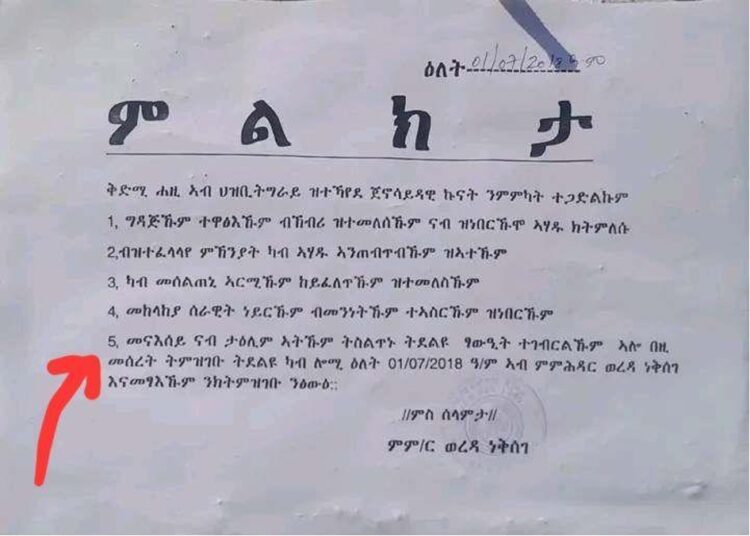
Notice
To those who fought to resist the genocidal war that was waged against the people of Tigray:
- Those of you who fulfilled your duty and returned with honour, and you must return to your former military units;
- Those of you who, for various reasons, were separated from your units;
- Those of you who returned from your training army unit without notifying;
- Those of you who were members of the Ethiopia National Defense Forces and were detained due to your identity;
- Youth who wish to receive military training, you have been called to join the military.
Accordingly, you are requested to get registered in the Neqsege Woreda Administration starting today, 10 March 2026.
End of note.
Besides, the messages posted in the notice boards in Kebele 03 (Hibret) in Shire city in Northwestern Tigray (Teame, 2026b) and Hadnet locality in Hawzen town in the Easter Zone of Tigray show that the veteran fighters are being called in their respective local administrations (Teame, 2026c).
The renewed mobilisation of youth in Tigray reflects a familiar pattern, one that blends narratives of existential survival with structured political-military organisation. Recent directives and speeches suggest that the TPLF is reactivating its mobilisation structures.
A directive letter issued by the Adwa Wereda Office of the Tigray People’s Liberation Front in the Central Zone of Tigray to the Adwa Wereda Office of Education calls for the identification and redeployment of “government employee fighters… to be reintegrated into their military units”.
Signed by Getnet G/Anenea, Coordinator of Recruitment and Mobilisation for the Struggle Committee led by the Adwa Wereda Office of the Tigray People’s Liberation Front, the letter stated:
the government employees who were demobilised or evaded the military units and training centers have been identified in every office at wereda and tabia [vicinity] levels. So the same as the recruitment and remobilisation campaign for these who were demobilised with honour or evaded their military units at Tabia level, the former fighters employed in the government offices must be returned to their respective military units. Thus, based on the list that was provided by the office heads, we order you to send us the list of these fighters in your respective structure at wereda and tabia levels by 9 April 2026 so that they can be redeployed to their units. (Tsegazeab, 2026)
Similarly, local administrations have ordered households to send their civilian children of military age to recruitment centres, framing the mobilisation as a national responsibility. The notice written by the Hayelom Tabia Administration in Adwa town warned that every household in the respective vicinity must handover their children of military service age to the mobilisation center in Adwa (Azmera, 2026). The notice reads as follows:
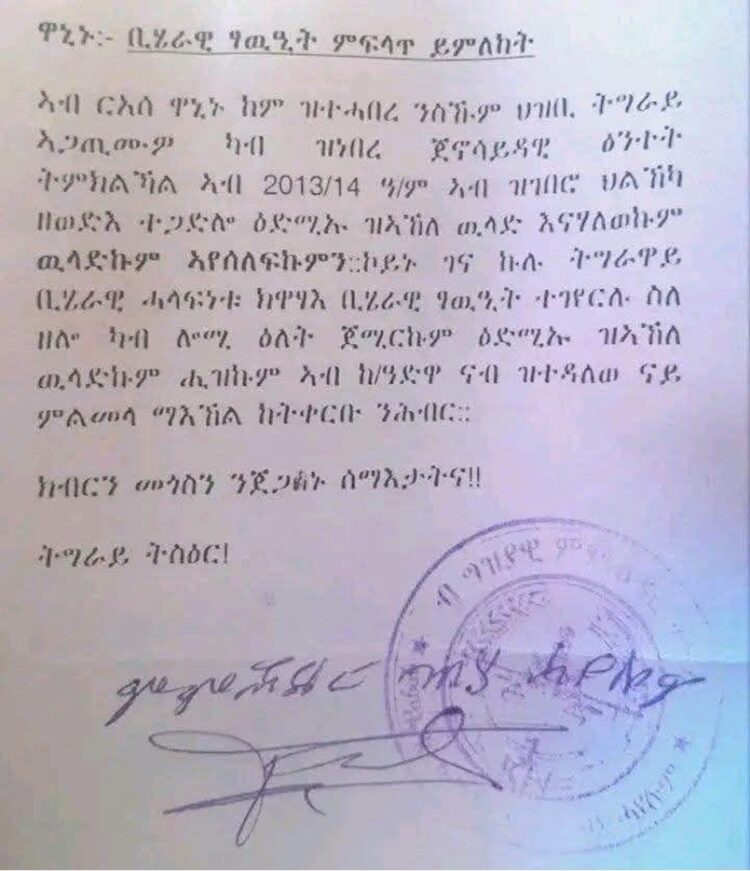
The note translates as follows:
Subject: Notifying National call
As indicated in the subject, you didn’t send your children who were in the age of military service during the genocidal war that the people of Tigray faced in 2020/2021. As the people of Tigray have been called to fulfill their national responsibility, we order you to take your children who are at the age of military service to the mobilization center prepared in Adwa town.
Eternal glory to our heroic martyrdoms!
Tigray will prevail!
Hayelom Tabia Administration
End of Note
This administrative language is reinforced by political rhetoric. Speaking on Dimtsi Weyane Television, TPLF member and attorney in the Tigray Bureau of Justice Godefay Tilahun said “The people of Tigray have two choices now. It is either to perish or to fight and survive as a people. It is either destruction or survival through a costly sacrifice” (Dimtsi Weyane, 2026a). Such binary framing, survival versus annihilation, has historically functioned as a powerful mobilisation tool.
Godefay added:
He who still thinks things are down now here in Tigray and who is travelling to Addis Ababa will be ashamed later. I remember 2020/21 when we [the TPLF and TDF] entered Mekelle on 28 June 2021 and all the youth flocked to the military training camp holding [Tigray] flags. This is because they were in Tigray. If the youth now goes to Addis Ababa, how will they fly to Tigray? This time they don’t get the opportunity they had to join the Tigray forces like the situation back then. (Dimtsi Weyane, 2026a)
The mobilisation is deeply embedded in institutional structures, from tabia (vicinity)-level administration to regional political leadership. The call for youth participation echoes Tigra Defense Force leader, General Yohannes Weldegiorgis’s assertion that
one generation must be dedicated for sacrifice, regardless of whether it would take 50 years or 100 years or 60 years. One generation must be able to prepare for this. (Dr Zetseat, 2026)
This quote is a compact but powerful expression of a long-war ideology, where time, sacrifice, and collective identity are tightly intertwined.
Historical Parallels? From Famine to War Financing
The current resource mobilisation campaign in Tigray is framed by its architects as a necessary response to an acute humanitarian and political crisis. Official narratives emphasise internal resilience and survival. As articulated during the launch of the regional contribution platform, the initiative is intended to “address the damage caused by war… treat wounded fighters, return displaced persons, and rehabilitate Tigray” while compensating for withheld federal budget allocations (Tigrai Television, 2026).
At face value, this mobilisation appears humanitarian that is centred on recovery, reconstruction, and survival. Yet, parallel accounts from dwellers of Edaga Arbi, Ahferom and Axum suggest that resource extraction extends beyond voluntary contribution into systematic and compulsory mobilisation of grain, cash, and labour at household level. This dual character, humanitarian framing alongside coercive implementation, invites comparison with earlier historical moments.
During the 1985 famine, the TPLF leadership publicly framed the crisis in existential humanitarian terms. Reflecting on that period, Meles Zenawi said “There is no point in fighting when the people are finished… the people that I am fighting for are dying because of lack of food” (Bereket100, 2012). The emphasis, then, was on survival of the population as the foundation of political struggle.
However, subsequent investigations complicate this narrative. A BBC inquiry reported that “millions of dollars in Western aid… was siphoned off by rebels to buy weapons,” with former commanders stating that large portions of humanitarian resources were redirected toward military objectives (Plaut, 2010).
The report shows that from the mobilised “$100m went through the hands of the TPLF and affiliated groups… $95m (£63m) – from Western governments and charities – was channelled into the rebel fight” (Plaut, 2010).
The United States of America Central Intelligence Agency (CIA) report confirmed that the TPLF redirected money that was collected to respond to the acute famine in Tigray in 1985 without disclosing the amount (Central Intelligence Agency, 1985). The report stated “Some funds that insurgent organisations are raising for relief operations, as a result of increased world publicity, are almost certainly being diverted for military purposes” (Central Intelligence Agency, 1985).
The parallel is not exact, but it is difficult to ignore. Then, as now, crisis conditions, famine in the 1980s, post-war humanitarian collapse today, serve as the context for centralised mobilisation of resources under political authority. The critical question that emerges is about intent, trajectory and current intensified recruitment of the youth: will the current mobilisation remain within its stated humanitarian and rehabilitation goals, or could it, as in the past, be redirected toward sustaining military confrontation?
Fragmentation and Internal Contestation
The mobilisation campaign is unfolding within a deeply fragmented political landscape in Tigray, marked by competing claims to legitimacy and authority. A key turning point emerged when the Adwa Town Council formally rejected the current interim administration and called for the reinstatement of the pre-war regional government elected in 2020, stating that “the council unanimously approved the return of the Tigray Regional Council and Government elected by the 2.7 million people” (Adwa Town PR Office, 2026).
This position aligns with the TPLF’s broader rejection of the current interim administration led by Lt. Gen. Tadesse Woreda. In its official statement, the TPLF argued that the extension of the interim administration’s mandate was carried out “without the knowledge and participation of the TPLF” and therefore constitutes a violation of the Pretoria Agreement (Dimtsi Weyane, 2026b).
On the other hand, the Ethiopian federal government has defended the extension as lawful, asserting that it is grounded in a revised legal framework governing interim administrations (BBC Tigrinya, 2026). This legal justification places the federal government in alignment with the continuation of Tadesse Woreda’s leadership, despite TPLF opposition.
Caught between these positions, President Tadesse Woreda has adopted a defensive stance. stating “it is a right to say that you [TPLF] don’t want the Interim Administration” but it is not acceptable to campaign for others that “you should not accept it either” and “I will fight this being in Tigray” (Office of the President-Tigray, 2026a). He further emphasised the risks of renewed conflict, noting that “it is easy to start a war but it is necessary to analyse how it ends” (Office of the President-Tigray, 2026a).
In the Central Committee meeting held in Axum, the TPLF further decided to restore the pre-war regional council rejecting the Tigray Interim Regional Administration (TIRA) arrangement under the auspices of the Pretoria Agreement (Tigray People’s Liberation Front, 2026). This decision triggered criticism by Tigrayans, on the social media, who are concerned that these tit-for-tat would lead to escalation of the tension to war.
The tension has escalated as President Tadesse Woreda has reiterated that the Tigray Interim Regional Administration would continue to exercise its power in Tigray mandated following the Pretoria Agreement, defying the TPLF decision (Office of the President-Tigray, 2026b).
This triangular contest, between the TPLF, the interim administration, and the federal government, reveals not only institutional fragmentation but also competing strategic visions: one leaning toward renewed mobilisation and confrontation, another toward cautious governance under constrained conditions, and a third anchored in federal authority and legal frameworks to contain the TPLF.
A Region at a Crossroads
These political divisions are actively reshaping the security landscape and the lived realities of Tigrayans. The divergence between the TPLF and the interim administration is particularly consequential. While the interim leadership emphasises stabilisation, rehabilitation, and cautious engagement, the TPLF frame the situation as an existential struggle requiring renewed mobilisation.
Simultaneously, military dynamics on the ground suggest parallel escalations. Reports indicate that Ethiopian federal forces and Tigrayan forces are once again mobilising along border areas, with a Western diplomat who spoke anonymously warning that “such large numbers of troops positioning themselves face to face is not a good sign” (The Defense Post, 2026). But who would be involved in a war is unclear.
The lack of clarity of what are the enemies for which the TPLF is mobilising the youth is provided by the Ximdo alignment, which allies the TPLF with Eritrea, the former enemy in the 2020-2022 war.
A TPLF-member and attorney in the Tigray Bureau of Justice Gedefay Tilahun has framed Eritrean support as a strategic asset, claiming that “The government of Eritrea is working for the people of Tigray more than what the people of Tigray could do” (Ashenafi, 2026, March 24).
As long as the Prosperity Party is allowed to continue to exist, there is no restoration of Tigray land, no restoration of identity, no salvation of the people, but we will be destroyed. There is only one solution: be resilient and earn your sovereignty through the sacrifice of your army. That way you can return these displaced to their home. Then you ask the people of Tigray, whether they want to rebuild the Ethiopia country in your mold or are you hopeless with staying in Ethiopia and you want to pursue an independent nation of Tigray. (Dimtsi Weyane, 2026a, March 12)
On one side, the Ethiopian National Defense Force aligned with the Tigray Peace Force in Afar region, supporting the Red Sea Afar Democratic Organisation (RSADO), on the other, the reconstituting TDF along with the Eritrean Defense Force. The current alignment underscores a deeper uncertainty: alliances that appear tactical and transactional in the present may be structurally unstable in the long term.
For civilians, these unstable and transactional geopolitical and political shifts translate into immediate and existential dilemmas. As reflected in multiple testimonies, families face pressures of recruitment, resource extraction, and fear of renewed war, while also navigating limited options for escape or protection. [IDN-InDepthNews]