
Diplomatic recognition has widened, but settlement expansion and territorial fragmentation threaten the foundations of Palestinian statehood.
By Ramesh Jaura
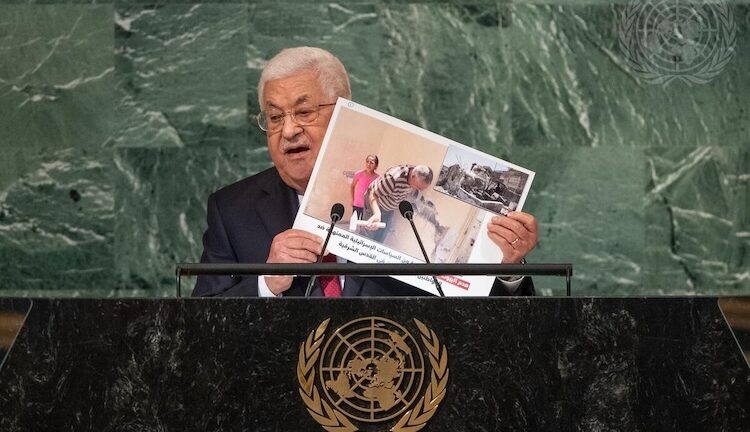
BERLIN | NEW YORK | 26 September 2026 (IDN) – Mahmoud Abbas delivered one of the most important speeches of this year’s United Nations General Assembly without being allowed into the hall.
The Palestinian president appeared via recorded video after the United States refused visas to his delegation for the second consecutive year. He called the decision unlawful and contrary to Washington’s responsibilities as host of the United Nations.
His absence added meaning to the speech. The General Assembly is meant to be the one international chamber in which states, large and small, can speak. Yet the representative of a people recognised by most UN members was prevented from appearing because of a decision taken by the host government.
Abbas’s warning went beyond the familiar argument that the two-state solution is in danger. He said Israeli policy threatened the continued existence of Palestinians on the land intended for their state.
He referred to Gaza’s destruction and displacement, the growth of settlements in the occupied West Bank and plans for construction in the E1 area east of Jerusalem. Building there could separate East Jerusalem from Palestinian population centres and divide the West Bank.
The argument about two states is therefore no longer chiefly diplomatic. It is becoming geographical.
Around 160 governments recognise the State of Palestine. This is a substantial majority of the UN membership. Recognition has given the Palestinian cause diplomatic standing and enabled Palestine to participate in international institutions.
It cannot preserve territorial continuity. It cannot remove settlements, stop demolitions or reunite Gaza and the West Bank under one government. A Palestinian state may be recognised internationally while the land needed to establish it steadily disappears.
Abbas called for implementation of the next stage of the Gaza plan, the reunification of Gaza and the West Bank and enforcement of Security Council Resolution 2334. That resolution states that Israeli settlements in occupied territory have no legal validity and constitute a serious obstacle to peace.
He also renewed the demand for full UN membership. Palestine has held non-member observer-state status since 2012. Full membership requires a Security Council recommendation before the General Assembly approves it. Even if an overwhelming majority favours admission, the United States can prevent it through its veto.
Abbas said the Palestinian Authority had carried out promised reforms and announced legislative elections for 28 November, followed by presidential and Palestinian National Council elections.
Elections are long overdue. The last Palestinian legislative vote took place in 2006. The subsequent division between Fatah and Hamas left Gaza and the West Bank under rival authorities and deprived a generation of Palestinians of the opportunity to choose their national leadership.
A credible election would not by itself resolve that division. Voting would have to be possible throughout the occupied territories, including East Jerusalem. Palestinian factions would need to accept the result, and Israel would have to permit the movement of candidates, officials and election materials.
The visa dispute raises a separate concern. The 1947 Headquarters Agreement generally requires the United States to permit recognised representatives to reach UN headquarters. Repeated political exclusions weaken the principle that all recognised delegations should have access.
For years, governments have repeated their support for two states while settlement construction, displacement and violence continued. Saving that possibility now requires action: preventing annexation, stopping settlement expansion, protecting civilians and restoring a common Palestinian administration in Gaza and the West Bank.
Abbas’s speech was addressed not only to Israel and the United States but also to countries that have recognised Palestine. Their declarations carry legal and symbolic importance. They have not stopped conditions on the ground from deteriorating. The world may otherwise discover that it recognised Palestine only after allowing the foundations of a viable state to disappear.
Source note: Based on Mahmoud Abbas’s address to the 81st UN General Assembly and official UN meeting coverage of 24 September 2026. (IDN-InDepthNews)