
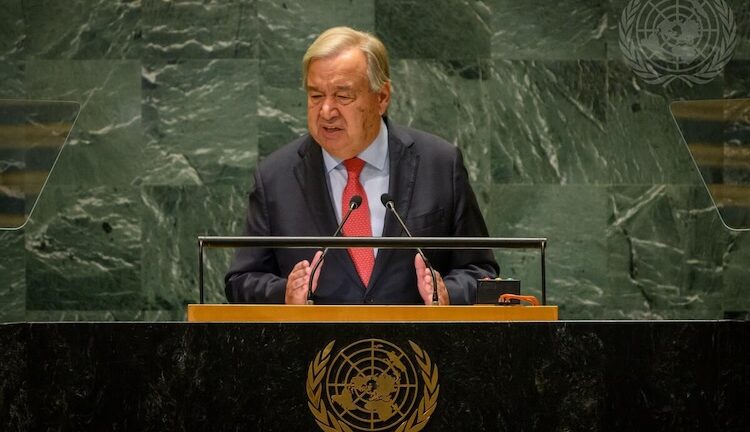
The outgoing Secretary-General leaves behind unresolved questions of war, representation, finance and climate justice.
By Ramesh Jaura
BERLIN | NEW YORK | 25 September 2026 (IDN) — The Security Council offers the clearest example. It becomes paralysed whenever a conflict touches the interests of a permanent member or a close ally. Russia can block action over Ukraine. The United States can block measures it considers unacceptable to Israel. China, France and Britain retain the same privilege.
This imbalance has become increasingly difficult to defend. Africa has 54 UN members and accounts for a large share of the Council’s work, yet it has no permanent seat. Guterres has described that exclusion as an injustice.
Most governments publicly support reform. Agreement disappears when they must decide which countries should receive permanent representation, whether new members should hold vetoes and whether the existing five should surrender any authority.
The UN’s financial position is equally serious. Contributions arrive late or are withheld for political reasons. Wealthy governments reduce humanitarian support even as the number of people displaced by conflict and hunger continues to grow.
These shortages determine whether food reaches a refugee settlement, medical clinics remain open, and relief agencies can respond before hunger becomes famine. Governments then criticise the organisation for failures caused partly by their own refusal to fund it.
Guterres also devoted much of his farewell address to climate change. He repeated his call for polluters to bear a larger share of the cost and criticised an economic order in which countries suffering the harshest consequences often pay the highest interest rates to rebuild.
Many developing countries contributed little to the accumulation of greenhouse gases but face destructive floods, droughts and rising seas. Their governments spend scarce funds servicing debt while richer countries subsidise clean industries and protect their populations with better infrastructure.
Guterres also warned that powerful computer systems should not remain under the exclusive control of a few states and corporations. He called for common safety standards, the exchange of information about serious risks and independent international supervision.
He returned to Gaza and the need for a Palestinian state alongside Israel. He called for an end to the fighting, unhindered humanitarian relief and respect for international law. International law cannot retain authority if it is applied according to alliances.
Assessments of Guterres’s years in office will differ. Some will say he was too cautious when confronting powerful governments. Others will point out that the Secretary-General has moral influence but no independent army, revenue or legislative authority. He can speak, mediate and mobilise; he cannot force states to honour the Charter.
His successor will inherit an unreformed Security Council, underfunded humanitarian agencies, inadequate climate finance and unfinished rules for powerful technologies. The test will be whether member states want a stronger United Nations or merely an organisation they can blame when national policies fail.
Guterres’s farewell placed the responsibility where it belongs. The UN is not an authority standing above governments. It is an institution created, financed and constrained by them. Its failures often reflect their choices.
Source note: Based on the Secretary-General’s General Assembly address and related UN and Reuters reporting of 22 September 2026. (IDN-InDepthNews)