
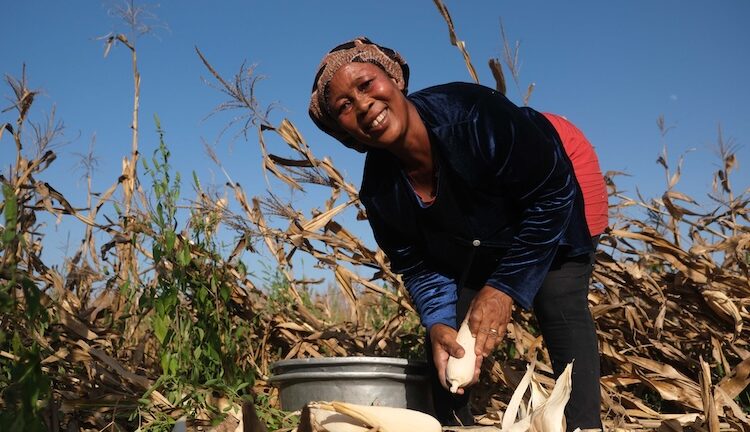
The world produces more than enough food, yet conflict, inequality, waste and the concentration of farmland leave billions without an adequate diet.
By Ramesh Jaura
BERLIN | 20 October 2026 (IDN) — The world’s farms produce more food than ever before. The average global supply now exceeds 3,000 calories per person a day. Yet more than a quarter of humanity cannot regularly obtain enough food—or food of sufficient quality—to live a healthy life.
For UN High Commissioner for Human Rights Volker Türk, this contradiction makes hunger more than a humanitarian emergency. It is evidence of economic and political systems that fail to distribute the world’s abundance fairly.
Addressing the UN-hosted Committee on World Food Security in Rome on 19 October, Türk described hunger as an avoidable tragedy. The international community, he argued, already possesses the food, knowledge and resources needed to prevent it.
What is missing is the political determination to make the right to food a reality.
Abundance without access
The scale of global food production challenges the long-standing assumption that hunger is mainly caused by shortages.
According to figures cited by Türk, the amount of food available worldwide has reached a historic high. At the same time, households discard more than one billion meals every day.
The problem is therefore not simply how much food is produced. It is who controls its production, who can afford it, and whether people have access to land, water, seeds, markets and public support.
Agricultural land has become increasingly concentrated. Just one per cent of the world’s farms operate more than 70 per cent of global farmland. Small-scale producers—particularly women and Indigenous communities—frequently struggle to secure land rights, credit, insurance and access to markets.
Many of these producers grow food for their communities but remain among those most exposed to hunger.
The right to adequate food is recognised in international law, including the Universal Declaration of Human Rights and the International Covenant on Economic, Social and Cultural Rights. Governments are obliged not only to avoid depriving people of food but also to protect them from abusive commercial practices and create conditions in which they can feed themselves with dignity.
For millions, however, that right remains little more than a promise.
Conflict drives the worst emergencies.
War is now the leading force behind many of the world’s gravest food crises.
Conflict is a major cause of acute hunger in 12 of the 13 countries and territories currently identified as hunger hotspots. Fighting destroys crops, markets, roads, water systems and health services. It displaces farming communities and prevents food from reaching civilians.
Restrictions on humanitarian relief deepen the damage. Aid convoys may be delayed or denied access, while humanitarian personnel face attacks, detention and intimidation.
Türk stressed that hunger must never be used as a method of warfare. International humanitarian law prohibits deliberately starving civilians and obstructing relief needed for their survival.
Yet the gap between legal obligations and conditions on the ground remains stark.
Sofía Monsalve Suárez, the UN Special Rapporteur on the right to food, told the Rome gathering that although chronic hunger declined during 2025, acute hunger has continued to rise since 2016.
An estimated 266 million people now confront acute food insecurity every day. The most serious crises include Sudan, South Sudan, the Democratic Republic of the Congo, Yemen and Gaza.
Around 1.4 million people in six countries face catastrophic levels of hunger. That figure is nine times higher than it was in 2016.
These numbers reflect more than the immediate consequences of warfare. They also reveal the weakness of international mechanisms intended to prevent food crises from becoming catastrophes.
Warnings are often issued months before famine-like conditions emerge. But relief operations remain chronically underfunded, access negotiations are prolonged, and political divisions obstruct collective action.
A different economic approach
Türk called for what he termed a human rights economy—one in which public policies are judged by whether they enable people to live securely and with dignity.
Such an approach would require governments to strengthen social protection, adopt fairer taxation and direct greater investment towards rural communities and small-scale producers.
Agricultural policy would need to ensure more equitable access to land, water and seeds. Women farmers and Indigenous Peoples would have to participate meaningfully in decisions affecting their livelihoods.
Climate measures are equally important. Droughts, floods, extreme heat and changing rainfall patterns are already damaging harvests and livestock, particularly in countries that have contributed least to global warming.
Investment in resilient agriculture, water management, early-warning systems and locally controlled food networks could reduce vulnerability. But climate adaptation programmes must be designed with affected communities, not imposed on them.
Governments also need to address the market forces shaping access to food. Speculation, excessive concentration in agricultural supply chains and sudden restrictions on food exports can raise prices far beyond the reach of poorer households.
Public policy, Türk argued, cannot treat food solely as a commodity. It is also a basic human entitlement.
Accountability cannot wait.
Monsalve Suárez called for stronger cooperation among the UN Security Council, the Committee on World Food Security, human rights institutions and organisations monitoring hunger.
At present, these bodies frequently operate on separate tracks. Humanitarian agencies document rising need, rights investigators record violations, and the Security Council discusses conflicts—often without an effective mechanism connecting early warnings to preventive action.
Closer cooperation could help identify when blockades, attacks on farms, forced displacement or restrictions on relief are creating the conditions for mass hunger.
It could also strengthen accountability. Where starvation is deliberately employed against civilians, those responsible must face investigation and possible prosecution.
The wider challenge is to move from reacting to hunger towards preventing it. Emergency food assistance remains indispensable, but it cannot substitute for political settlements, functioning public institutions and fairer agricultural systems.
The Rome meeting placed the contradiction at the centre of the debate: humanity has achieved an unprecedented capacity to produce food, while tolerating hunger on a massive scale.
Hunger in such circumstances is not an unavoidable consequence of nature. It results from choices—about war and peace, public spending, land ownership, trade, humanitarian access, and whose rights governments are prepared to defend.
Ending it will require more than higher crop yields. It will require changing the systems that decide who eats and who goes without. (IDN-InDepthNews)
Source: Based on a UN News report published on 19 October 2026 and the address by UN High Commissioner for Human Rights Volker Türk. The figures cited above were presented during the Committee on World Food Security meeting in Rome. Global Issues