
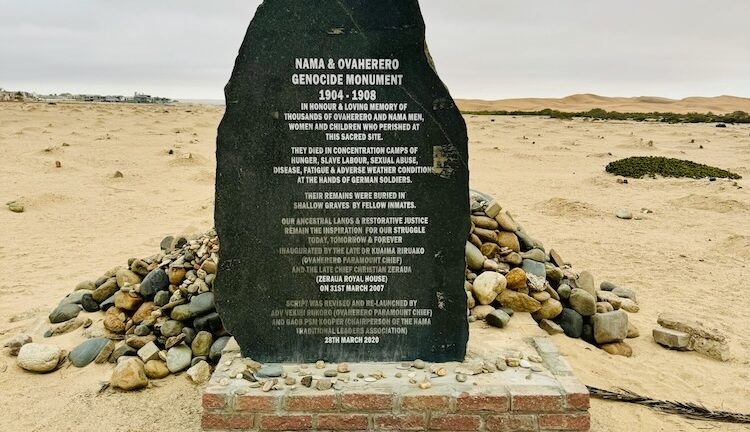
Debate over the genocide committed in Namibia has revived questions about recognition, reparations and whether Germany is willing to confront its colonial past as seriously as other chapters of its history.
By Ramesh Jaura
BERLIN | 20 October 2026 (IDN) — Over a century after German colonial troops committed mass killings in what is now Namibia, the subject has resurfaced in the Bundestag with significant political momentum.
The whole thing was kicked off by an opposition motion calling for Germany to recognise the genocide against the Ovaherero and Nama unambiguously and to go beyond development aid to what the proponents would describe as restorative justice. DW reported on the ensuing parliamentary debate and the long-standing dispute over recognition and reparations.
From the visitors’ gallery, you had the representatives of the various communities whose families have been waiting for generations for recognition and for restitution. Gaob Daniel Timotheus Frederick of the Nama Traditional Leaders Association was there, the great-grandson of Cornelius Frederick who died on Shark Island (one of the most horrific sites of German colonial repression). He was calling for an unqualified apology. Ovaherero Paramount Chief Mutjinde Katjiua was also there and was calling on the Bundestag to recognise the genocide formally.
Recognition Without Resolution
The historical record is undisputed. From 1904 to 1908, the German Imperial forces conducted a campaign of extermination in German South West Africa against the Ovaherero, the Nama and other indigenous groups. Some 100,000 people were killed, many more were displaced, many were subjected to forced labour, and many lost their land. The impact of those dispossession and seizures is still very much with us in terms of the patterns of ownership and inequality in Namibia today.
Germany has admitted in its talks with Namibia that the atrocities would be termed genocide in today’s terms. That admission has not yet led to a full reconciliation agreement or unqualified parliamentary recognition.
That gap has become more and more contentious as the Bundestag has formally acknowledged other historical atrocities (the Armenian genocide, the Holodomor in Ukraine, the genocide of the Yazidis). Historian Jürgen Zimmerer told DW that the failure to pass a similar resolution on Namibia stems from a lack of political will, not doubt about the weight of the historical evidence.
The Reparations Dispute
Compensation is at the heart of the controversy.
Germany and Namibia have been in talks since 2021 over a joint declaration whereby Berlin would provide €1.1 bn over 30 years for reconstruction and development programmes. Germany has consistently maintained that recognition of genocide does not in any way give rise to a legal claim for reparations.
Ovaherero and Nama representatives maintain that this distinction sidesteps the real issue. They argue that development assistance does not replace reparations and that the communities in question must be directly involved in negotiations over restitution.
Katjiua has dismissed the current German-Namibian framework for this very reason, maintaining that those whose ancestors were victims of the genocide should have a direct place at the table.
The Bundestag debate therefore revealed a deeper disagreement over what historical responsibility entails. Is recognition simply symbolic or does it have to involve some form of compensation, restitution and direct dealings with the descendants of the victims?
Human Remains and Cultural Property
The dispute goes well beyond the money.
The remains of vast numbers of people taken from Namibia during the colonial period are thought to still be in Germany. Cultural objects were removed too and are in museums and collections.
Germany has taken steps toward restitution. A coordination council was set up earlier this year to improve the return of cultural property and human remains to their countries of origin. However, some argue that progress to date is still too slow and fragmented.
The current German coalition agreement promises further research, restitution of cultural property and the creation of a dignified memorial site. Yet specialists interviewed by DW say colonial history has lost political visibility compared with the previous government.
Zimmerer warned that Germany risks undermining the international reputation it has built through confronting its past.
A Test of Germany’s Memory Culture
That question may prove to be the lasting significance of the Bundestag debate.
Germany is widely associated with a political culture built on remembrance, responsibility and historical self-examination. But its colonial history has never occupied the same place in public consciousness as the crimes of the Nazi era.
The debate over Namibia challenges that hierarchy of memory.
Supporters of stronger action argue that Germany cannot credibly present itself as a country that learns from history while leaving the victims of colonial crimes waiting indefinitely for full recognition and restitution.
The Bundestag debate does not settle the matter. It does, however, bring the issue back into national political life and pressure the government to decide whether its acknowledgement of colonial injustice will remain largely declaratory or lead to a broader settlement with those most directly affected.
As Frederick told DW, the affected communities are asking above all to participate in determining “the rest of the way.” (IDN-InDepthNews)