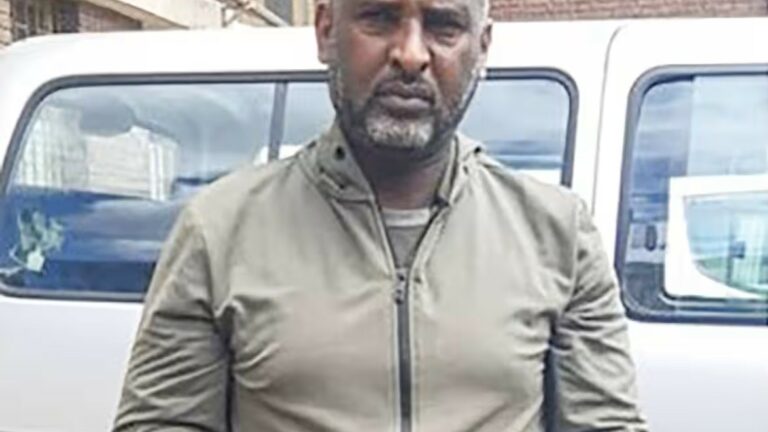
By Cedric Stephany and Mirjam van Reisen | BRUSSELS, Belgium | 12 June 2026 (IDN) — A pro forma hearing against the alleged human trafficker called Kidane, took place last month in Zwolle in The Netherlands, marking another step in what has become one of the most significant human trafficking prosecutions in European legal history.
Two Men, One Case, Split in Two
To understand the significance of the pro-forma hearing against the human trafficker Kidane, you have to go back to a single investigation: The Pearce investigation.
The investigation was launched in 2018 by a Joint Investigation Team comprising the Netherlands and Italy, in collaboration with the International Criminal Court (ICC). The Pearce investigation was designed to dismantle a brutal migrant smuggling network operating out of Libya.
At the centre of that network were two Eritrean nationals: Tewelde Goitom, known as “Walid,” and Kidane Zekarias Habtemariam, known simply as “Kidane.”
The Dutch prosecution also brought charges against five individuals based in the Netherlands. They are accused of participating in the extortion and the facilitation of money transfers through the hawala informal banking system, their trial began in April 2026.
The Walid case concluded in January 2026, when the court in Zwolle sentenced him to 20 years in prison, the maximum available sentence for smuggling under Dutch law. Kidane’s trial started on March 31, 2026. The trial of the Eritrean follows after what could easily been a movie script: an escape from prison in Addis Ababa, an arrest in Khartoum, a trial in Dubai and finally the extradition to The Netherlands.
The delay of the extradition of Kidane to The Netherlands impacted on Walid’s trial. The defence lawyers had requested Kidane’s testimony.
The question of jurisdiction, whether a Dutch court could try crimes committed in Libya by Eritrean nationals against Eritrean victims, added another layer of complexity.
Walid’s lawyers argued that Dutch law required smuggling to have the Netherlands as a final destination to establish jurisdiction. The prosecution countered that because the extortion of families took place in the Netherlands, because the victims ultimately arrived there, and because there was no smuggling without payment and no payment without violence, the territorial link was clear. The court agreed, that precedent now benefits the prosecution in Kidane’s case.
Arrest and extradition
The two men were first arrested together in Addis Ababa, Ethiopia, in early 2020. Walid was convicted in Ethiopia in 2021 on counts of human smuggling and trafficking, and subsequently extradited to the Netherlands in late 2022.
Kidane, on the other hand, managed to escape from court in Ethiopia. He was convicted in absentia and sentenced to life imprisonment. But on January 5th, 2023, Interpol announced his arrest in Sudan in cooperation with the United Arab Emirates, where he was later charged for money laundering before his extradition to the Netherlands on December 24th, 2025. He now faces charges of participation in a criminal organisation involved in migrant smuggling, hostage-taking, extortion and sexual violence.
What Happened in Bani Walid
To understand why these trials matter, you have to understand Bani Walid.
Located approximately 170 kilometres southeast of Tripoli, in the arid hills of northwestern Libya, Bani Walid became one of the most feared transit points on the central Mediterranean migration route.
The facility at the centre of both the Walid and Kidane cases was a former chicken farm on the outskirts of town, a fenced perimeter enclosing a yard and four large warehouses, each managed by a different smuggler. They lived in adjacent smaller houses on the compound. Their warehouses shared a wall, with a hole through which captives could see, and hear what was happening on the other side.
Well over a thousand people were crowded into Walid’s warehouse alone. Migrants from Eritrea, Ethiopia, Somalia and elsewhere had travelled through Sudan and across the desert, often under false promises of safe passage to Europe. Upon arrival in Bani Walid, they found themselves locked in. Witnesses testified to staying for periods of three to seven months, without adequate food, water, or sanitary facilities.
The business model was systematic extortion. Captives were forced to call their family members, some of them already in Europe, in the Netherlands, in Italy, in Sweden among others, and beg for ransom. Traffickers would ensure the call was credible: they would beat or electrocute the captive while the phone line was open, so the family on the other end could hear. Ransoms typically ran to thousands of dollars, and were rarely sufficient. Families would pay once, only to receive another call demanding more.
Kidane’s operation functioned on the same logic. The Dutch prosecution alleges that he ran his own compound at Bani Walid where Eritrean refugees were detained, tortured, extorted, sexually abused, and in some cases killed.
Why This Case Matters
Human trafficking prosecutions in Europe typically target low-level facilitators: the people who arrange the boat, drive the van, who wire the money, who rent the flat. The organisers, the leaders, the men who run the warehouses and give the orders, have historically remained beyond reach: too far away, too difficult to identify, operating in countries with which European states have limited extradition arrangements. All other European trials connected to migrant smuggling in Libya “were against small fish”, says Luigi Prosperi to Justice info, assistant professor at the Utrecht University School of Law
Walid’s conviction in January 2026 was historic. It was the largest human trafficking trial in Dutch legal history. More importantly, it established a precedent: that Dutch courts can claim jurisdiction over crimes committed abroad, against foreign nationals, by foreign nationals, when the effects of those crimes are felt in the Netherlands, when the families who paid the ransoms lived in Amsterdam, in Rotterdam or in Zwolle for example.
That precedent matters enormously for the Kidane trial now underway. It means the jurisdictional battles that consumed significant time in Walid’s proceedings are, almost, already settled. The prosecution can build on pre-established ground.
There is also a deeper question. What does the Eritrean origin of so many victims and traffickers say about the organisation of the operation ? As we learn in the book “Human Trafficking and Trauma in the Digital Era The Ongoing Tragedy of the Trade in Refugees from Eritrea”, Kidane started as a facilitator of the boats in Tripoli and climbed up in the organisation until he, together with Walid, ran his own ‘line’. How these ‘lines’ are run within the context of the criminal organisation that is required to protect these lines, remains an important question.
The Eritrean state operates one of the most repressive conscription systems in the world, with indefinite military service that functions, in practice, as forced labour. For decades, Eritreans have fled in enormous numbers. According to the researchers behind the book “Enslaved”, between 2016 and 2021 around 114,000 Eritreans arrived in Europe through Libya, precisely the route that Kidane and Walid industrialised for profit. The victims of Bani Walid were fleeing conditions made intolerable by their own government, only to fall into the hands of fellow Eritreans who had monetised that desperation. The Eritrean state administers a parallel informal economy centred on informal value transfer systems (hawala) and black-market currency exchange networks. These arrangements are embedded within state structures and serve as an important mechanism for foreign currency acquisition and the maintenance of political control.
The Kidane case is an important opportunity, to understand the wider embedding of this criminal activity, with a view to identify where responsibility lies for the continuing operations of the criminal organisation. It is hoped that the case against Kidane will give more insight in how he started as a low-level agent in the criminal organisation, climbed up and who offered him protection as he ran the criminal human trafficking ‘line’.
The pro forma hearing
The pro forma hearing last week was, in the language of Dutch criminal procedure, a procedural step: a moment to confirm timelines, address preliminary motions, and set the course for what lies ahead. But its significance reaches far beyond the courtroom in Zwolle. For the hundreds of survivors who testified in the Walid trial, and for those who will testify in the case against Kidane, it represents something rarer in the landscape of international human rights accountability: the possibility that the men who ran the warehouses will face judgment in a court of law.
Kidane has confirmed his name in court. To see this person standing in court, to hear him confirm his name, was a first step towards justice for the many victims who have waited for years for this moment where justice can be served. [IDN-InDepthNews]