Ahead of the UN General Assembly’s high-level debate, a 20-country survey finds strong support for international cooperation despite widespread anxiety about wars and the future.
By Ramesh Jaura
BERLIN | 20 September 2026 (IDN) — The United Nations may be struggling with wars it cannot stop, divisions among the major powers and growing doubts about the international order. But a new global poll suggests that people are not ready to give up on either the UN or international cooperation.
They do, however, expect more.
A survey released by the United Nations Foundation on 17 September found that 57 per cent of respondents were worried about the future, while nearly nine in ten believed that even the world’s most powerful countries need the international system rather than trying to confront today’s problems on their own.
Only 13 per cent regarded the United Nations as outdated and no longer necessary.
But 52 per cent said the organisation remains necessary, even as it struggles to deliver results.
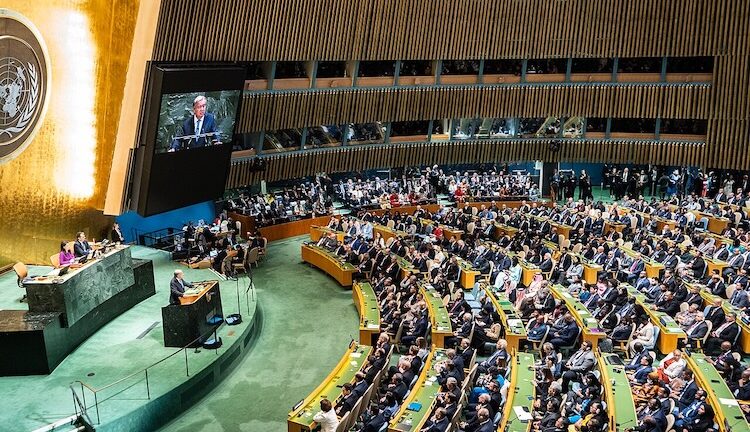
The findings come as world leaders gather in New York for the high-level meetings of the 81st session of the UN General Assembly. The General Debate opens on 22 September and runs through 26 September before concluding on 28 September.
This year’s theme could hardly be more relevant: “Restoring trust, managing transformation: a United Nations that delivers for all.”
A Worried World Still Wants Cooperation
The survey, conducted by GeoPoll for the UN Foundation between 1 and 16 September, questioned 5,000 people in 20 countries that together account for 56 per cent of the world’s population. They include all 15 members of the UN Security Council.
Asked what international cooperation should accomplish, respondents put one concern clearly ahead of the others: preventing and ending armed conflicts.
Fifty-eight per cent included it among their three leading priorities. Reducing poverty and inequality followed at 45 per cent, climate action at 40 per cent, protecting human rights at 35 per cent and managing the global economy at 29 per cent.
The emphasis on peace is striking for an organisation created in 1945 above all to save succeeding generations from war.
More than eight decades later, the Security Council is repeatedly divided over major conflicts. At the same time, the UN faces wars and humanitarian emergencies alongside climate disruption, growing inequality and pressure on development financing.
Yet dissatisfaction with the way the international system is working has not turned into a general rejection of countries working together.
A much larger survey released by the Rockefeller Foundation a day before the UN Foundation poll found something similar.
Conducted with Focaldata between 21 July and 5 August, it questioned 35,399 adults in 34 countries. Nearly seven in ten said the world had become worse over the previous year.
At the same time, preventing wars and conflicts was the leading priority for international cooperation in 21 of the 34 countries and ranked among the top two in 33.
The two surveys asked different questions and cannot be directly compared. But both capture a public mood in which pessimism about the state of the world coexists with continued support for countries working together.
More Confidence in the Global South
One of the clearest differences in the UN Foundation poll is between the Global North and Global South.
Overall, 58 per cent of respondents said they trusted the UN and other international institutions to make progress on the challenges that mattered most to them.
In the Global South, that figure reached 65 per cent. In the Global North, it was only 44 per cent.
The difference comes as governments in Africa, Asia and Latin America press for greater representation in institutions largely shaped in the aftermath of the Second World War.
Reform of the Security Council and international financial institutions has become part of a wider argument over whether today’s system adequately reflects changes in population, economic weight and political influence since 1945.
The figures also show that criticism of the present system should not automatically be read as rejection of multilateralism. In many countries, the demand is for international institutions to work differently and give a greater voice to those they are supposed to serve.
What People Want From the Next UN Chief
The survey also comes at a significant moment for the organisation itself.
António Guterres is approaching the end of his second term, and the process of choosing the tenth UN Secretary-General is under way.
Outside diplomatic circles, however, the contest has little public awareness. Eighty-five per cent of respondents said they had heard little or nothing about the selection process.
But when asked what sort of Secretary-General they wanted, their answers were revealing.
Twenty-eight per cent wanted a diplomat who could help end wars. Twenty-six per cent preferred a crisis manager able to respond to global emergencies, while 25 per cent wanted a moral voice prepared to speak out on human rights and existential threats.
Only 17 per cent prioritised a Secretary-General focused mainly on reforming the organisation internally.
The survey also addressed a precedent that has lasted throughout the UN’s history.
All nine Secretaries-General since 1945 have been men.
Sixty-one per cent of respondents said it was important that the next Secretary-General should be a woman. Support rose to 68 per cent among women and respondents aged between 18 and 34, and to 70 per cent among those surveyed in the Global South.
Support Without Satisfaction
The findings need to be treated with some caution.
The UN Foundation is committed to strengthening the United Nations and international cooperation. The survey’s 5,000 respondents provide a broad multinational sample, but the individual country samples are much smaller. Its mobile and web-based methodology can also favour more digitally connected sections of society.
Nor does the Rockefeller survey confirm every finding of the UN Foundation study. Its questions and sample were different.
It does, however, provide useful evidence of the wider public mood.
The Rockefeller Foundation found that 61 per cent of respondents would support a coalition of countries addressing global problems without either the United States or China.
That is noteworthy, given how much discussion of the international order is framed around rivalry between Washington and Beijing. Many respondents evidently see room for international cooperation that does not depend entirely on either power.
For the UN, the more immediate finding is simpler.
Most respondents do not regard the organisation as obsolete. They want countries to work together, and they put preventing and ending wars at the top of their priorities.
But they also see a United Nations struggling to deliver.
When presidents and prime ministers enter the General Assembly Hall this week, they will speak under a banner promising a UN “that delivers for all.”
The new poll suggests that the public has not abandoned that idea.
The question is how much longer people will be satisfied with the promise rather than the results. [IDN-InDepthNews]