
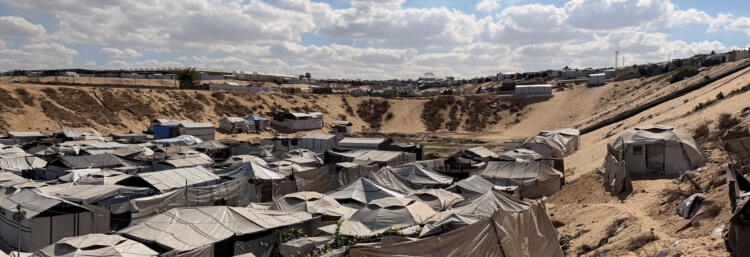
UN rights officials warn that repeated displacement, attacks near encampments and restrictions on shelter materials are making return increasingly difficult.
By Ramesh Jaura
BERLIN | 2 November 2026 (IDN) — A ceasefire may have reduced the scale of fighting in Gaza, but it has not ended the displacement of Palestinians. Nor has it given most families a realistic prospect of returning home.
The United Nations Human Rights Office, OHCHR, warned on 30 October that Israeli military operations continued to force Palestinians into ever-smaller areas of the Gaza Strip. Homes and public infrastructure were still being destroyed, displacement sites had come under attack, and families were being pushed away from areas close to the Israeli-controlled “Yellow Line”.
“The nightmare of displacement in Gaza is both acute and chronic,” said Ajith Sunghay, head of the UN Human Rights Office in the Occupied Palestinian Territory.
Many Palestinians displaced before the ceasefire cannot return because their former neighbourhoods lie beyond the Yellow Line. Others have been uprooted repeatedly from places where they sought temporary shelter.
The warning gained fresh urgency on 1 November, when Israeli strikes killed at least eight Palestinians, according to Gaza medical officials and the Hamas-run Interior Ministry. Five were police officers killed in western Khan Younis; three others died in Gaza City.
Further strikes on 2 November killed at least four Palestinians and wounded several others, according to medics. Two people were killed in Khan Younis, one in Al-Mussadar and one when a vehicle was struck in Gaza City’s Tel Al-Hawa neighbourhood.
The Israeli military said it had struck militants in Khan Younis but did not immediately comment on the Gaza City attack. Israel accused Hamas of rearming and violating the ceasefire. Hamas denied the allegation and accused Israel of undermining the agreement.
Gaza health officials say Israeli attacks have killed at least 1,580 Palestinians since the ceasefire took effect in October 2025. Israel says four of its soldiers have been killed during the same period. The figures come from the respective parties and have not all been independently verified.
Fires and conflicting figures
UN reports describe shootings, fires and the placement of additional yellow concrete markers in areas close to the line. Humanitarian workers have distributed tents, blankets, tarpaulins and hygiene kits, but their stocks are limited.
The available UN accounts give different figures for fires near Al Shujaiyeh. The UN News report said an incident on 25 October displaced around 200 families comprising 800 people, most of them women, children and older people.
OCHA’s more detailed field report said a fire at tents in the area directly affected nine families that day. It also recorded a separate, earlier fire that displaced 137 households. The reports may refer to different incidents or assessments, but they do not fully reconcile the numbers.
The discrepancy does not alter the wider finding: people living near the Yellow Line face pressure to move, often without a safe or adequately equipped alternative.v
A ceasefire line becomes a boundary.
The Yellow Line emerged from the ceasefire that took effect on 10 October 2025. It marked the area behind which Israeli forces were expected to remain temporarily.
It has since taken on broader significance. For Palestinians, it determines which parts of Gaza they can approach and where Israeli forces may use lethal force to enforce access restrictions.
The original arrangement left Israeli forces in control of about 53 per cent of Gaza. More recent assessments place the area under effective Israeli control at roughly two-thirds of the territory, concentrating most of Gaza’s population of more than two million in the remaining area.
A UN commission of inquiry reported in October that the Yellow Line was developing into an expanding boundary of Israeli control. It identified new military bases and supporting infrastructure along the line and questioned whether the demarcation remained temporary.
Israeli officials say the restricted areas and military positions are needed to prevent attacks and protect Israeli forces. Israel also maintains that Hamas has failed to disarm, as envisaged under the ceasefire plan.
The line is not always clearly marked on the ground. Yellow concrete blocks have appeared in some locations, sometimes farther west than earlier demarcations. For civilians moving through heavily damaged neighbourhoods, approaching the restricted area can be fatal.
OHCHR verified 1,076 conflict-related Palestinian deaths between the ceasefire announcement and the end of July 2026. Of these, 331 occurred near the Yellow Line. In many of those cases, the office said, it found no indication that the victims posed a threat to Israeli forces.
A ceasefire in name
The ceasefire ended the largest military operations, enabled the return of the remaining Israeli hostages and their remains, and allowed more humanitarian supplies to enter. Yet airstrikes, shelling, drone attacks and ground operations have continued. Hamas and other armed groups have not disarmed.
Briefing the Security Council on 15 October, UN Middle East coordinator Ramiz Alakbarov said that for Palestinians living near the Yellow Line, the ceasefire existed “in name only”.
During a visit to Shujaiyeh, he met families living in constant fear of gunfire. Some had nowhere safer to go. The area housed about 950 displaced families, including children and older people.
The human rights office has warned that Israel, as the occupying power, must not forcibly transfer Palestinians within Gaza. Forcible transfer is prohibited under international humanitarian law and can constitute a war crime. If carried out as part of a widespread or systematic attack against civilians, it may also amount to a crime against humanity.
OHCHR has raised concerns that the continuing reduction of the territory available to Palestinians could result in ethnic cleansing. The term refers to the removal of an ethnic or religious population from a particular area through force, intimidation or other coercive measures.
Israel rejects allegations that it is seeking to remove Gaza’s Palestinian population. It says its military operations are directed against Hamas and other armed groups and are required to protect Israel from further attacks.
Israel has also rejected the findings of the UN commission of inquiry, describing them as part of a campaign to delegitimise the country and deny its right to defend itself.
Another winter under canvas
The displacement crisis is becoming more dangerous as winter approaches.
Nearly two million people in Gaza require shelter assistance. More than 65 per cent of displaced households surveyed by humanitarian agencies were living in tents or makeshift structures, over half of which were in poor or very poor condition.
Approximately 950,000 people were staying at sites considered at medium or high risk of flooding. More than 400,000 were at high risk. Available supplies could partially assist only 18 per cent of the families requiring shelter support for the rainy season.
Gaza’s damaged infrastructure compounds the danger. All six wastewater treatment plants remain out of operation, most sewage-pumping stations do not function, and many families depend on water delivered by tanker. Thousands are also living in damaged buildings that could collapse.
Israel says restrictions on certain materials are required because items classified as “dual use” could be diverted for military purposes. UN agencies say the controls have delayed ordinary medical, sanitation and shelter equipment essential to civilian survival.
The question is no longer only where displaced Palestinians can find another tent. It is whether the military and geographical changes taking place under the ceasefire will leave them anywhere to return to.
The agreement stopped Gaza’s most intense period of warfare. It has yet to provide the basic conditions for peace: personal safety, freedom of movement, adequate shelter, and the right of displaced people to go home. (IDN-InDeprhNews)
Sources: UN News, 30 October 2026; OCHA Humanitarian Situation Report, 29 October 2026; Reuters, 1 November 2026; Reuters, 2 November 2026