
By Jonathan Power*
LUND, Sweden | 4 November 2026 (IDN) — “Suppose aliens existed, and that some had been watching our planet for its entire forty-five million centuries, what would they have seen? Over most of that vast time-span, Earth’s appearance altered very gradually. Continents drifted; ice-cover waxed and waned; successive species emerged, evolved and became extinct.
“But just in a tiny sliver of Earth’s history—the last hundred centuries—the patterns of vegetation altered much faster than before. This signalled the start of agriculture—and then urbanization.”
We are at the very end of that “sliver”.
So begins a book by Martin Rees, Britain’s former Astronomer Royal, On the Future: Prospects for Humanity.
There is much in this short, very readable book—the disturbing, sometimes positive, sometimes negative, future of biotech, artificial intelligence, global warming, medicine, ageing, communications, nuclear energy, weapons development, sustainability, agricultural research, poverty and employment—but its centrepiece is astronomy.
A Universe Beyond Comprehension
Over the last 60 years our knowledge of the universe has grown exponentially. Today we know our Sun is one of one hundred billion stars in our galaxy, which is itself one of at least one hundred billion other galaxies. These stars orbit around a central hub where lurks a massive black hole. Neither we humans nor any creatures living light years away could ever hope to meet each other. For humans it would take tens of thousands of years to reach the nearest star.
At best there might eventually be a connection established by radio signals. Astronomers with their quite amazing telescopes have detected ‘echoes’ of the ‘big bang’ that triggered our entire universe 13.8 billion years ago. The universe is still expanding. This is how it was born—and with it, all the basic particles of nature.
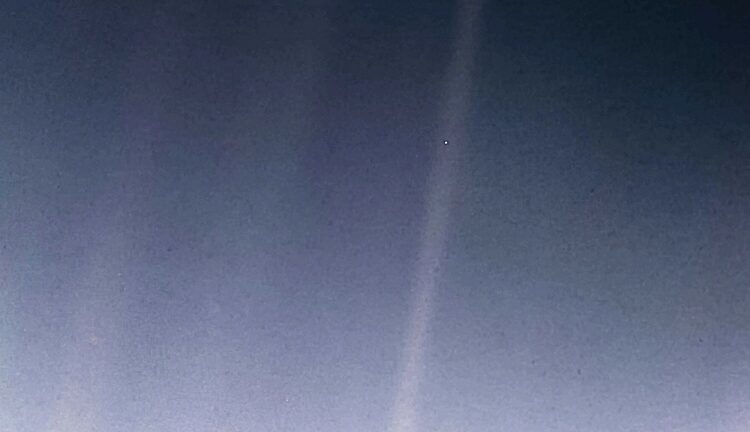
The great American astronomer Carl Sagan wrote in 1990 of the photo taken of the Earth by the probe Voyager 1 from a distance of six billion kilometers. The Earth appeared as a “pale blue dot”. His observation was almost poetic: “Look again at that dot. That’s here. That’s home. That’s us—On it everyone you love, everyone you know, everyone you have ever heard of, every human being who ever was, lived out their lives. Every saint and sinner in the history of our species lived there—on a mote of dust suspended in a sunbeam.”
More than that, Rees explains, “We are literally the ashes of long-dead stars—or the nuclear waste from the fuel that made stars shine.”
Is Life a Cosmic Fluke?
Eminent nineteenth century thinkers argued that life must pervade the cosmos because, otherwise, such vast domains of space would seem such a waste of the Creator’s efforts. (My own observation is that if there is a God then he must think that creating life on this planet was a grave mistake, given what we’ve done with it.)
Is life a fluke? If we could find vestigial-life forms elsewhere in the solar system it would be of “epochal importance”. That would tell us life wasn’t a rare fluke but was widespread in the cosmos. Even then that would not be enough to show that intelligent life exists elsewhere. It is most likely that since life’s origin requires such special contingencies that it only happened once in our entire galaxy.
By the time the reader has digested the riches of Martin Rees’s discussion he or she will have absorbed the essentials of astronomy. One thought I had when I put the book down was to wonder what my grand, grand children will get to know about our universe and what they will do with that knowledge.
Can Humanity Survive Itself?
Will they manage to save our planet from self-destruction because of war, climate change, massive Earth-wide rebellion by the less well off or artificial intelligence getting out of control? (It could be, at the rate we are going, that will happen even sooner.)
Our universe might go on expanding forever, but are our horizons? Woody Allen once said, eternity is very long, especially towards the end. But that’s only so if we contrive to make it so.
This is the only existence we know or are ever likely to know. We try to make the best of it. And so we should, which should mean not enjoining war, war crimes and crimes against humanity, thuggishness, destructiveness, criminality, discrimination and exploitation.
We want in our world honesty, compassion, responsibility, love, fairness and justice. And good governance of home, nation and world. How many of us can put their hand upon their heart and say they have never failed these ideals?
Making the Best of Our Brief Moment
We had better get on with life for all its faults and complexity. Worrying over the fact that we are less than a pin-prick in our galaxy gets us nowhere. We must give of our best, make the best, adore our world and its peoples and then peacefully fade away, our job of living on this quite insignificant planet well done.
Copyright: Jonathan Power.
*Jonathan Power is a veteran foreign affairs journalist and columnist who has written extensively on international politics, peace, development and human rights.
Editor’s Note:This article is published as opinion. The views and interpretations expressed are those of the author and do not necessarily reflect the editorial position of IDN-InDepthNews.