By Daniel Tesfa
ADDIS ABEBA, Ethiopia | 28 August 2026 (IDN) — I come from the social sciences. My research focuses particularly on patterns of human trafficking and the post-war refugee crisis in the Horn of Africa. When I first joined the VODAN Africa FAIR Engineering journey, my ambition was relatively simple: I wanted to organise my research data better while protecting the safety and privacy of sensitive information.
I was thinking primarily as a researcher.
I had data that needed to be structured, analysed and protected. Much of it concerned vulnerable people, displacement, trafficking and experiences that could expose individuals to serious risks if sensitive information were improperly disclosed. I therefore saw FAIR data mainly as a way of making my research data better organised, more manageable and potentially reusable without compromising the rights of the people represented in it.
Fourteen weeks later, my ambition has changed.
I still care about organising and protecting data. But I have begun to see possibilities beyond the boundaries of my own dataset. I am now thinking about how distributed datasets can communicate with one another, how repositories can be queried across organisational boundaries, and how such connections can help us understand broader patterns of humanitarian crises.
This has been one of the most important transformations of my experience with VODAN Africa.
From a social science to the FAIR system challenge
Coming from a social-science background, I did not initially approach FAIR Engineering as a software engineer would. My starting point was the research problem.
How do trafficking routes develop? How do people move across borders? What circumstances make refugees vulnerable? How do conflict, displacement, poverty, technology and political conditions interact? And, perhaps most importantly, how can we study these questions without putting the people represented in our data at further risk?
Organised by the Europe External Programme with Africa (EEPA) and the Africa University Network on FAIR Open Science (AU-FOS), the FAIR Engineering training introduced me to a different way of approaching these questions.
I began to understand that the way data is structured determines what can subsequently be connected, compared, queried and reused. A dataset is, therefore, not simply a collection of information. Its structure creates possibilities for analysis. This changed how I think about my own research.
The Beginning: Many tools, many steps
At the beginning of our FAIR Engineering journey, achieving a FAIR data workflow involved a number of different tools and technical steps.
We worked with REDCap for data capture, Protégé for ontology development, OpenRefine and Protégé for RDF transformation, AllegroGraph for repository and analysis, and additional tools for visualisation.
The process could be represented as:
Data Capture → Data Input Schema → CDM → Ontology → RDF Transformation → Repository → Analysis → Visualisation
Each component taught us something important.
REDCap demonstrated the importance of structured data capture. Protégé helped us understand ontologies and semantic relationships. OpenRefine provided tools for transforming and cleaning data. RDF provided a machine-readable representation of relationships. AllegroGraph provided a powerful environment for storing and querying linked data.
But for a newcomer like me, the architecture could also appear complicated as the challenge was not simply learning each tool. It was learning how the tools work together as one FAIR architecture.
The Transformation: FAIR functions moving into the applications
The major transformation became visible with the development of applications such as Emergency Diary, RPDS, SafeVoice, SafeLine and Thinx in the Data Science in Practice (DSIP) course in the Leiden Institute of Advanced Computer Science in Leiden University. Rather than requiring the user to navigate multiple independent tools, these applications increasingly integrate FAIR functions into the application workflow itself.
Data capture, the Data Input Schema, the use of the Common Data Model and RDF transformation can be incorporated within the application. The resulting structured data can then be pushed to AllegroGraph for storage and analysis and connected to the wider Humanitarian Data Space.
The architecture becomes much simpler:
Application → AllegroGraph → Humanitarian Data Space
For me, this represents an important shift. We are no longer simply learning how to use many different software. We are learning how to engineer applications that incorporate FAIR principles and technologies into their own workflows.
The complexity has not disappeared. Instead, it has moved into the architecture behind the application. That makes FAIR system more accessible to the organisations and communities that actually produce humanitarian data.
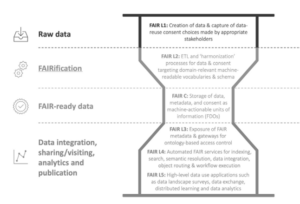 The Hourglass Model by Cardoso Silva Ferreira & Van Reisen, 2023.
The CDM: A common language across applications
One of the most important concepts I encountered was the Common Data Model (CDM). It provides a common vocabulary between the Data Input Schema and application-specific data structures. It helps different applications describe related humanitarian concepts in compatible ways.
Concepts such as Victim, Incident, Location, Organisation, Event, Situation, Destination and Trafficker can be represented through a shared semantic framework. Controlled values for concepts such as gender, nationality, displacement status, accommodation and humanitarian needs further strengthen consistency.
This is crucial because applications should not have to be identical to be interoperable.
Emergency Diary can inform the refugees self-reported context to address protection needs. SafeVoice can focus on sources and trafficking-related information. RPDS can address refugee protection contexts at organizational level. SafeLine can detail the sexual violence refugees and human trafficking victims face in their journey.
Yet they can still participate in the same wider data environment because they are built around common semantic principles. The CDM, therefore, acts as a bridge between application-specific data and cross-application interoperability.
From protecting my data to asking new questions
When I joined VODAN, my immediate concern was: How can I organise my data and keep sensitive information safe?
That remains fundamental.
But once I understood how RDF and semantic interoperability work, another possibility became visible. What if information from different datasets could be queried together to show the patterns that I would have able to comprehend individually?
What if trafficking information could be examined alongside information about refugee protection? What if patterns appearing in one repository could be considered in relation to information held in another—without necessarily centralising all the underlying sensitive data?
This is where my aspiration moved beyond data management towards pattern research using cross-repository analysis with the works of other colleagues. I began to see that FAIR system could potentially change not only how I manage research data, but also the kinds of research questions I can ask.
The emerging focus on cross-repository queries is therefore particularly exciting to me as a researcher. Instead of asking only what can I learn from my dataset, we can begin asking, what can be learned when appropriately governed datasets from different repositories can be queried together.
This opens a completely different analytical horizon.
For research on trafficking and displacement in the Horn of Africa, for example, different datasets may capture different dimensions of the same wider phenomenon. One may provide information about trafficking routes; another about protection needs; another about sexual violence incidents, another about humanitarian crisis or refugee contexts.
The ability to query across repositories could allow researchers to identify relationships and patterns that are difficult to see when datasets remain isolated. The important point is that cross-repository analysis does not necessarily mean centralising all data. With appropriate governance and access controls, the data can remain within their respective environments while authorised queries operate across them. For sensitive humanitarian data, this distinction is critical.
Local ownership and data sovereignty
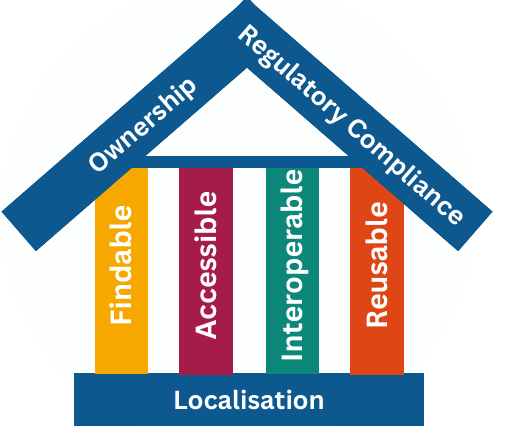
This transformation also reinforces another principle that has become increasingly important to me: local ownership. FAIR should not mean that data produced by African organisations becomes FAIR primarily for external users.
The organisations and communities producing the data should have meaningful control over how their data is stored, accessed, shared and reused. This is particularly important in humanitarian contexts where data can describe vulnerable people, displacement, trafficking, conflict and protection needs.
The Humanitarian Data Space, therefore, represents more than a technical infrastructure. It can become an instrument for strengthening data sovereignty, privacy and agency. For me, this is where FAIR system connects directly with the broader crisis of digital colonialism.
The objective is not simply to make African data visible. It is to help ensure that African organisations can own, govern and benefit from the data they produce.
The VODAN Miracle
Perhaps the most unexpected part of this journey has been what I call “the VODAN Miracle.” The transformation did not happen because each person independently became an expert in every technology. It happened because people supported one another.
Across countries, teams shared knowledge, discussed problems, tested solutions and helped one another understand difficult technical concepts. A challenge encountered by one application team could become a learning opportunity for another.
Knowledge moved not only vertically from trainers to trainees but horizontally between teams. This created a remarkable culture of collective learning. People who initially needed support gradually became people who could provide support to others.
The result was more than technical training. We developed a growing community of practice. For me, this is perhaps the strongest evidence of capacity development. We moved from asking “how do I do this” towards “how can we build this together”.
Beyond the training
The real test now is what we do with this capacity.
The Humanitarian Data Space should ultimately become more than a catalogue of datasets or a collection of repositories. It should continue to become an infrastructure through which humanitarian organisations retain ownership and agency while enabling responsible discovery, interoperability, analysis and reuse.
For researchers, this creates exciting possibilities. For humanitarian organisations, it creates new analytical capacity towards understanding the real-life problems of people on the move. And for vulnerable communities, it creates the possibility that their data can contribute to better understanding and better responses without sacrificing their privacy, dignity and rights.
That is the transformation I have experienced through VODAN Africa: from learning tools to integrated systems; from managing individual datasets to understanding patterns; and from protecting my own research data to imagining what responsible cross-repository knowledge could make possible. [IDN-InDepthNews]