By Somar Wijayadasa*
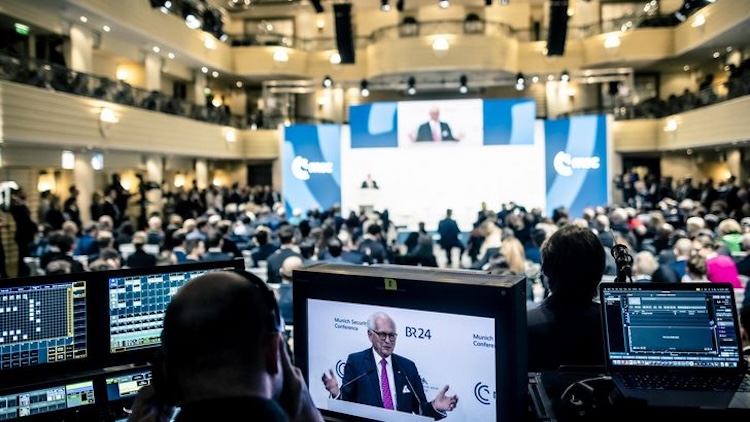
NEW YORK | 19 February 2026 (IDN) — The 62nd Munich Security Conference (MSC), held from February 13–15 in Munich, Germany, convened global leaders at a moment of mounting geopolitical strain. Long regarded as a premier forum for international security dialogue, this year’s conference unfolded against the backdrop of what its organizers describe as a period of profound systemic disruption.
Titled “Under Destruction”, the MSC report examines what it calls the rise of political forces that “favor destruction over reform”. Introducing the report, longtime MSC chairman Wolfgang Ischinger warned that “a wrecking ball is currently smashing what would normally be part of a stable international order”.
According to the report, the world has entered an era of “wrecking-ball politics,” in which sweeping dismantlement has replaced careful reform as the dominant political impulse. It argues that more than eighty years after its construction began, the US-led post-1945 international order is now under direct strain, with the current US administration portrayed as one of the most prominent challengers to that framework.
The report ultimately cautions that alliances are weakening, geopolitical tensions are intensifying, and a political climate is emerging in which those who deploy “bulldozers, wrecking balls, and chainsaws” are increasingly admired rather than resisted.
Participation Amid Turbulence
The Conference brought together a broad cross-section of the global security leadership. Delegates included heads of state and government, foreign and defense ministers, and senior representatives of international organizations — with participation from over 70 heads of state and government, more than 140 ministers, and dozens of leaders from international bodies.
The conference followed a year of mounting geopolitical strain. The raging war in Ukraine, the military strike on Venezuela and the abduction of it’s President Nicolas Maduro and his wife (widely condemned as a gross violation of international law), threatened NATO ally Denmark with forcibly seizing Greenland, withdrawing the USA from 66 international bodies, including 31 United Nations (UN) entities, threats of another attack on Iran that would engulf the Middle East, a Peace Treaty that never fully stopped the genocide in Gaza. These underscored rifts among traditionally aligned partners.
These actions prove that the world is in the midst of discord between longstanding alliances, the rules-based international order eroding, and mounting instability and escalating conflicts across the globe – issues that prove that multilateralism is in crisis and that the US is simply walking away from the multilateral system it helped build.
Discourse: Sound and Fury?
US Secretary of State Marco Rubio, in a conciliatory speech, called for reviving alliances between the United States and its European allies, at a time when President Trump’s aggressive, America First policies have inflamed tensions with some longtime partners.
He reinforced Trump’s rhetoric that Europe faces the prospect of “civilizational erasure” amid its immigration policies.
Rubio slammed the UN for “having no answers” on crises from Gaza to Ukraine, claiming “it took American leadership” to try to untangle the messes. He said that it also took “American bombs” to stop Iran from building a nuclear weapon — even though Tehran has long denied having any intentions of doing so. He also praised the US for “liberating Venezuela from a narco terrorist dictator,” defending the abduction of President Nicolas Maduro as if it were business as usual.
His address was markedly different in style from last year’s appearance by Vice President J.D. Vance, whose speech sharply criticized European liberal governance, immigration policies, and what he described as democratic backsliding. Vance argued that Europe’s gravest dangers came not from Moscow or Beijing, but from within its own political systems — a message that unsettled many in the Atlanticist establishment.
This year’s exchanges felt less incendiary but no less revealing. European leaders responded with a mixture of reassurance and recalibration.
British Prime Minister Keir Starmer reaffirmed that “the U.S. remains an indispensable ally,” while urging European NATO members to reduce over-dependence on Washington and invest in greater strategic autonomy and hard power. French President Emmanuel Macron echoed that call, arguing that Europe must become a geopolitical power in its own right, strengthening its military capabilities and industrial base to increase pressure on Russia.
Macron announced that he had been in talks with German Chancellor Friedrich Merz and a “few other European leaders” on developing a joint nuclear doctrine. Discussions of closer defense coordination — including potential nuclear cooperation — underscored the seriousness of that shift.
Merz struck a particularly stark tone, declaring that “the international order based on rights and rules no longer exists.” He called for the remilitarization of the EU, in which the German military would be the “strongest conventional army in Europe.” This is aimed squarely at Russia”, he said, vowing to keep backing Ukraine in its “brave resistance against Russian imperialism”.
Comparing Russian President Vladimir Putin to Adolf Hitler, Ukrainian President Volodymyr Zelenskyy maintained a firm stance, rejecting territorial concessions to Russia and urging sustained European military support, more sanctions on Moscow, and claimed that his military is preventing the fall of “an independent Poland and the free Baltic states”.
At the same time, alternative perspectives emerged. Chinese Foreign Minister Wang Yi emphasized the need to reform global governance structures and warned that abandoning the United Nations framework would risk a return to “the law of the jungle.” India’s External Affairs Minister S. Jaishankar similarly stressed the importance of multipolarity and strategic autonomy.
Even dissenting American voices surfaced. Representative Alexandria Ocasio-Cortez criticized what she described as a retreat from multilateralism and warned against US disengagement from global institutions. She condemned the kidnapping of Nicolas Maduro, the planned annexation of Greenland, and Trump’s apparent contentment with letting Putin “bully our allies” in Europe. She called for a return to a “rules-based order”.
The Absence of Russian and Iranian Representatives
Though her speech was a departure from the others, it reminded me of Russia’s President Vladimir Putin’s 2007 address to the same forum in which Putin explained that there has always been “one center of authority, one center of force, one center of decision-making” in the so-called “rules-based order” of the US — and that it is pernicious.
Notably absent from the conference were official representatives from Russia and Iran, both excluded from participation. Instead, long-exiled Iranian opposition figure Reza Pahlavi addressed the forum, and Venezuela’s exiled María Corina Machado delivered a virtual address — highlighting the increasingly political contours of participation.
While the conference was principally a venue for diplomatic dialogue rather than formal decision-making, its high attendance and sharp exchanges reflected mounting tensions and a perceived erosion of the “rules-based” global system — issues that animated discussions about multilateralism, alliance cohesion, and the future of international cooperation.
For longtime observers of Munich, the cumulative effect was striking. The rhetoric was forceful, the diagnosis severe, yet concrete pathways forward remained elusive. The conference, designed as a forum for dialogue, reflected instead a world talking past itself — alliances strained, multilateralism questioned, and competing visions of order laid bare.
In the end, the status quo may appear intact. Yet beneath it, the foundations are shifting.
*Somar Wijayadasa, originally from Sri Lanka, is an International lawyer who worked in several UN organizations (IAEA, FAO, since 1973), UNESCO Delegate to the UN General Assembly for 15 years (1980-1995), and was the Representative of UNAIDS at the United Nations from 1995-2000. [IDN-InDepthNews]