
Challenging Modern Chauvinism
By Jan Servaes
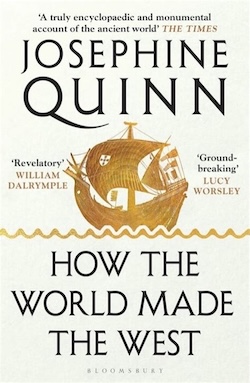
BRUSSELS | 29 July 2026 (IDN) — In *How the World Made the West: A 4,000 Year History*, Josephine Quinn argues that Western civilisation emerged from long-standing cultural exchanges between Africa, Asia, and Europe—rather than being merely a product of Greece and Rome—as we were traditionally taught in school.
 According to Quinn, the West developed out of a rich array of cultural interactions spanning Europe, Asia, and Africa. These exchanges introduced new technologies, scientific knowledge, and religious ideas to the West—particularly during the Islamic Golden Age and through trade networks such as the Silk Road and the quest to reach India—and contributed to the shaping of the European Renaissance by spreading advances in astronomy, medicine, and mathematics.
Josephine Quinn is Professor of Ancient History at the University of Cambridge, the first woman to hold this chair. She holds degrees from Oxford and the University of California, Berkeley, has taught in the United States, Italy, and Oxford, and was co-director of the Tunisian-British archaeological excavations at Utica.
Even more so than in Howard French’s book *Born in Blackness. Africa, Africans, and the Making of the Modern World. 1471 to the Second World War* (reviewed here) or João Paulo Oliveira e Costa’s *Henrique, o precursor da globalização* (see here), Josephine Quinn challenges our Western conception of history.
She demonstrates how ideas, technologies, and institutions labelled as “Western” emerged through continuous interactions and the adoption of elements from diverse cultures. In doing so, Quinn traces the interconnected networks of trade, the exchange of ideas, and the cross-pollination of customs among civilisations spanning from the Bronze Age to the Middle Ages. As empires rose and fell, diverse societies influenced one another through technology, religion, artistic styles, and political systems, thereby contributing to what we now regard as the Western world.
According to Quinn, “Western civilization” would not exist without its Islamic, African, Indian, and Chinese influences. To understand why, she looks back in time, starting with the bustling port city of Byblos in Lebanon around 2000 BCE. It was the height of the Bronze Age, a period that “ushered in a new era of regular long-distance trade.”
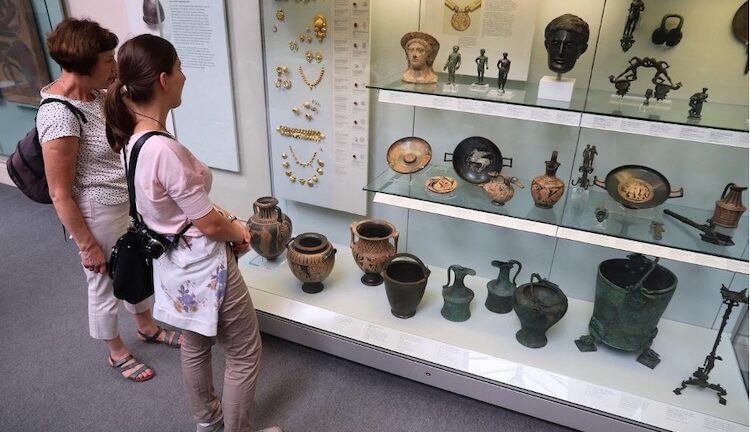
Carbon dating techniques applied to recent archaeological finds provide compelling evidence of just how “globalised” the Mediterranean region already was 4,000 years ago. Welsh copper travelled to Scandinavia, and Cornish tin even reached Germany, where it was used to forge bronze weapons. Beads made of Baltic amber—found in the tombs of Mycenaean nobles—originated in Britain. A thousand years later, trade along the Atlantic coast led to “Irish cauldrons becoming particularly popular in northern Portugal.”
Emerging trade routes connected the Mediterranean region with China
Quinn highlights the interconnectedness of the global economy during the first millennium AD. The Indian Ocean played a crucial role in this regard, serving as the primary conduit for the supply of goods from China.
She also emphasises the importance of Roman control over Egypt in establishing a vital link between this maritime trade network and Europe’s economic systems. During the 13th century, the expansion of the Mongol Empire bolstered the development of Mediterranean trade connections and led to the creation of new overland trade routes traversing Asia. This significantly extended the reach of Eurasian trade networks.
In the first century AD, a new route for Indian goods destined for the Roman Empire was established, utilising camel caravans and riverboats. This route connected Palmyra to the Persian Gulf, offering an alternative to the traditional maritime route via the Red Sea.
The author describes Palmyra as a pivotal desert crossroads where, in the first century AD, merchants from the Roman Empire converged with travellers following established routes to ports on the Persian Gulf and in India. The city benefited from its strategic location and cooperation with neighbouring Arab tribes, employing camels that were ideally suited for the long journey eastward across the desert.
The development of an alternative route originating in Antioch and other Roman ports ultimately created a connection to Indian trade centres via the Gulf. During the first centuries of the Common Era, the authentic Silk Roads consisted primarily of maritime routes traversing the Persian Gulf and the Indian Ocean, benefiting from reliable monsoon winds, diverse trading communities, and Roman rule over Egypt.
Pre-colonial trade between Europe and Africa
Thus, prior to the European voyages of discovery in the fifteenth century, African rulers and traders already maintained trade relations with the Mediterranean, West Asia, and the Indian Ocean region. Within the African continent itself, local exchanges between neighbouring peoples fit into a broader framework of long-distance trade.
European ‘explorers’ who began trading along Africa’s Atlantic coast therefore encountered an established trading population. Merchants from England, France, Portugal, Spain, and the Netherlands quickly developed trade relations with indigenous local rulers and built fortified trading posts in coastal areas to store goods and protect their trading rights against foreign interference. Independent Portuguese merchants settled along Africa’s coasts and rivers, from present-day Senegal to Angola. There, they were integrated into African society and acted as intermediaries between European and African traders.
The goods most frequently imported into Africa included textiles, iron and copper (both raw and processed), and cowrie shells, which the local population used as currency. Non-utilitarian items such as jewellery, beads, and alcohol also found a receptive market. Catholic countries like Portugal were—in theory, at least—prohibited by papal decree from selling goods with potential military utility to non-Christians, although it remains unclear how strictly this rule was observed in practice. In exchange for their wares, Europeans returned with textiles, wood carvings, spices, ivory, gum, and African slaves.
Contrary to common perceptions of pre-colonial Africa, local manufacturers at the time produced goods of quality comparable—if not superior—to those of pre-industrial Europe. Thanks to advances in indigenous forging technology, blacksmiths in certain regions of sub-Saharan Africa produced steel of higher quality than their European counterparts, while highly developed textile workshops in West Africa were producing fine fabrics for export long before the arrival of European traders.
Conversely, the novelty and relative scarcity of European imports gave them a significant advantage over local products, and powerful rulers eagerly adopted them as symbols of courtly status. Dr. Alexander Ives Bortolet cites one such status object: a necklace belonging to a Chokwe chief from Central Africa. The white ceramic “shell” attached to a woven band was an item manufactured in Europe—likely Germany—for use by Portuguese slave traders. Round, white shells are prized symbols of spirituality and leadership in many Central African cultures, and European traders clearly created this ceramic version to meet the specific demands and interests of their trading partners. Local leaders who benefited from international trade also commissioned other prestigious objects—such as elaborate wood and ivory carvings—from local artisans.
The blending of diverse cultural perspectives on world geography
Quinn highlights the gradual emergence of the conviction that Western civilisation was unique and superior—a process that unfolded during a complex era marked by the fall of the Western Roman Empire, the rise of an Islamic empire to the south and east of Europe, and the widespread adoption of Christianity across the region. During this period, Jews, Muslims, and other religious communities deemed unwelcome were expelled or subjected to harsh treatment.
The Roman Empire reached its zenith by integrating a multitude of cultural influences.
The fall of the Roman Empire was not the result of a single event; rather, it stemmed from a long period of cultural exchange. During this time, the empire—stretching from the Mediterranean to the Euphrates, from north to south, and from the Atlantic to its eastern frontiers—integrated foreign ideas and peoples, including the so-called barbarians who eventually supplanted Roman rule.
Quinn emphasises that Rome was characterised by its hospitality from the very beginning. Roman culture was defined by an identity linked more to the exercise of political power than to specific ethnic ties. As the Romans expanded their dominion, they deliberately incorporated local customs and social structures into their own way of life. This gave rise to a community that relied on a diverse population, ranging from the supreme ruler to the enslaved. The cultural integration and the establishment of systems that enabled Roman rulers to maintain authority over a vast and diverse territory began in the 5th century BC, a period when Rome was merely a minor player on the Mediterranean political and cultural stage.
During the 2nd and 3rd centuries, as Rome’s European frontiers became increasingly exposed yet simultaneously fortified, surrounding societies adopted Roman technological advancements and cultural practices. This gave rise to new administrative systems and entities capable of challenging Rome’s supremacy.
Quinn suggests that, over time, indigenous communities rapidly adopted Roman developments and traditions, integrating them into their own complex administrative systems and customs. The establishment of a well-defended frontier separating the Roman Empire from groups in Northern Europe led to an increase in hierarchical social structures within adjacent communities, where local leaders waged war to expand their territories and consolidate their control over neighboring groups.
Further case studies
The book includes various case studies that illustrate the key arguments:
- Byblos and Bronze Age networks: Examines early trade and cultural exchanges in the Levant.
- Minoan and Mycenaean Crete: Discusses the influence of these civilizations on later Greek culture.
- The alphabetic innovation of Ugarit: Highlights the development of writing systems that influenced communication.
- Phoenician expansion: Investigates the spread of trade and culture across the Mediterranean.
- Islamic caliphates: Analyses the intellectual exchanges between Christian and Islamic scholars.
‘The West’
Yet it was not until the 19th century that the idea of ”the West” emerged, Quinn notes. However, the “earliest known version of a binary polarity pitting Europe against Asia” can already be found in Herodotus’s accounts of the Persian Wars; and Frankish Christians began to view themselves as “European” in the wake of the Arab conquest.
For this reason, the book also challenges modern Western chauvinism. To the extent that we have inherited classical culture, Quinn argues, it is in a rather distorted form.
In short
The book emphasises the interconnectedness of cultures and the impact of historical events—such as war and migration—on the development of Western ideas and institutions.
Although Quinn has garnered praise primarily for her detailed and nuanced analyses, there has been some criticism as well. Yet, as *The Economist* concludes: “Even seasoned history buffs will find much that is new and fascinating… Whoever thought history was passe could not be more wrong.” [IDN-InDepthNews]
Reference
Josephine Quinn (2024), “How the World Made the West. A 4,000 Year History” , Bloomsbury Publishing, London, 562 pp. ISBN: 9781526605221
https://www.bloomsbury.com/uk/how-the-world-made-the-west-9781526605184/