
By Jan Servaes
BRUSSELS | 8 July 2026 (IDN) — For the average global citizen, the level of democracy today has regressed to that of 1978. This means that all the democratic gains of the so-called ‘third wave of democratization’—which began with Portugal’s Carnation Revolution in 1974—have either vanished or been significantly eroded.
This is the conclusion reached by the ‘Varieties of Democracy’ (V-Dem) Institute, based at the University of Gothenburg in Sweden. Their findings rely on a detailed, multidimensional dataset compiled annually that reflects the complexity of the concept of democracy—a form of governance that extends beyond the mere existence of elections. They identify five fundamental democratic principles: electoral, liberal, participatory, deliberative, and egalitarian.
In its 2026 report, the Institute identifies three patterns: democratic decline in some historically stable democracies; significant setbacks—and often even the collapse of democracy—in countries that had successfully democratized during the late twentieth and early twenty-first centuries; and the strengthening of autocracy in states that were already autocratic.
Bottom-up democracy
The V-Dem Institute is not alone in reaching these conclusions. Yet, while mainstream media and political circles remain fixated on the formal aspects of elections—and whether or not they are legitimate—‘alternative’ spheres have for some time been seeking more ‘participatory’, ‘deliberative’, and ‘egalitarian’ forms of democracy and sustainable transformation. Various scholars and activists—such as Saul Alinsky, Paul Almeida, Lydia Ashcombe, Deepak Bhargava, Richard Cloward, Marshall Ganz, Frances Fox Piven, and Stephanie Luce—have studied community organizing and grassroots social movements, analyzing the factors contributing to their success or failure, as well as the relative strength of local versus national movements.
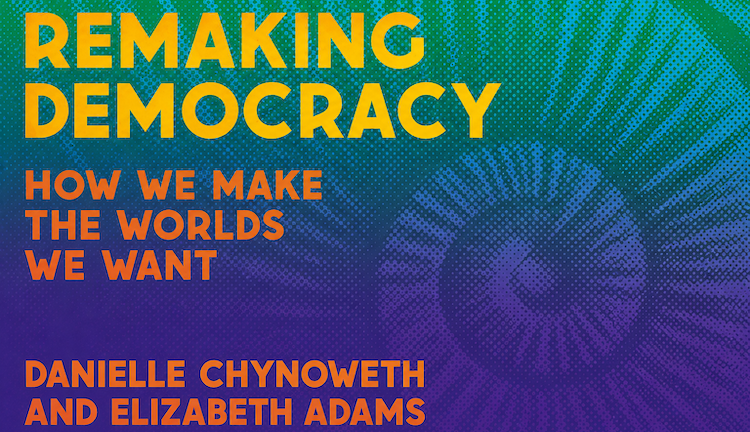
A recent and interesting addition to this field is *Remaking Democracy: How We Make the Worlds We Want*, a guide by Danielle Chynoweth and Elizabeth Adams that offers strategies and case studies for social change. It addresses the urgent need for social change in the face of rising fascism and environmental crises. The book serves as a practical resource for individuals and communities seeking to create just and participatory systems.
Both authors can be considered outsiders, as they do not belong to traditional academic or political circles. Moreover, their book was published by Common Notions—a Creative Commons-based “publishing and programming platform that promotes new formulations of liberation and lived autonomy.”
Danielle Chynoweth is active in movements fighting for media justice and housing rights. As an elected official, she established alternative crisis interventions, family shelters, and ‘Solidarity Gardens’; she also played a leading role in projects involving public art, community broadband networks, solar-powered affordable housing, and police oversight. She served as Organizing Director for media justice and co-founded the *Urbana-Champaign Independent Media Center*. She teaches courses on social change at the University of Illinois, the *School for Designing a Society*, and at international venues.
Elizabeth Adams (PhD) is a composer, educator, and family caregiver. She has been working at the intersection of art, education, and social activism for over twenty years. As a knowledge worker committed to a cultural shift toward social justice, she co-initiated *Julie & Elizabeth’s Anti-Capitalist Concert Series* and collaborated with organizations such as the *Crown Heights Tenant Union*, *Free University NYC*, and *What A Neighborhood!*. She has taught at Columbia University and the *School for Designing a Society*.
Strategies for Change
While traditional political methods are often based on top-down decision-making by established authorities, the authors emphasize the importance of grassroots organizing, empowerment, and participation. Community organizing demonstrates that democracy is not merely about the power vested in elected leaders; it is about the power ordinary people possess to reshape society. This grassroots approach fosters broader participation and can lead to more direct action and relevant solutions for local problems.
The book offers a toolkit comprising case studies and concrete strategies.
Key strategies for social change at the local level include empowering individuals and communities, employing non-violent collective action, and focusing on sustainable transformation through community organizing. Concrete examples of protests, demonstrations, petition drives, and social media campaigns are discussed as instances of non-violent collective action. All these strategies emphasize the importance of participation and direct involvement in creating social change.
The focus lies on sustainable transformation and collective action. Principles such as participatory democracy—‘encouraging active participation by community members in decision-making processes’—and building solidarity—‘uniting diverse groups around shared goals to strengthen movements’—are explored in depth. Through direct participation and human agency, the authors advocate for the importance of building structures that support values such as care, justice, and respect for the Earth and all its inhabitants.
Community organizing thus serves as a powerful counterweight to top-down approaches, reminding us that meaningful, sustainable reforms emerge when individuals come together, driven by shared values and a pursuit of justice. These grassroots initiatives are not merely a supplement to formal political structures, the authors argue; they are the lifeblood of democracy itself, actively building democratic values—such as participation, equality, and solidarity—from the bottom up. In the hands of engaged citizens, grassroots movements become engines of social transformation—neighbourhood by neighbourhood, issue by issue, and victory by victory.
Addressing current crises
The authors also discuss the failure of current institutions in the face of health crises and environmental degradation.
They argue that despair can be transformed into hope through collective action and community engagement. The authors acknowledge that collective actions can entail risks—such as state repression, internal fragmentation of the movement, and unintended counter-reactions that undermine the objectives. Yet, employing a dialectical approach, they also seek positive solutions for each of these challenges.
In doing so, they emphasize the interconnectedness of social justice and ecological sustainability. This enables them to develop a long-term vision—focusing on strategies aimed at lasting change rather than short-term fixes.
*Remaking Democracy* is praised for its accessible writing style and practical insights. The book serves as an important guide for anyone committed to fostering meaningful social change. By combining theoretical insights with practical tools, it stands as a valuable resource for activists, educators, and community leaders alike.
Reference:
Danielle Chynoweth & Elizabeth Adams (2026), *Remaking Democracy: How We Make The Worlds We Want*, Common Notions, Philadelphia PA, 268 pp. ISBN: 9781945335518 https://www.commonnotions.org/buy/remaking-democracy [IDN-InDepthNews]