
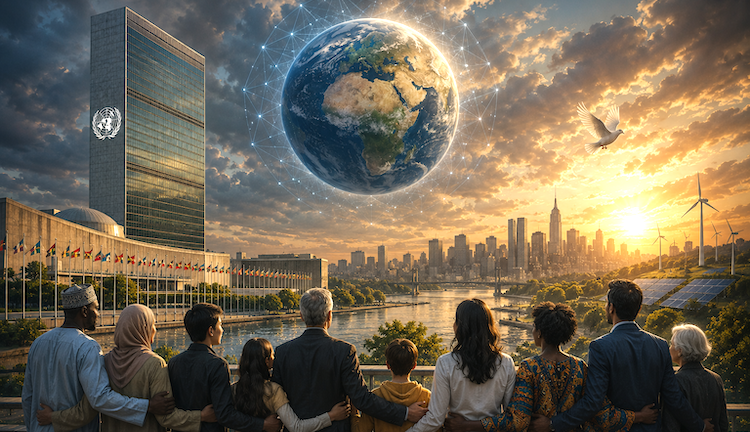
Hamburg and the Future of International Cooperation
“The United Nations was not created to take mankind to heaven, but to save humanity from hell.” – — Dag Hammarskjöld
By Ramesh Jaura
This article was first published on https://rjaura.substack.com
BERLIN | 7 July 2026 (IDN) — Eighty years after the founding of the United Nations, the international order is under unprecedented strain. War has returned to Europe, conflict continues across the Middle East and Africa, climate change is accelerating, and the Sustainable Development Goals are slipping out of reach. Against this backdrop, the recent Hamburg Sustainability Conference offered more than another gathering of governments and experts. It invited a larger question: can international cooperation itself evolve to meet the challenges of a fragmented twenty-first Century?
The Promise
They chose not simply to end a war. They chose to organise peace. They understood that humanity could no longer afford repeated failures of international politics. Cooperation was no longer simply an aspiration; it had become a condition of survival.
Their conviction was both practical and visionary. Lasting security could not rest indefinitely upon military victory or shifting balances of power. It required institutions capable of transforming confrontation into dialogue, rivalry into negotiation and shared vulnerability into shared responsibility. Peace demanded rules that extended beyond national borders and institutions through which governments could continue talking even when politics divided them.
While the international order from San Francisco reflected both promise and contradictions, it underscores the need to reform institutions to better align with contemporary global realities and foster effective cooperation.
The United Nations became history’s most ambitious experiment in organised international cooperation, inspiring confidence in collective action. It helped shape international norms on human rights, advanced global health, and demonstrated that cooperation remains vital despite imperfections.
Its achievements were rarely dramatic. More often they became woven so quietly into the fabric of international life that they gradually came to be taken for granted.
Seven decades later, the same conviction found renewed expression in the adoption of the 2030 Agenda for Sustainable Development. The seventeen Sustainable Development Goals represented the most comprehensive attempt yet to redefine security and prosperity in human rather than purely national terms. Poverty, hunger, inequality, climate change, education, public health and peace were no longer treated as separate policy challenges but as interconnected elements of a single global agenda.
Underlying the Goals was a simple but profound proposition: no nation, however wealthy or powerful, could secure its own future while others remained trapped in poverty, conflict or environmental decline. Sustainable development was not presented as an act of generosity by rich countries towards poorer ones. It was recognised as an investment in shared stability and shared prosperity.
The adoption of the SDGs reflected the optimism of a period when many believed that globalisation, technological progress, and expanding international cooperation would reinforce one another, fostering confidence that multilateral institutions could address common challenges effectively, a confidence that recent global crises have since challenged.
That confidence proved short-lived.
The COVID-19 pandemic demonstrated both the extraordinary possibilities and the profound fragility of international cooperation. Scientific collaboration produced effective vaccines in record time, revealing what collective knowledge could achieve when mobilised with urgency. Yet the unequal distribution of those vaccines exposed how quickly national priorities could eclipse global solidarity. The same crisis that showcased humanity’s capacity for cooperation also revealed its political limits.
Even before the pandemic had fully receded, war returned to Europe on a scale few had imagined possible. Russia’s invasion of Ukraine shattered assumptions that major interstate conflict had become a relic of the past. Violence continued across the Middle East and parts of Africa. Strategic rivalry increasingly shaped relations among the world’s leading powers. Trade became entangled with national security, technology with geopolitical competition and development assistance with domestic political calculations.
At the same time, climate change accelerated. Extreme weather events became more frequent and more destructive. Developing countries, often the least responsible for global emissions, found themselves confronting the gravest consequences while struggling under mounting debt burdens and constrained public finances. Resources urgently needed for education, healthcare, and resilient infrastructure were increasingly diverted to emergency relief, debt servicing, and rising defence expenditure.
The consequences extended well beyond individual crises.
Progress in reducing poverty slowed dramatically. Hunger began rising again in several regions. The financing gap for sustainable development widened. International institutions that had once symbolised collective purpose increasingly struggled to translate ambitious agreements into sustained political action.
The challenge confronting the international community was therefore more fundamental than merely implementing the Sustainable Development Goals; it involved addressing the limitations of existing institutions and methods that shaped international cooperation since 1945, which now require renewed political will and commitment.
Could the institutions and methods that shaped international cooperation since 1945 still respond effectively without renewed political will and commitment?
The world possessed greater scientific knowledge, technological capability and financial resources than at any previous point in history. What it increasingly lacked was the political capacity to mobilise those resources around common objectives.
The world has become remarkably effective at recognising common problems. It has proved considerably less successful at organising common solutions.
That observation lies at the heart of the present crisis. Interdependence has not disappeared. It has become contested.
Hamburg’s Experiment

Photographed on behalf of the Hamburg Sustainability Conference
Against this changing international landscape, the third Hamburg Sustainability Conference, held on 29-30 June, sought to answer a practical question. If governments alone cannot mobilise the scale of action required to confront global challenges, how should international cooperation evolve?
What set the Hamburg Sustainability Conference apart from previous gatherings
was its focus on practical implementation, emphasising that global cooperation can evolve through actionable steps rather than mere declarations and highlighting the need for broader coalitions to address global challenges.
Rather than negotiating another universal declaration, the conference focused on implementation, emphasising that solutions require a broad coalition of actors, empowering the audience to see their role in shaping progress. This represented less a departure from multilateralism than an attempt to adapt it.
Governments remain indispensable. Only they possess the legitimacy to negotiate international agreements, establish common rules and uphold international law. Yet governments no longer command a monopoly over the financial resources, technological innovation or scientific expertise needed to address challenges such as climate change, digital transformation and sustainable development.
International cooperation has therefore entered a new phase. Its success increasingly depends upon the ability to connect public authority with private investment, scientific knowledge and civic engagement while preserving the legitimacy that only international institutions can provide.
Whether that approach succeeds cannot yet be known. History offers ample reason for humility.
The international community has never lacked ambitious declarations or carefully negotiated agreements. The greater challenge has almost always emerged after the delegates returned home, when political priorities shifted, and implementation collided with domestic realities. International conferences are remembered less for the promises they make than for what survives after the conference halls fall silent.
Hamburg should therefore be judged not by the number of initiatives announced during its proceedings but by the durability of the partnerships it helps create and the practical results they deliver over time. That is the standard against which history is likely to measure it.
From Declarations to Delivery
One of Hamburg’s most significant contributions lay in its determination to narrow the widening gap between ambition and implementation.
For decades, international diplomacy has demonstrated a remarkable capacity to define common objectives. From the Charter of the United Nations to the Sustainable Development Goals and the Paris Climate Agreement, governments have repeatedly shown that agreement on broad principles is possible. Turning those principles into sustained action has proved considerably more difficult.
Hamburg therefore placed unusual emphasis on implementation. Food security offered one illustration. Improving nutrition during the first thousand days of a child’s life is not simply a humanitarian objective. It shapes educational attainment, public health, economic productivity and social resilience for decades. Investment in nutrition is therefore investment in human capability itself.
The same logic informed discussions on sustainable finance. The world does not suffer from a shortage of capital. Global financial markets command resources on a scale unprecedented in history. The challenge lies in directing even a modest share of those resources towards societies where development needs are greatest, but investment risks remain high.
Public development assistance remains essential, particularly for the poorest countries, but it cannot by itself bridge the financing gap confronting the Sustainable Development Goals. Mobilising private investment while ensuring that it supports long-term social and environmental objectives has become an indispensable part of contemporary development strategy.
Artificial intelligence introduced another dimension. Too often, AI is discussed primarily as a geopolitical arena. Hamburg invited a different perspective. Can artificial intelligence become a global public good? Can it strengthen education, healthcare, agriculture and public administration in countries that risk being left behind by the digital revolution? Or will it deepen existing inequalities between societies that develop advanced technologies and those that merely consume them?
These questions concern far more than innovation. They concern the future distribution of opportunity.
An Unfinished Agenda

When the Independent Commission on International Development Issues, chaired by former West German Chancellor and 1971 Nobel Peace laureate Willy Brandt, published its landmark report North–South: A Programme for Survival in 1980, it challenged many of the assumptions that shaped relations between industrialised and developing countries. Its central argument was both simple and far-reaching: lasting peace, economic prosperity and social justice could not be separated. A world divided by widening inequalities would ultimately become less secure for everyone.
Nearly half a Century has passed since that report appeared. The geopolitical landscape has been transformed. The Cold War has ended. Globalisation has reshaped trade and production. Digital technologies have altered the way economies function. New powers have emerged, while climate change has become a defining challenge for every society.
Yet the central proposition of the Brandt Commission has only grown stronger. Development is no longer simply an economic objective. It has become an essential condition for international stability.
Climate change, sovereign debt, food insecurity, pandemics, migration and technological inequality all demonstrate that prosperity cannot remain secure where deprivation and instability persist elsewhere. The interdependence that Brandt described has become more complex, but it has not disappeared. If anything, it has become more visible.
A New South–North Dialogue
Against this background, the creation of the South-North Commission deserves careful attention. Its significance lies less in its establishment than in the questions it seeks to reopen. Can the relationship between developed and developing countries move beyond traditional aid models towards genuine partnership? Can development finance be organised at a scale commensurate with today’s challenges? Can technological innovation be shared more equitably? Can international institutions regain the confidence required to mobilise collective action?
These questions are neither new nor easily answered. History counsels humility. International commissions are remembered not for the elegance of their reports but for the willingness of governments to act upon their recommendations.
The Brandt Commission helped reshape global thinking, even where many of its proposals remained only partially implemented. The South-North Commission will confront an even more demanding international environment—one marked by geopolitical rivalry, mounting debt, slowing growth and declining confidence in multilateral institutions.
The significance of its launch cannot be measured by its success. The quality of its analysis will measure it, the practicality of its recommendations and, above all, by whether governments demonstrate the political resolve to act upon them. That judgement belongs not to today’s observers but to history.
The United Nations at Eighty
The eightieth anniversary of the United Nations invites neither celebration nor despair. It invites perspective. The Organisation has often been criticised—and not without reason—for failing to prevent conflict, overcome political divisions or reform institutions whose structures still reflect the balance of power that emerged from the Second World War.
Yet that is only part of its story. The United Nations is often judged by the crises it fails to resolve.
Less frequently do we consider the countless forms of international cooperation that depend on common institutions. Civil aviation, maritime law, disease surveillance, refugee protection, humanitarian relief, international telecommunications, meteorology and countless technical standards rarely attract public attention precisely because they have become part of the ordinary functioning of international life.
Their quiet success remains one of the Organisation’s least appreciated achievements. Perhaps that is inevitable. Institutions attract headlines when they fail.
They seldom receive equal attention when, day after day, they prevent disorder, facilitate cooperation and quietly sustain the framework upon which an interconnected world depends.
The history of the United Nations is therefore neither one of uninterrupted success nor one of persistent failure. It is a history of adaptation. From peacekeeping and decolonisation to sustainable development and climate diplomacy, the Organisation has repeatedly expanded its understanding of what international security requires. That capacity to evolve may prove its greatest strength.
The Next Chapter
History rarely moves in straight lines. The evolution of international cooperation has never been a steady progression from conflict to consensus. It has advanced through cycles of crisis and renewal, disappointment and reinvention.
The institutions created in San Francisco in 1945 were themselves born from catastrophe. The Brandt Commission emerged during another period of global uncertainty. The Sustainable Development Goals reflected the optimism of a more interconnected world. Hamburg belongs to this continuing story—not as its culmination, but as one more attempt to adapt international cooperation to changing realities.
Whether that attempt succeeds cannot yet be known.
International conferences do not change the world by the declarations they produce. They matter only when they influence decisions taken long after the conference halls have emptied. History judges them not by the elegance of their communiqués but by the practical consequences that follow.
Hamburg should therefore be seen neither as a turning point nor as a disappointment. It is better understood as a reminder. A reminder that international cooperation cannot remain static while the world around it is transformed. Institutions must evolve. Partnerships must broaden. Financing must become more innovative. Technology must be governed more wisely. Above all, governments must rediscover the political will to pursue long-term common interests even when short-term national pressures point in another direction.
The challenge confronting the international community today is therefore larger than implementing the Sustainable Development Goals or reforming individual institutions. The question is whether the habits of cooperation painstakingly built over eight decades can survive an era increasingly defined by geopolitical rivalry, strategic competition, and declining trust.
The answer will not be found in one conference. Nor will it be determined by any single institution. It will depend upon whether governments, businesses, international organisations, scientists and civil society recognise that interdependence is no longer a political choice. It is the defining condition of the twenty-first Century.
The founders of the United Nations understood this through the experience of war. Our generation confronts different tests. Climate change ignores borders. Pandemics travel faster than diplomacy. Artificial intelligence challenges existing systems of governance. Financial instability spreads across continents in moments.
None of these challenges can be contained within national frontiers. Each demands cooperation on a scale that often appears politically difficult but has become historically unavoidable. Perhaps that is the enduring lesson linking San Francisco, the Brandt Commission and Hamburg across eight decades.
Not that international cooperation is ever complete. But that every generation is called upon to renew it.
The founders of the United Nations did not believe they were creating a perfect world. They understood something both simpler and more demanding: cooperation was not the easier path. It was the necessary one.
Eighty years later, the distribution of power has changed. Technology has transformed the human condition. The challenges confronting humanity have multiplied. Yet the essential question remains remarkably familiar.
Can nations still recognise that their long-term interests are inseparable from the common good?
The founders of the United Nations wrote the opening chapter of organised international cooperation. Whether our generation possesses the resolve to write the next remains one of the defining questions of our time. [IDN-InDepthNews]
About the author: Ramesh Jaura is affiliated with ACUNS, the Academic Council of the United Nations, and an accomplished journalist with sixty years of professional experience as a freelancer, head of Inter Press Service, and founder-editor of IDN-InDepthNews. His expertise is grounded in extensive field reporting and comprehensive coverage of international conferences and events. Subscribe for free or pay and stay updated. Buy SKYWARD HAVEN – A Speculative Novel.
Original link: https://rjaura.substack.com/p/can-the-world-still-work-together
Related links:
https://www.eurasiareview.com/06072026-can-the-world-still-work-together-oped/
https://www.other-news.info/can-the-world-still-work-together/
https://www.world-view.net/can-the-world-still-work-together/