
By Sam Ben-Meir*
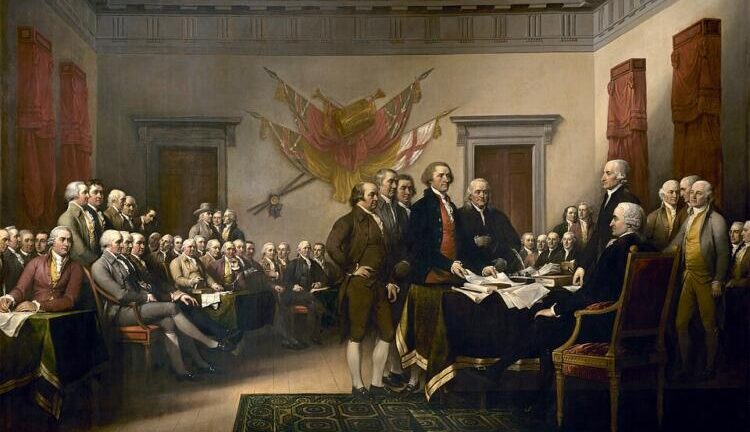
NEW YORK | 6 July 2026 (IDN) — On Saturday, July 4, Americans celebrated the nation’s 250th anniversary with the familiar fanfare: fireworks, flags, patriotic speeches, and ritual invocations of liberty. Yet at this extraordinary milestone, when the country is more deeply divided than at any time in recent memory over the meaning of democracy itself, it is worth asking what, precisely, we are celebrating.
The obvious answer is that we celebrate the birth of the United States. But that answer is incomplete. Every Fourth of July Americans commemorate not the Constitution but the Declaration of Independence. This is a remarkable fact, though we seldom pause to consider it. The Constitution governs us. Judges interpret it. Presidents swear to preserve, protect, and defend it. Congress legislates under it. The Declaration possesses no binding legal authority, and yet it remains the moral touchstone of the American political tradition. The Declaration embodies a conception of democracy considerably more radical than the constitutional order that followed it. It announces a political principle that no constitution—not even the Constitution of the United States—can ever fully contain.
What the Declaration reveals, perhaps more clearly than any modern political document, is what Antonio Negri calls constituent power. In Insurgencies, Negri writes that “the Declaration of Independence reveals itself an act of constituent power.” That observation invites us to read America’s founding documents in an entirely different light. We ordinarily understand the Declaration as a justification for independence and the Constitution as its natural completion. Negri suggests the reverse. The Declaration is not merely the preface to the Constitution. It is the democratic principle against which every constitution must forever be judged.
Constituent vs. Constituted Power
This distinction lies at the heart of democracy itself. Every political order rests upon two different kinds of power: the power to create institutions and the power exercised by those institutions once they exist. Negri calls the first constituent power and the second constituted power. Constituent power belongs to the people; constituted power belongs to the governments they create. The mistake of modern constitutional thought has been to confuse the two, treating constituted power as though it exhausted the constituent power from which it first arose. The Declaration refuses precisely this confusion.
What distinguishes the Declaration is that it relocates the very source of political legitimacy. Its most radical claim is not that George III abused his office, but that no ruler possesses legitimate authority except through the people themselves. Jefferson’s political genius lay not simply in proclaiming independence from Britain but in relocating sovereignty altogether. As Negri observes, Jefferson “will vigorously and unequivocally reconnect any legitimacy of government to popular sovereignty, to direct democratic consent understood as expression of the rights preceding any constitution. That is, as permanent expression of constituent power.”
The final phrase is decisive. Permanent expression. Not temporary, or merely historical, but permanent. Rights precede constitutions. The people precede governments. Constituent power precedes constituted power. The order cannot be reversed. We have become accustomed to imagining the Constitution as the foundation of American political life. Yet constitutions themselves require a foundation. Before there can be constitutional authority, there must first exist a people capable of constituting political authority in the first place.
The Constitution presupposes what it can never itself produce – namely, the people. Few thinkers understood this more clearly than the German jurist Carl Schmitt. Although his politics stand worlds apart from Negri’s, Schmitt offered perhaps the clearest definition ever written of constituent power. Every constitution, he argued, ultimately rests upon a constituent power lying outside the constitutional order it creates. No constitution can authorize its own beginning. Every legal order presupposes a prior political decision that law itself cannot explain.
More remarkably still, Schmitt insisted that constituent power never disappears once a constitution has been established. It “cannot be delegated, alienated, absorbed, or consumed.” The constitution depends upon constituent power, but constituent power always exceeds the constitution. Schmitt found the clearest democratic formulation of this principle not in America but in revolutionary France. The Constitution of 1793 declared: “A people always has the right to revise, reform, and change its constitution.” The implications are astonishing. The constitution does not authorize the people. The people authorize the constitution.
Nor is that authorization exhausted by the founding moment. The constituent people remain permanently greater than every constitutional arrangement they establish. Read in this light, the Declaration becomes something quite different from the patriotic relic into which it has often been transformed. Its opening words are not simply eloquent. They are performative. “We hold these truths to be self-evident…” Who is this “we”? Not a king, parliament, group of judges, or even constitutional framers; but ordinary people. Authority no longer descends from above: it speaks in the first-person plural.
Even the famous proposition that “all men are created equal” has been domesticated by familiarity. We usually hear it as a moral proposition, when it is far more explosive than that. Its deepest significance is political. If all are created equal, then no one possesses a natural title to rule another. The source of sovereignty is equally distributed because constituent power belongs equally to everyone. This is democratic egalitarianism in its purest form. It is also why the Declaration remains an unsettling document. For if sovereignty belongs equally to the people, then no existing political order can ever claim final legitimacy simply because it exists. Every institution remains answerable to the constituent power from which it arose.
The Constitution and the Limits of Democracy
The Declaration therefore contains a revolutionary principle that extends far beyond 1776. It announces not simply the birth of a nation. It announces the permanent sovereignty of the people. That, however, immediately created a new problem. How does one institutionalize a revolution whose deepest principle is that the constituent people always remain greater than the institutions they create?
The decade separating 1776 from 1787 was one of the most democratic—and politically turbulent—moments in American history. Royal authority had collapsed. State legislatures and local assemblies flourished. Ordinary farmers, mechanics, artisans, and laborers entered political life with an energy that alarmed many members of the revolutionary elite. Politics ceased to be the exclusive preserve of gentlemen and became, for the first time, the business of ordinary citizens.
To many Americans, this was precisely what the Revolution had promised. To many of its leaders, it appeared dangerously unstable. The shock of Shays’ Rebellion in western Massachusetts only intensified these anxieties, convincing many among the political elite that the democratic energies released in 1776 threatened not only public order but property itself.
Nothing illustrates this anxiety more clearly than the debates surrounding the Constitutional Convention of 1787. The Constitution was certainly intended to create a stronger union after the evident weaknesses of the Articles of Confederation. But it also pursued another objective that is discussed far less often: the disciplining of democratic power.
This is not a cynical interpretation imposed upon the Constitution from the outside. It emerges from the arguments of the framers themselves. No figure better embodies this tension than James Madison…
Democracy’s Unfinished Revolution
The Constitution did not abolish constituent power but institutionalized it—and in institutionalizing it, it necessarily limited it. Seen through Negri’s lens, the Constitutional Convention appears in a strikingly different light. Rather than reading the Declaration as an introduction to the Constitution, we begin to read the Constitution as a response to the Declaration.
Every constitution performs an indispensable act of closure. Constituent power opens history; constituted power seeks to stabilize it. No society can remain permanently in the revolutionary moment, and freedom requires durable institutions. Yet institutions always exact a price: they preserve constituent power only by containing it, translating the infinite creativity of democratic founding into finite constitutional forms.
The Revolution becomes government. The constituent people become citizens. Political creation becomes administration. Negri’s great insight is that this transformation is never complete.
This insight casts the entire history of American democracy in a new light. Every great democratic struggle—from abolition and Lincoln to women’s suffrage, organized labor, and the civil rights movement—can be understood as the return of constituent power whenever existing institutions cease to embody the equality from which they first derived their legitimacy.
The Declaration’s Enduring Promise
If Negri is right, then the Declaration does not belong only to the past. It belongs equally to the future. Its significance lies not simply in what it accomplished in 1776 but in what it continues to demand of every generation that claims fidelity to it.
The Constitution necessarily asks how political power should be organized, distributed, and restrained. The Declaration asks a prior question: Where does political power come from? Its answer remains revolutionary. It comes from the people—and it remains with the people.
Political democracy without economic democracy therefore remains incomplete—not because equality of outcomes is required, but because extreme concentrations of wealth gradually become concentrations of political power.
The Responsibility of Every Generation
The American Revolution therefore cannot be regarded as a completed event, safely enclosed within the eighteenth century. It remains an unfinished democratic project. Not because the Constitution failed, nor because the founders were hypocrites—but because constituent power is, by its very nature, inexhaustible.
Jefferson understood that rights precede constitutions because the people precede constitutions. The Declaration therefore does not merely authorize the republic founded in 1787. It permanently authorizes the people to judge whether that republic continues to embody the democratic equality from which it first derived its legitimacy.
We often imagine that fidelity to the Founding means preserving the constitutional order inherited from 1787. The Declaration suggests something far more demanding. Fidelity to the Founding means remaining faithful to the constituent power from which every constitutional order derives its legitimacy.
The Revolution could never be completed because constituent power can never be exhausted. Every generation inherits not merely a Constitution but the authority—and the responsibility—to ask whether existing institutions continue to embody the democratic principle announced in 1776. The Constitution may organize democracy, but only the Declaration continually renews it.
*Sam Ben-Meir teaches philosophy at the City University of New York, College of Technology. He is the author of Ethical Interanimality: Toward a Relational Philosophy of Nature (Westphalia Press, 2026). [IDN-InDepthNews]