By Jan Servaes * Bangkok, Thailand| 5 February 2026 (IDN)
As is tradition, for the 36th time, Human Rights Watch (HRW) has examined the human rights situation in more than 100 countries in a 529-page World Report 2026.
In his introductory essay, titled “Will Human Rights Survive a Trumpian World? Authoritarian Advances Threaten Rules-Based Order,” director Philippe Bolopion writes that stemming the authoritarian wave sweeping the world is the challenge of a generation. It represents a “blatant disregard for human rights.” With the human rights system under unprecedented pressure from the Trump administration and other global powers, Bolopion calls on human rights-respecting democracies and civil society to form a strategic alliance to defend fundamental freedoms.
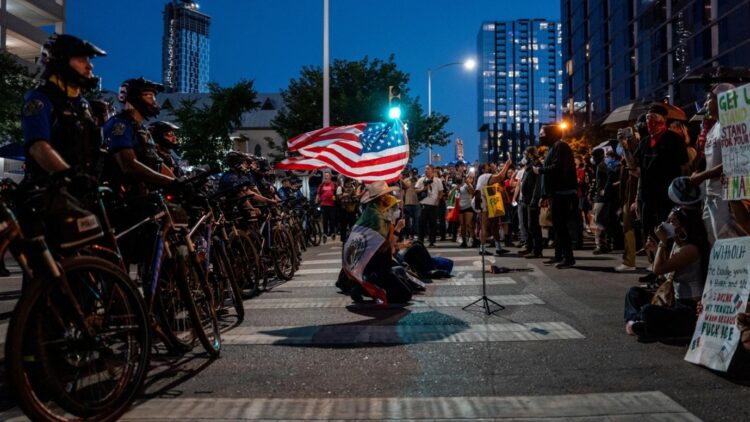
Meanwhile, the Trump administration has abandoned the United States’ human rights obligations, drastically cut the country’s foreign aid budget, and halted the admission of most refugees. According to the report, the US has made a “clear shift toward authoritarianism” in the first year of President Donald Trump’s second term.
The report identifies immigration, health, the environment, labor, disability, gender equality, criminal justice, and freedom of expression as areas of human rights where the administration has taken “significant steps backward.”
“These Trump administration actions posed a significant threat to the global human rights framework. The administration’s open abandonment of a longstanding— but uneven —US commitment to make rule of law, democracy, and human rights central elements of foreign policy signaled to other governments that the United States cannot be relied on to stand up for international human rights law or use its influence to press for accountability for violations”.
HRW also alleges that the US has “undermined” the United Nations’ (UN) ability to support human rights operations and peacekeeping missions by withholding contributions and withdrawing from human rights bodies such as the UN Human Rights Council.
Human Rights in Asia
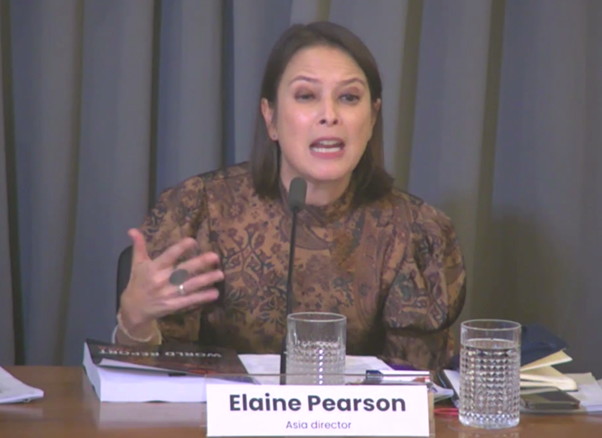
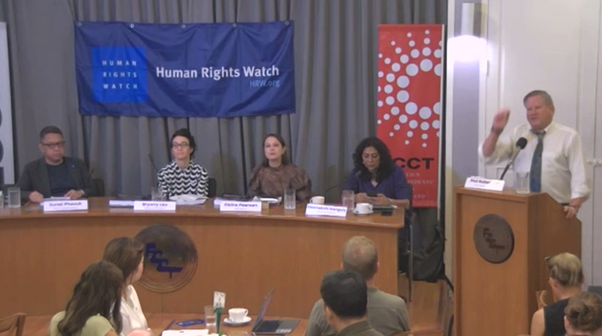
During the report’s Asia launch on February 5, 2026, at the Foreign Correspondents Club Thailand (FCCT) in Bangkok, Elaine Pearson, HRW Asia Director, Meenakshi Ganguly, Deputy Asia Director focusing on India, Bryony Lau, Deputy Asia Director covering Myanmar, and Sunai Phasuk, Senior Advisor for Thailand, spoke in succession. The moderator was Phil Robertson, a board member of the FCCT.
They reported on the serious deterioration of human rights in Asia, as well as regional trends such as rising authoritarianism, transnational repression, violations of press freedom, shrinking civic space, and civilians becoming victims of armed conflict.
The past year saw continued violations of crimes against humanity in China, Myanmar, and North Korea; a worsening human rights and humanitarian catastrophe in Afghanistan; the weakening of democratic institutions in India and Pakistan; and conflict-related abuses between Afghanistan and Pakistan, as well as border incidents between Thailand and Cambodia.
While protest movements seek to oust governments for human rights violations, mismanagement, and corruption, voters in Bangladesh, Nepal, and elsewhere go to the polls to determine their future, while sham elections in Hong Kong and Myanmar only serve to deprive people of their fundamental rights.
Positive steps taken to demand international accountability for crimes against humanity in the Philippines, Myanmar, and Afghanistan, and the rise of youth protest movements in Nepal and Indonesia, were also presented.
Thailand
Although Thailand is undergoing another election campaign, human rights are rarely discussed, because, as Sunai Phasuk stated, “Thai political parties are extremely conservative.”
The Thai government of Prime Minister Anutin Charnvirakul has done little to improve respect for human rights in the country.
A new election is scheduled for February 8, 2026. Major concerns include judicial intervention in politics, repression of free expression, and a mixed record in regard to refugees and asylum seekers.
“Prime Minister Anutin should take concrete measures to reverse Thailand’s backsliding on human rights,” said Elaine Pearson, Asia director at Human Rights Watch. “Successive Thai governments pledged to promote and protect human rights, yet repression and abuse continue unabated.”
US
Meanwhile, the Trump administration has abandoned the United States’ human rights obligations, drastically reduced the country’s foreign aid budget, and halted the admission of most refugees.
The report also examines how the Trump administration has revoked protected status and legal pathways for immigrants from various countries, and the “inhuman and degrading conditions” for those deported to CECOT, the notorious maximum-security prison in El Salvador, and for those held in immigration detention centers across the United States.
“New detention centers were opened at military sites and in states like Florida. Reports of abuse—including gross medical neglect, overcrowding, and inadequate sanitation—were reported in these facilities,” the report states. “By the end of August, ICE had detained more than three times as many people as it held in all of 2024.”
In a separate chapter on the criminal justice system, Human Rights Watch also highlights the persistent structural racism within the justice and prison systems. “Children continue to be prosecuted as adults in all 50 states, with racial and ethnic disparities persisting throughout the criminal justice system, including at the time of arrest, detention, and sentencing,” it reads. “This year, the president called for tougher sentences for children, and Congress passed legislation to increase the prosecution of children as adults in Washington, D.C. The United States remains the only country in the world that sentences children to death in prison.”
Europe
Eliane Pearson lamented the fact that human rights have disappeared from the agenda in trade negotiations and international relations. She explicitly noted the absence of any reference to the recently concluded trade agreement between India and the European Union.
“Racism and other forms of discrimination are a persistent concern in the EU, exacerbated by the normalisation of far-right narratives by mainstream parties. Member states continued to backslide on rule of law commitments, but the EU Council took no effective action, and the European Commission provided inconsistent follow-through in response to these worrying trends. Civil society space continued to shrink, in part because of EU actions”.
More data and arguments have been compiled by Time and Amnesty International, among others.
Call to Arms
Human Rights Watch (HRW) concludes: “Breaking the authoritarian wave and standing up for human rights is a generational challenge. In 2026, it will play out most acutely in the US, with far-reaching consequences for the rest of the world. Fighting back will require a determined, strategic, and coordinated reaction from voters, civil society, multilateral institutions, and rights-respecting governments around the globe”.