
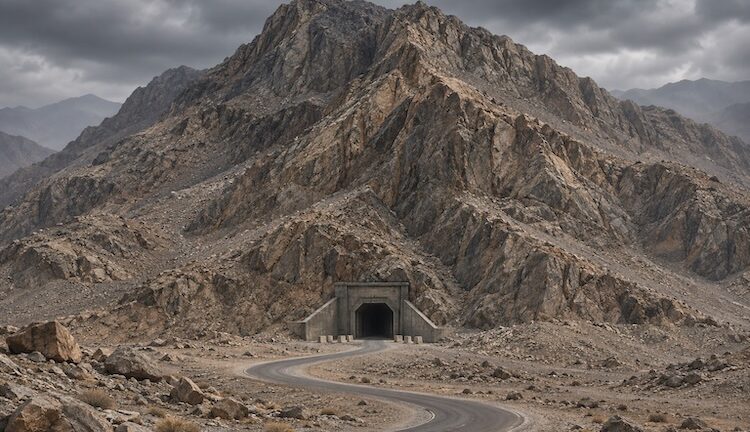
Talk of a nuclear strike on Iran’s “Pickaxe Mountain” has no official basis. But if the idea resurfaces, the US National Academies settled the central question two decades ago: an earth-penetrating nuclear weapon cannot contain its effects.
By Tariq Rauf*
VIENNA | 9 November 2026 (IDN) — In recent days, parts of the US and international media have speculated that Washington might use a nuclear weapon against Kuh-e Kolang Gaz La (“Pickaxe Mountain”), the tunnel complex Iran reportedly is building inside a granite mountain about two kilometres south of its Natanz enrichment plant. To be clear at the outset: there is no official indication whatsoever that such a strike is contemplated or authorized. President Trump has said he would not use a nuclear weapon against Iran, and the weapon he has named for any attack on the site, the GBU-43/B Massive Ordnance Air Blast bomb, is conventional.
Yet the idea of a nuclear “bunker-buster” resurfaces whenever a target is buried deep, and “Pickaxe Mountain”, as Western media call it, is such a target. Its halls are estimated to lie at least 100 metres below the surface, and the International Atomic Energy Agency (IAEA) has never been allowed inside as Iran has not declared it as a nuclear facility. It is therefore worth recalling what the most authoritative public study of these weapons found, because it disposes of the notion that a nuclear strike on a buried site could be clean, contained or limited.
What the National Academies were asked
In 2002 the US Congress directed the Pentagon to ask the National Research Council, the operating arm of the National Academy of Sciences, to examine the health and environmental effects of nuclear earth-penetrator weapons. The committee, chaired by John Ahearne and including Richard Garwin, Steve Fetter and Raymond Jeanloz, reviewed classified material, and its casualty estimates were calculated by Lawrence Livermore National Laboratory and the Defense Threat Reduction Agency. Its report, Effects of Nuclear Earth-Penetrator and Other Weapons, was published in 2005. Its central conclusions have not been overtaken.
Containment is physically impossible
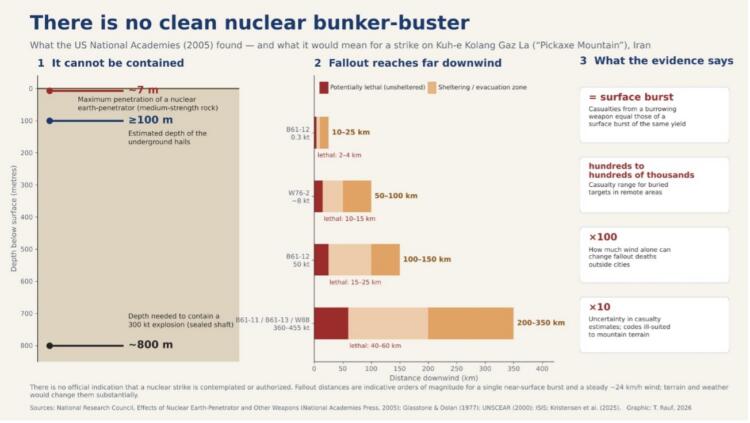
The first finding concerns physics. A nuclear explosion is contained only if it is buried very deep and the shaft sealed. The committee calculated that a 300-kiloton explosion would need to be set off at the bottom of a carefully stemmed hole about 800 metres deep. A bomb dropped from an aircraft gets nowhere near that: the committee estimated maximum penetration of about seven metres into medium-strength rock, and granite is harder still. Its conclusion was unequivocal. Earth-penetrating weapons cannot reach the depths needed to contain a nuclear explosion, and the hole the weapon itself punches into the ground ensures massive venting.Casualties are those of a surface burst
The second finding removes the political appeal of the weapon. For the same yield and weather, the committee found, casualties from an earth-penetrator detonated a few metres underground are, for all practical purposes, the same as from a surface burst. Burying the weapon a few metres sends a stronger shock wave into the rock, so a smaller yield can do the same damage; that, and only that, is why casualties might be lower. The fireball still breaks the surface, and a shallow burst in rock hurls pulverised, highly radioactive debris into the air, the classic recipe for heavy local fallout. The committee also noted that the United States had conducted only three tests at such shallow scaled depths, none of them in rock, so fallout from a burst in granite is poorly understood.
The study’s casualty ranges are sobering. For buried targets in remote, lightly populated areas, it estimated casualties from hundreds at low yields to hundreds of thousands at high yields with unfavourable winds; near cities, from thousands to more than a million. Kuh-e Kolang Gaz La lies between these cases. Its immediate surroundings are sparsely populated, but the town of Natanz is about 29 kilometres away, Kashan (some 300,000 people) 40 kilometres, Isfahan (about two million) 120 kilometres and Qom 130 kilometres.
Applying standard references, Glasstone and Dolan’s The Effects of Nuclear Weapons and UN fission-yield factors, to the weapons in the current US arsenal gives a sense of scale. Even the lowest-yield option, the B61-12 bomb at 0.3 kilotons, would leave a fallout field lethal to unsheltered people over several kilometres and require protective action out to 10–25 kilometres. The B61-11, the only dedicated US earth-penetrator at about 400 kilotons, would produce lethal fallout 40–60 kilometres downwind and require sheltering or evacuation over 200–350 kilometres. It would release roughly half as much iodine-131 as Chornobyl. Under the prevailing westerly winds, fallout could reach Afghanistan and Pakistan.
Uncertainty cuts both ways
The National Academies were candid about uncertainty, and that candour matters. They judged casualty estimates uncertain by about a factor of ten. Wind alone could change fallout deaths outside cities by more than a factor of 100, and assumptions about sheltering and evacuation by a factor of two to eight. Planners might try to time an attack for favourable winds, the committee noted, but weather is hard to predict, and waiting may not be possible. It also warned that the computer codes used were designed for Cold War scenarios and are poorly suited to single detonations in complex terrain, which is exactly what a mountain in central Iran presents. No one ordering such a strike could know in advance whether it would kill hundreds or hundreds of thousands.
The committee further found that anyone entering the area afterwards would face the same radiation hazards as after a surface burst. That would include rescue teams and, eventually, IAEA inspectors asked to account for whatever nuclear material had been inside the mountain. In the committee’s own judgement, collateral damage from a nuclear earth-penetrator cannot be avoided entirely.
A non-proliferation paradox
This points to a paradox. The IAEA has not had access to Kuh Kolang Gaz La and cannot say whether any of Iran’s roughly 440.9 kilogrammes of uranium enriched to 60 per cent is stored there. A nuclear strike would scatter whatever is inside across a radioactive crater field, making it practically impossible ever to re-establish continuity of knowledge about that material. That is the opposite of the non-proliferation objective that would be invoked to justify an attack.
It would also be the first use of a nuclear weapon in war since Nagasaki on 9 August 1945, ending an 80-year norm. The International Court of Justice found in 1996 that the use of nuclear weapons would generally be contrary to the rules of international humanitarian law, and uncontrollable fallout drifting over populated areas and across borders is hard to reconcile with the principles of distinction and proportionality. Any argument that US negative security assurances no longer apply to Iran would weaken confidence in such assurances for every non-nuclear-weapon state party to the Non-Proliferation Treaty.
The evidence, not alarm
None of this is a prediction, and it is not meant to alarm. It is a reminder of what the evidence says, gathered by scientists working with the US government’s own laboratories. The President’s statement that he will not use nuclear weapons against Iran is welcome and should be reaffirmed without ambiguity. The way to answer the questions posed by Pickaxe Mountain is not with a weapon whose effects cannot be contained, but by restoring IAEA access to Iran’s nuclear sites, including this one.
*Tariq Rauf is former Head of Verification and Security Policy at the International Atomic Energy Agency. The views expressed are his own. (IDN-InDepthNews)