
By Sam Ben-Meir*
NEW YORK | 17 August 2026 (IDN) — Emily Wilson begins her celebrated translation of Homer’s Odyssey with an imperative that has become almost as famous as the poem itself: “Tell me about a complicated man.” Christopher Nolan has acknowledged the importance of that formulation to his own adaptation of Homer. Yet in her fierce review of Nolan’s film, “An Uncomplicated Man,” Wilson argues that this is precisely what Nolan has failed to give us. His Odysseus, in her reading, is essentially an action hero who feels bad about being an action hero, a psychologically flattened version of one of literature’s most elusive figures.
I did not see the film that way at all. Nolan’s Odysseus is complicated not because he reproduces every contradiction of Homer’s hero, but because Nolan has reorganized those contradictions around one of the oldest and most difficult questions posed by the Odyssey: what does it mean to come home from war? The answer, Nolan suggests, is that strictly speaking one cannot.
When War Becomes Home
This is why Odysseus’s longing for Ithaca must be understood alongside his extraordinary capacity to postpone his return. He wants nothing more than to see Penelope and Telemachus again. Home is the fixed point around which his wandering consciousness revolves. Yet he remains with Calypso for seven years. More significantly in Nolan’s telling, he willingly consumes the lotus, surrendering himself to oblivion. He wants to forget Troy, his companions, his guilt, perhaps even the man he has become.
The contradiction is only apparent. These are the two desires of the traumatized veteran: I want to go home; I want to cease being the man who must go home. Nolan understands something here that Kathryn Bigelow understood in The Hurt Locker: war is a drug. Its addictive quality does not lie simply in violence. War reorganizes experience. Terror, comradeship, exhaustion, danger, purpose and the constant proximity of death establish an intensity against which ordinary existence can come to seem strangely insubstantial. Once that intensity disappears, something must fill the void.
Uberto Pasolini’s The Return (2024), another recent reimagining of Odysseus’s arrival on Ithaca, makes the point with brutal economy. Ralph Fiennes’s exhausted Odysseus observes that “war becomes home.” The phrase captures the terrible paradox at the center of nostos. Odysseus is homesick for Ithaca, but war has become another home. The journey from Troy is therefore never merely geographical. The deeper question is whether the man produced by Troy can still inhabit Ithaca.
Wilson is surely right that Homer’s Odysseus possesses a multiplicity that cannot easily be reduced to modern psychological categories. He is warrior and liar, husband and adulterer, victim and perpetrator, king and beggar, strategist and fool. But adaptation need not reproduce every Homeric contradiction to discover a genuine contradiction of its own. Nolan’s “strong misreading,” if we want to call it that, locates the complexity of Odysseus in traumatic return.
Between Memory and Oblivion
This is precisely why Calypso and the lotus matter so much. The lotus is not merely temptation. It offers release from biography. To eat it is to relinquish the burden of being the person who did what Odysseus has done. Troy disappears. His dead companions disappear. Penelope and Telemachus disappear. The terrible continuity between the warrior and the returning husband disappears. For a man haunted by what he has seen and done, there is mercy in such oblivion. But there is also annihilation. If Penelope represents the possibility of memory endured, the lotus represents memory extinguished. Odysseus is suspended between them. He can remember his way home, or he can forget why he ever wanted one.
That is hardly an uncomplicated man. Nor does Nolan allow Odysseus’s dilemma to exist in isolation. His use of Agamemnon’s return as a counterpoint is crucial. Agamemnon, too, goes home from Troy. His nostos is shorter and, geographically speaking, more successful. But arriving home does not save him. He returns carrying Troy with him and is murdered within the household to which he believed he had returned.
Agamemnon’s fate exposes the illusion contained in the very idea of homecoming. The warrior imagines home as something preserved in his absence: the same house, the same relationships, the same identity waiting to receive him when history has finished with him. But history does not leave home untouched. Nor does it leave the warrior untouched. The man who returns is not the man who departed, and the household to which he returns is not the household he left.
Agamemnon reaches home and discovers that home no longer exists in the form he imagined. Odysseus takes ten years longer to make the same discovery. In this respect Thomas Wolfe’s famous formulation—You Can’t Go Home Again—could serve almost as a subtitle to the Odyssey. Homecoming contains an impossible demand. It asks not merely that we return to a place but that time itself reverse direction. Restore the wife I left. Restore the child I knew. Restore the kingdom I ruled. Above all, restore the self who departed.
But there is no restoration. Penelope has spent twenty years without Odysseus. Telemachus has become a man in the absence of his father. Ithaca has been transformed by political disorder. And Odysseus has become someone whom the king who sailed for Troy might scarcely recognize. The deepest obstacle between Odysseus and Ithaca is therefore not Poseidon. It is time. And this is where Nolan’s emphasis on violence becomes particularly important. For when Odysseus finally returns, he does not simply put war behind him. He brings its grammar home.
When the Battlefield Enters the Home
The great irony of the Odyssey is that the warrior restores domestic order through slaughter. The skills that allowed Odysseus to survive Troy and the long journey home become the means by which he reclaims his household. Bow, cunning, disguise, calculation and killing—the instruments of war become instruments of reconciliation.
But what kind of reconciliation is achieved through massacre? Agamemnon returns from war and is murdered at home. Odysseus returns from war and murders at home. Their stories differ radically, yet Nolan’s juxtaposition of them illuminates the same terrible truth: the boundary between battlefield and household is far more porous than the warrior would like to believe. War follows him across the threshold.
That is why the Odyssey remains perhaps the greatest tale of homesickness ever written. And it is one reason it stands so close to the foundations of Western civilization. If the Iliad plunges us into the world of war—glory, rage, mortality, comradeship, revenge—the Odyssey asks the question that follows: what happens to the warrior afterward? How does the killer become a husband again, the soldier a father? How does a human being habituated to violence recover ordinary time? And can violence ever truly be left behind?
These questions reach far beyond Homeric Greece. They belong to every society that sends people to war and then expects them somehow to resume ordinary existence when they return. We speak casually of veterans “coming home,” as though geographical relocation accomplished the return. But the deeper homecoming—the recovery of intimacy, ordinary time, trust, vulnerability and a tolerable relation to memory—is infinitely more difficult.
The desire for Ithaca therefore cannot simply be opposed to the desire for war. Odysseus wants home desperately precisely because he has been transformed by its opposite. Yet the longer he remains away, the more impossible the object of his longing becomes. Ithaca gradually ceases to be merely a geographical place and becomes an image of reconciliation: the fantasy that the fragments of a life divided by war might somehow be made whole again.
The Pain of an Irrecoverable Past
This is why nostalgia is never simply memory. It is memory charged with desire—the longing not merely for what was, but for what can no longer be recovered. The word nostalgia itself preserves the wound: nostos, homecoming, joined to algos, pain. The desire for home is inseparable from the knowledge that the home one desires no longer exists.
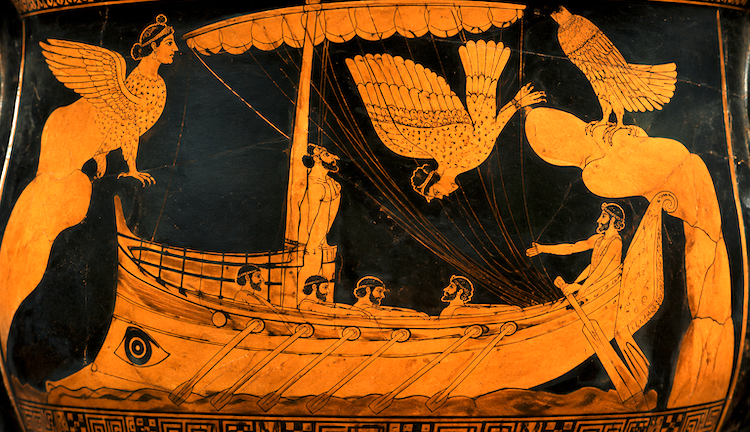
Nolan’s Sirens give this nostalgia its most seductive form. Here he departs sharply from Homer. In Book XII, the Sirens tempt Odysseus with knowledge: they know what happened at Troy and promise access to what can otherwise remain hidden from mortal understanding. Nolan transforms their temptation into something more psychological. Their song reveals that “what you most want is what you most can’t have”: what you desire most is “what you already had . . . and lost.” The Sirens therefore offer not knowledge but restoration—the fantasy that what time has taken might somehow be recovered. If the lotus promises escape from the past through forgetting, the Sirens promise escape from it through nostalgia. One says: erase what happened. The other: return to what was. Both tempt Odysseus with the same impossibility—the refusal to accept that time is irreversible.
And here lies the spiritual crisis diagnosed by the Odyssey. Western civilization has repeatedly imagined history through departure and return: exile and promised land, fall and redemption, alienation and reconciliation, revolution and restoration. We leave home and dream of coming back transformed but intact. Homer knew better.
There is no return without transformation because time itself makes literal return impossible. The question is not whether Odysseus can recover the world he lost. He cannot. The question is whether he can establish a relationship with what remains. That distinction matters. Reconciliation is not restoration.
The past survives precisely because it cannot be repaired. Nolan’s Odysseus therefore faces something more difficult than monsters. He must learn whether memory can be borne without either repeating what it remembers or fleeing into oblivion. The lotus offers one answer: forget. War offers another: repeat. Ithaca demands something harder: remember and nevertheless live. That is the real homecoming.
The Greater Ordeal of Coming Home
Wilson’s criticism of Nolan ultimately rests not on fidelity alone. She has explicitly defended adaptations that radically transform their sources. Her deeper complaint is that Nolan’s transformation produces an Odysseus without sufficient psychological, emotional or ethical depth—that the complicated man has been converted into a conventional action hero.
But that judgment overlooks the contradiction around which Nolan has constructed his protagonist. His Odysseus longs for precisely what he repeatedly flees. He wants Penelope and chooses oblivion. He seeks peace but carries within himself the habits of war. He desires home while no longer knowing whether he is capable of inhabiting it. He survives because of the qualities that make reconciliation most difficult. The action hero normally defeats his enemies and returns home. Odysseus discovers that returning home is the greater ordeal.
That is why the lotus and the Sirens matter. One reveals how attractive the destruction of memory can become when memory itself is unbearable; the other, the equally seductive fantasy that what has been lost might somehow be restored. And that is why the violence on Ithaca matters. It demonstrates that Troy cannot simply be left behind on the other side of the sea.
Nolan’s Odysseus is not Homer’s Odysseus in every respect. No adaptation could be. But he is hardly uncomplicated. He is divided between memory and oblivion, war and domesticity, guilt and survival, the man who left and the man who returns. His tragedy is not that he cannot find his way home. It is that he finds it. And discovers that homecoming has only just begun.
*Sam Ben-Meir teaches philosophy at the City University of New York, College of Technology. He is the author of Ethical Interanimality: Toward a Relational Philosophy of Nature (Westphalia Press, 2026). [IDN-InDepthNews]