
By Medea Benjamin*
NEW YORK | 13 February 2026 (IDN) — Marta Jiménez, a hairdresser in Cuba’s eastern city of Holguín, covered her face with her hands and broke down in tears when I asked her about Trump’s blockade of the island—especially now that the United States is choking off oil shipments.
“You can’t imagine how it touches every part of our lives,” she sobbed. “It’s a vicious, all-encompassing spiral downward. With no gasoline, buses don’t run, so we can’t get to work. We have electricity for only three to six hours a day. There’s no gas for cooking, so we’re burning wood and charcoal in our apartments. It’s like going back 100 years. The blockade is suffocating us—especially single mothers,” she said, crying into her hands, “and no one is stopping these demons: Trump and Marco Rubio.”
A Country Running on Empty
We came to Holguín to deliver 2,500 pounds of lentils, thanks to fundraising by CODEPINK and the Cuban-American group Puentes de Amor. On our last trip, we brought 50-pound bags of powdered milk to the children’s hospital. With Trump imposing what many Cubans describe as a medieval-style siege, humanitarian aid has become even more critical.
But lentils and milk cannot power a country.
What Cuba desperately needs is oil.
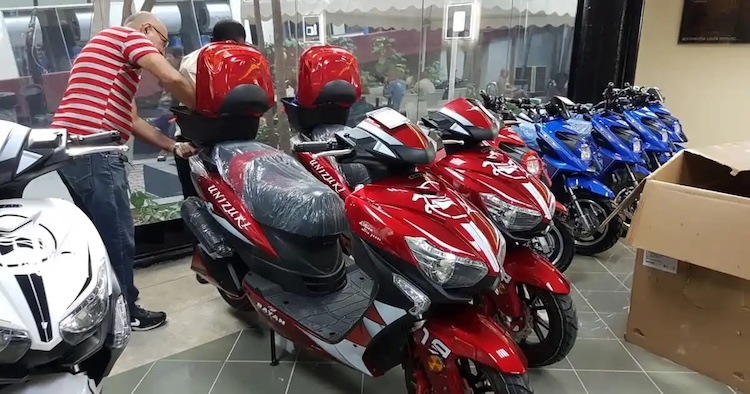
There were no taxis at the airport. We hitchhiked into town in the truck that came to pick up the donations. The highway was eerily empty. In the city, few gas-powered cars were running, and no buses were operating. Yet the streets were far from deserted. Bicycles wove between electric motorcycles and three-wheeled electric vehicles carrying passengers and goods.
Most of the motorcycles—Chinese, Japanese, or Korean models—are shipped in from Panama. With a price tag of around $2,000, they are affordable only for those with family abroad sending remittances.
Thirty-five-year-old Javier Silva gazed longingly at a Yamaha parked on the street. “I could never buy one of those on my salary of 4,000 pesos a month,” he told me. With inflation soaring and the dollar trading at roughly 480 pesos, his monthly income amounts to less than ten dollars.
The blockade may be a political instrument in Washington, but here it is a daily absence: empty roads, silent engines, darkened homes.
An Economy on the Brink
Cubans do not pay rent or hold mortgages; they own their homes. Healthcare, though deteriorating due to shortages of medicine and equipment, remains free. The system is gasping, but it has not been abandoned.
When my partner Tighe suffered an asthma attack, we rushed to a local clinic. Within minutes, he was breathing albuterol mist from a nebulizer. No insurance forms. No billing department. Just care—competent and delivered with warmth. That is what healthcare looks like when it is treated as a right.
But food has become the heaviest burden.
Markets are stocked, but prices are punishing—especially for staples like pork, chicken, milk, and even tomatoes. What was once affordable is now a luxury.
Holguín used to be called Cuba’s breadbasket, blessed with fertile agricultural land. That reputation took a devastating hit when Hurricane Melissa tore through the province, flattening crops and damaging irrigation systems. Replanting is nearly impossible without gasoline for tractors or reliable electricity to pump water.
Less production means higher prices.
Across the country, production is grinding to a halt. Factories shut down when power fails. Skilled professionals leave state jobs because wages cannot support their families.
Jorge, whom I met selling slices of bologna at the market, once worked as an engineer in a state enterprise. Verónica, a former teacher, now sells homemade sweets when electricity allows her to bake.
Ironically, while Senator Marco Rubio insists he wants to usher capitalism into Cuba, U.S. sanctions are crippling the very private sector that many Cubans now depend on for survival.
Blame, Anger, and Memory
Cuba’s crisis is not viewed through a single lens.
Some people I met openly blamed the Cuban government and said they longed for the end of communism. Young people spoke candidly about their desire to leave the island for opportunities abroad.
Yet I did not encounter a single person who supported the blockade or advocated for a U.S. invasion.
“This government is terrible,” said a thin man who exchanges dollars on the street—a technically illegal but widely tolerated activity. But when I showed him a photo of Marco Rubio, he didn’t hesitate. “That man is the devil. A self-serving politician who doesn’t care about us.”
Others pointed directly at Washington. They recalled the period between 2014 and 2016, when Presidents Obama and Raúl Castro reached a détente, and sanctions were eased.
“It was the same Cuban government we have now,” one man told me. “But when the U.S. loosened the rope around our necks, we could breathe. If they just left us alone, we could find our own solutions.”
Memory lingers here. The Bay of Pigs invasion. The collapse of the Soviet Union and the desperate “Special Period” of the 1990s. Each hardship becomes part of a collective narrative of survival.
Endurance in the Face of Siege
What keeps Cuba functioning, barely, is solidarity.
Neighbors trade rice for coffee. Families share cooking oil. The phrase no hay, pero se resuelve—we don’t have much, but we make it work—is more than a saying; it is a survival ethic.
The government provides daily meals for the most vulnerable—elderly people, individuals with disabilities, mothers with no income. But with less fuel and less food, even that safety net frays.
At one feeding center, an elderly volunteer proudly showed us a chunk of wooden pallet he had scavenged for firewood. Nails still stuck out from the splintered board.
“This guarantees tomorrow’s meal,” he said, his expression a mixture of pride and quiet sorrow.
How long can Cubans endure as conditions continue to deteriorate? What is the endgame?
Rubio speaks of regime change. But no one can explain how that would occur—or what would replace the current government.
Some speculate that Trump might be open to a deal. “Make Trump the minister of tourism,” a hotel clerk joked, only half in jest. “Give him a hotel and a golf course in Varadero—his own Mar-a-Lago—and maybe he’d leave us alone.”
There is gallows humor in Cuba. It masks exhaustion.
Ernesto, who repairs refrigerators whenever electricity permits, placed his faith not in politicians but in the Cuban people.
“We’re rebels,” he told me. “We defeated Batista in 1959. We survived the Bay of Pigs. We endured the Special Period when the Soviet Union collapsed, and we were left with nothing. We’ll survive this, too.”
He quoted the songwriter Silvio Rodríguez, words every Cuban knows: El tiempo está a favor de los pequeños, de los desnudos, de los olvidados—time belongs to the small, the exposed, the forgotten.
In the long sweep of history, endurance often outlasts domination.
*Medea Benjamin is a cofounder of both CODEPINK and the international human rights organization Global Exchange. She is the author of 11 books, including Drone Warfare: Killing by Remote Control, Kingdom of the Unjust: Behind the U.S.-Saudi Connection, Inside Iran: The Real History and Politics of the Islamic Republic of Iran, and War in Ukraine: Making Sense of a Senseless Conflict, coauthored with Nicolas J.S. Davies. Her most recent book, coauthored with David Swanson, is NATO: What You Need to Know. [IDN-InDepthNews]