
By Jonathan Power
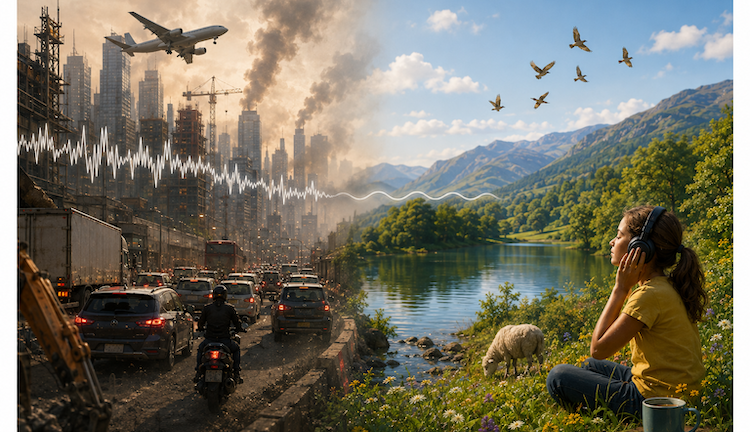
LUND, Sweden | 26 August 2026 (IDN) –Everyone has their favourite sounds- a ball on a cricket bat on a summer’s afternoon, birds singing, waves breaking on the beach, the coffee pot perking on the stove, children playing Scooby-Doo. Mine are the quiet sounds of the English Lake District- William Wordsworth’s:
“A flock of sheep that leisurely
pass by one after one;
the sound of rain and bees
murmuring; the fall of rivers,
wind and lakes, smooth fields;
white sheets of water, and pure sky.”
Noise is less and less sweet sounds. It is cars and trucks, aeroplanes and builders, canned music in cafes, a symphony playing an atonal concerto. Some pop music makes so much noise that pure sounds no longer exist. Noise is the excreta of technological civilisation. One study predicts that exposure to loud music will cause 50 million Americans to suffer heavy hearing loss by 2050. Ex-President Bill Clinton has long worn a hearing aid because, in his youth, he enjoyed loud music.
When Noise Becomes a Health and Political Issue
Noise can make us ill- not just hearing loss (as I have from starting a dance club for Caribbean youth in an abandoned factory in London), but also high blood pressure, disturbed sleep and even heart disease. An article in a German trade union newspaper claimed that “noise sickness” tops the list of industrial ailments. Noise is a pollutant. It creates a lot of stress and strain for bodies and minds already taxed by a high-pressure economic system.
Noise is the silent political issue that grates on many people’s nerves. In a poll, 45% of the German population said they believe that protection against noise is more important than building new roads. Tens of thousands of people who live near London’s Heathrow airport have for years managed to stymie successive government plans to build a new runway. The government has approved the plan, but it still faces the possibility of mass demonstrations that could seriously hinder the work.
We are a long way from the hoped-for day when national political figures will ride to power quoting Wordsworth’s poem, “On Westminster Bridge”:
“The city now doth, like a garment, wear
the beauty of the morning, silent, bare.”
But that doesn’t mean battles can’t be won on a smaller scale than defeating a plan at a big airport for noisier flights. Campaigners on the busy road where I used to live managed to close it to night-time traffic. Lake District lovers, aghast at a new main road through Grasmere sending shock waves up the fells, have struggled to make sure the mistake is not repeated. A friend of mine in central Copenhagen, whose balcony gives her a view of one of the peaceful canals, complains to me about the noise from the street below. Too many cars, motorbikes, tourist buses and delivery vans destroy what at first sight seems beautiful and tranquil. Since 1994, Denmark has had noise control legislation, and many streets are now pedestrianised. Copenhagen is flooded with bicycle riders; cars and their noise in the inner city have been significantly reduced. But still the legislation is far from enough.
What Governments Can Do
Although noise is never likely to compete with other political issues such as unemployment and nuclear weapons in North Korea, political leaders, whatever their stripes and spots, are amenable to pressure. Classless in its impact, hurting rich and poor alike, protestors and agitators are pushing open a door. Many of the required changes have been tried and tested elsewhere.
- Gothenburg, Sweden: There are restrictions on the through passage of motorists and lorry drivers. Trams and buses have been given a reserved right of way and priority at signals. This makes public transport more attractive than driving a car—the result: reduced noise in the main shopping streets.
- Switzerland: Driving heavy trucks at night and on Sundays is prohibited.
- Britain: As far back as 1973, Parliament passed a law allowing building owners to seek compensation for property that depreciates because of new public works that cause noise, vibration, and dust. As far back as 2008, a woman was sentenced to 90 days in jail for violating a court order not to play loud music that had disturbed her neighbours eleven times. (But why did they have to wait until the eleventh time?)
- The US and Britain: In 1976, for the first time, they modified their noise regulations to require older aircraft to comply with the noise limits required for new aircraft. Over the years, the regulations have been toughened.
Lots of Sounds, Not Noise
Put these examples on Facebook, demand MORE, and distribute your demands far and wide to places where, as the poet Jeni Couzyn wrote:
“Under the screech and hiss
of progress,
creeps an army of emptiness”.
Could we once again hear the sheep and the rain, the wind and the coffee pot, the sound of the bat on the ball and children playing? Lots of sounds, not noise. [IDN-InDepthNews]
Copyright: Jonathan Power